Blog Posts

  • Of Copies and Exemplars

    Of Copies and Exemplars

    I am currently feeling under the weather in a way that has me waking up at 3 am feeling slightly feverish. Sometimes my febrile state bubbles long-standing thoughts up to the surface. At 3 am this morning, it was this:

    English seems to be an outlier in the European languages in the way it refers to a physically reproduced impression of a book.

    The common word for an individual impression of a book in English is “copy”: “The book sold one million copies”; “I bought two copies of the book, one for me and one for a friend”; and so on. 

    Many European languages, though, use a different word for an individual instance of a book. For instance:

    French: exemplaire

    German: Exemplar

    Spanish: ejemplar

    Portuguese: exemplar

    Now, all of these languages also have a word for “copy” (Fr. “copie”; Gr. “Kopie”; Sp. “copia”; Pr. “”cópia”). It’s just that the word is not used, or exclusively used, to refer to printed books. The dictionary of the Real Academia Española attests to the use of “copia” to refer to individual printed books (although it’s only the ninth of ten definitions!) and I think Italian may use its word “copia” this way also. But French and German, to my knowledge, almost never refer to a printed book as a “copie” or “Kopie” and almost always as an “exemplaire” or “Exemplar.”

    In all of these languages, the cognates for “copy” connote an object that endeavors to reproduce as faithfully as possible all of the visible properties of an object. So, for instance, a copy of a painting in French would be a “copie.” Copies made by a Xerox machine would in German be a “Photokopie.” And so on. The implication is, I suppose, that typeset books aren’t “copies” of an author’s original manuscript in this sense; they don’t exactly reproduce the manuscript’s pagination, handwriting or typeface, etc. The word for “copy” in these languages also carries the negative connotations that “copy” in English sometimes carries, implying something fake, phony, knocked off, not as good as the genuine article. 

    The “exemplar” words in these languages do not, however, carry any of these negative connotations of phoniness. Their semantic range is limited to describing individuals of a  similar or like kind. Individual copies of a printed book are obviously as nearly identical to one another as can be achieved, and so the individuals are “exemplaires,” “Exemplare,” etc. These words are also used to describe individuals in a species of animals, which obviously differ among themselves but have common species-related characteristics. In English, we tend to use the word “specimen” for this, if we use a specific word at all. 

    As far as I can tell, the European languages refer to manually produced (not printed) instances of a book or other writing as “copies.” So books produced before the advent of the printing press, copied by hand by scribes, could be referred to as “copies,” although modern usage may also refer to them as “exemplars.” Manuscript copies of a book or writing done by an author would definitely be referred to as “copies,” as they would be in English. Referring to the individual instances of a book as “exemplars” appears to postdate the advent of the printing press in Europe. 

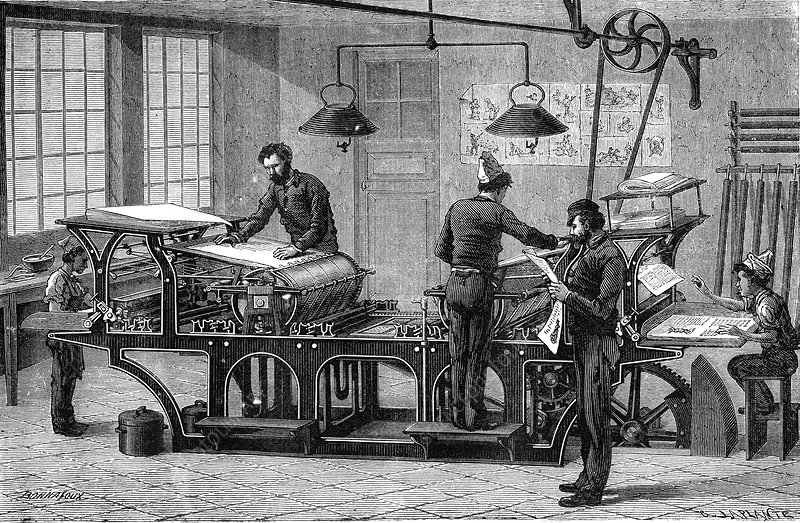
    Printing press, 19th-century illustration. The printing press changed the course of history–did it also change the course of how Europeans talk about books?

    In English, however, these distinctions which European languages use different words to track all get subsumed under the wide semantic umbrella of the single word “copy.” Manuscripts of ancient books are “copies”; forged artworks are “copies”; individual bound volumes of Dan Brown novels for sale at the airport are “copies.”

    English of course has its own word “exemplar,” but it’s extremely rare or odd to hear it applied to individual books. In common parlance it is most often applied to people, not animals or things. It means something more like “ideal,” “paragon,” or “role model”: not just a copy, not even just an example, but an instance of something or someone so characteristic, so perfect in its kind, that it takes on a special status. An exemplary status! To my knowledge, the European languages don’t commonly use any cognate of “exemplar” to describe such a thing or person. (Littré’s major dictionary of French usage cites 16th- and 17th-century uses of “exemplaire” as a noun in this sense. Le Dictionnaire Robert gives this sense as a second separate meaning of “exemplaire” as an adjective with meanings similar to “exemplary” in English, but includes no substantival use of “exemplaire” in this sense.)

    Littré’s first definition of “exemplaire”: “Model to follow.” As Louis-Ferdinand Céline once said, “Littre said it, and he is never mistaken.” (Céline’s remark is ironic, of course, but he has forgotten more about 17th-century French usage than I will ever know.)

    There is one minor, but telling, exception to this. In Spanish and Italian, and possibly in some other languages, their cognate word for “exemplar” can be used to refer to a story or other example which conveys a moral or a warning to the reader or hearer. The Novelas ejemplares of Miguel de Cervantes use “ejemplar” in this sense. English has its own word for this, “exemplum,” which is quite rare and is derived directly from Latin. We do have shades of this meaning from other words and expressions in English: “exemplary punishment,” “making an example of someone.” From the 17th century onwards German used the word “Exempel” for this, although my understanding is that over the centuries this meaning, to the extent that it is still there, has become mostly absorbed into the more common German word for “example,” “Beispiel.”

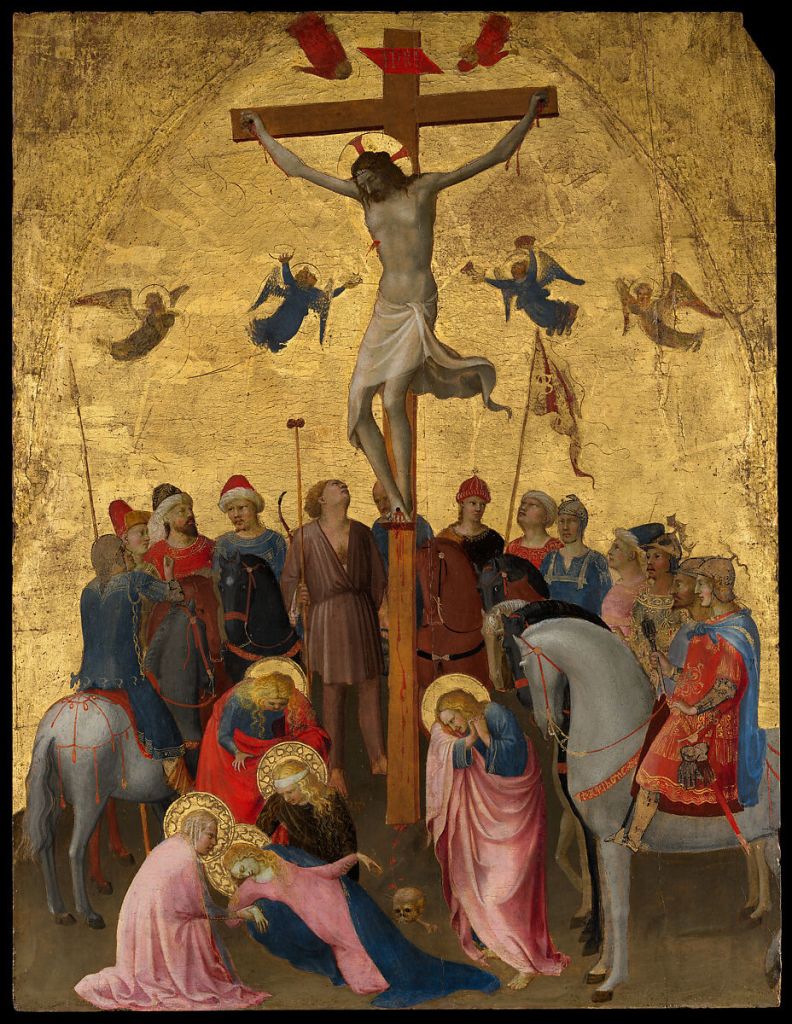
    Fra Angelico, The Crucifixion. In the Roman world, crucifixion would have been a common form of exemplary punishment. The Latin term “exemplum” sometimes carries the sense of “warning” or “punishment,” although most often it means a “sample,” “imitation,” or “image.”

    “Exemplar” in English also has a long-standing technical meaning in philosophy and theology to refer to an “idea” or “ideal object.” “Exemplarism” refers to a conception in medieval Christian philosophy whereby God creates and manages the world by means of eternal archetypal ideas in the divine intellect—exemplars—that are part of the divine nature. It’s also sometimes used to describe the theory of atonement from Peter Abelard through Protestantism in which Christ is sent to the world as an example to humankind, rather than as a substitutionary sacrifice. In the current philosophical world, dominated by work in the English language and only dimly aware of history, exemplarism is used by Linda Zagzebski and others to describe a moral theory in which the following of moral examples and imitation of exemplary persons can furnish a complete ethical theory. Since philosophy and theology are relatively transnational (and also somewhat insular) pursuits, this use of “exemplar” and “exemplarism” persists in philosophy, theology, and history written in the European languages. But this usage is only tangentially related to the wider usages  of “exemplar” and its cognates to refer to books and moral examples. 

    André de Muralt’s book in which he recasts Husserlian phenomenology along the lines of Hegelian dialectic. He reads Husserl as advocating for a sort of “exemplarism,” as the subtitle makes clear.

    What does all this linguistic and conceptual history mean? I haven’t been able to do the really deep dive into etymology required to tease out all of the relevant history. But at a glance it appears to me that sometime around the advent of mechanical reproduction of books in Europe, the languages on the continent responded to an unspecified pressure to distinguish printed books from “copies.” Perhaps it was to avoid the negative connotations of phoniness or untrustworthiness inherent in mere “copies.” For whatever reason, English did not respond to this linguistic pressure. The usage and development of its word “exemplar” trotted off in its own direction largely unknown on the continent, only intersecting occasionally in technical usage in the recondite precincts of international philosophy and theology. 

    I don’t know all of the European languages, and I don’t know the ones I know as well as I would like! If you know and speak a language of European origin and have read this far, what is your experience with this cluster of words for talking about books? Do you know any of the etymological and historical links missing from my account? Have I misstated relevant facts? Let me know in the comments!

  • The Dualities of Jane Austen

    The Dualities of Jane Austen

    No author’s subsequent reception best exemplifies the two strategies for reading fiction I described in an earlier post than that of Jane Austen.

    On the one hand, Austen’s works, especially perennial favorites such as Pride and Prejudice and Sense and Sensibility, have served millions of readers as a lens for bringing their own wishes, desires, and sense of themselves into greater focus. The dramatic romance of Elizabeth Bennet and Fitzwilliam Darcy, and the differently satisfied hopes of Elinor and Marianne Dashwood, continue to serve millions as a source of wish-fulfillment and literary identification. They have also left their indelible stamp upon the contemporary genre of the romance novel, many of whose cherished tropes, including the marriage plot and the necessity of the “happily ever after,” took their most recognizable forms with Austen. This aspect of Austen’s work has inspired an entire catalogue of imagined sequels, narrow or liberal rewritings and recastings, television and film adaptations, and literary festivals, not to mention the innumerable echoes of Austen throughout popular culture. Austen’s face even graces the back of the £10 note in the UK, on the other side of King Charles. Austen’s work is, for many, a door which beckons them to enter into and inhabit another world, an imagined one of greater gentility and courtesy, a world which in turn prods us to imagine our own world as something better.

    The world depicted by Jane Austen, though, is, for all the relatability of its emotional content, not only very different than our own, but is also skillfully and minutely realized in its psychological, sociological, and historical details. Austen’s novels afford a point of entry into the state of men’s and women’s fashions in the Regency period of English history; the wide variety of carriages, coaches, carts, and other conveyances, and the roads on which they travelled; the societal and economic changes brought about by England’s developed colonial economy and by the Napoleonic wars, and in particular the fortunes made by naval officers in that conflict; and the English laws of inheritance, just to name a few. Far from just being background scenery, these aspects of Austen’s novels are regularly central to their plots and themes. More broadly, Austen’s novels portray the wide variety of constraints under which women in the Regency era lived their lives—the vast, nuanced network of social expectations shaped by wealth and class, economic and financial constraints (or the lack thereof)—and the way in which Austen’s characters imagine their own agency and choices in light of those constraints and reimagine and reconfigure those choices. Austen criticism in this vein draws insight not only from history at large, but also from Austen’s own biography and correspondence and the biographies of her family and other relations. Austen’s work, in other words, is a rich trove of cultural artifacts that one can unpack, examine, and relate to other such artifacts, and Austen criticism has risen to that task.

    Cassandra Austen (Synnove Karlsen) and Jane Austen (Patsy Ferran) from the recent BBC adaptation of Gill Hornby’s novel Miss Austen, which attempts to imagine the circumstances behind Cassandra’s famous destruction of much of Jane Austen’s correspondence. The search for biographical clues to the significance of Austen’s work has certainly survived the “death of the author.”

    At the extremes, these two ways of reading Austen can lapse into one-sidedness or into apparent conflict with one another. Readings of Pride and Prejudice that over-identify with Elizabeth Bennet or merely use her as an imaginative prop for the reader’s own fantasies, on the one hand, clash with readings of the novels that see them as a collection of historical details organized loosely around a plot. As I said in my previous post, though, I don’t think these two strategies of reading fiction, and in particular of reading Austen’s fiction, need necessarily conflict. In fact, I am not convinced that any real engagement with Austen’s work can dispense entirely with either strategy. What makes Austen’s fiction so good is that the two poles towards which each strategy of reading gravitates—the inner life of imagination and the emotions, the outer world of society and history—are woven together in it into such tightly integrated wholes that one almost has to do perform surgery upon the texts, if not do violence to them, to extricate one or the other element.

    Each of Austen’s finished novels could serve as an illustration of this point, even the widely exposed and thoroughly commented-upon Pride and Prejudice. The best single illustration of it, though, is Mansfield Park, in part because, whatever else one might say about it, it is definitely not a wish-fulfillment story. Which isn’t to say that it’s a tragedy. Its heroine, Fanny Price, does end up with her “happily ever after,” such as it is. Austen treats the ultimate steps whereby she obtains her happy ending, though, in such a cursory fashion, almost as in an epilogue, that they are obviously not Austen’s focus. Austen’s interest lays just to one side of rendering Fanny Price, and us as sympathetic readers of her tale, contented and happy. It is this tension between Austen’s narrative aims and the sympathetic reader’s expectations that makes Mansfield Park such a rich, and in some ways disturbing, work.

    ***

    Austen’s heroines can be said to strike one or the other of two postures in her fiction. Austen herself announces the distinction in the very title of her first-published novel, Sense and Sensibility. On the one hand, there is the posture of good sense. Elinor Dashwood exemplifies this in Sense and Sensibility: cool, reasonable, grounded, aware both of her own feelings and the feelings of others, considerate, eager to keep herself and her actions within the bounds of proper conduct, ready to exhort others to proper conduct but not controlling, manipulative, high-handed, or sanctimonious. Often the Woman of Sense (as we might call her) is surrounded by characters who exist on a spectrum from the merely silly to the hypocritical and pig-headed. Anne Elliot in Persuasion, for instance, is the island of good sense in a family of vain, fatuous nincompoops. The Woman of Sense is not an unfeeling robot—her good sense is unimaginable without a significant degree of what we might today call “emotional intelligence”—but her judgment and actions are not controlled by her emotions. The Woman of Sense feels, and feels deeply, but is armed with self-knowledge and hence is able to keep her search for what she wants for herself within the bounds of propriety. After all, getting what one wants at the cost of burning one’s bridges with one’s family and friends and flouting the good opinions of society is, for the Woman of Sense, very much like not getting what one wants at all.

    We see the opposite tendency in Marianne Dashwood, the personification of “sensibility” in Sense and Sensibility. In the idiom of early 19th-century English, being “sensible” doesn’t mean what it means in contemporary English, where it connotes clear-headedness, modesty or lack of extravagance, or sure-footed rationality. In Austen’s idiom it connotes almost the opposite, something more like “susceptible to powerful emotions” or “impressionable,” possibly to the point of self-indulgence. (I have to assume that this usage of “sensibility” owes a great deal to early modern psychological theory, itself indebted to the Aristotelianism of Scholastic philosophy and theology, which viewed emotions as “passions,” that is, states which the soul passively undergoes, as opposed to the “active” intellect.) Marianne is “sensible” in that she feels everything deeply and intensely, forms emotional attachments quickly, speaks and acts impetuously, and sets great store upon poetry, music, nature, or other pursuits that go beyond the realm of the immediately practical such as dancing, balls, and parties. The Impetuous Woman (let’s call her that) is not necessarily foolish, although she can be; Lydia Bennet in Pride and Prejudice comes to mind. She can in fact be quite clever, possibly smarter than most of the people around her. Emma Woodhouse in Emma is the perfect example: more vivacious and witty than any of her female company, but an Impetuous Woman nonetheless in her commitment to her ill-starred match-making projects.

    I call these two general tendencies of character in Austen’s heroines “postures” because they aren’t necessarily mutually exclusive. Character isn’t necessarily a fixed quantity; Austen’s heroines aren’t allegorical figures who wandered in from Pilgrim’s Progress. Typically it’s the Impetuous Women who either gain hard-won sense (Marianne Dashwood, Emma Woodhouse) or follow their feelings into disgrace (Maria Bertram in Mansfield Park). However, in her last completed novel, Persuasion, Austen gives us the story of Anne Elliot, another Woman of Sense who allows herself in youth to be persuaded out of a marital attachment that her family views as risky, only to learn to trust and follow her feelings when her beloved returns to her life. The Woman of Sense in Persuasion learns when to set aside presumed good sense in favor of intuition and emotional receptivity.

    Anne Elliot (Amanda Root) and Captain Wentworth (Ciarán Hinds) from the 1995 BBC adaptation of Persuasion. I view this adaptation as superior to the others for its balanced portrayal of Anne.

    Austen’s consistent preference, though, is for the Woman of Sense. Elinor Dashwood, and especially Elizabeth Bennet, are definitely spirited heroines, but in them good sense prevails. Each one exhibits awareness of others and, crucially, self-awareness. Awareness, however, doesn’t always imply actual knowledge; many of the decisive junctures of Austen’s plots involve the Woman of Sense being forced to act in situations of imperfect or incomplete knowledge of all of the relevant facts. (Elizabeth Bennet’s misjudgment of Mr. Darcy and of Wickham in Pride and Prejudice, and her consequent actions, are just the most well-known example of this.) The Woman of Sense is, however, best poised to profit from getting a more complete view of the facts, and least likely to act precipitously in the absence of material facts, and in Austen’s world this tends to allow her to emerge from sticky situations with a minimum of damage. Although Marianne Dashwood’s reproach of Elinor as cold, unfeeling, and unsympathetic in Sense and Sensibility is, and is portrayed as, unjust, there is an element of justice in Marianne’s complaint, perhaps; the Woman of Sense perpetually runs the risk of being priggish and convention-bound.

    This is, in fact, just the view that much of the critical literature on Mansfield Park takes towards Austen’s consummate Woman of Sense, Fanny Price. She’s dull, she’s too passive, she is less interesting than the novel’s more spirited foil, Mary Crawford. Yet I find this reading of Fanny Price and Mansfield Park unnecessarily restrictive.

    In my next Austen post, I will explain what I think Fanny Price really represents and why I find her, and the story of which she is the protagonist, are Austen’s richest creation.

  • Book Notes in Brief: The Flow of Illicit Funds

    Book Notes in Brief: The Flow of Illicit Funds

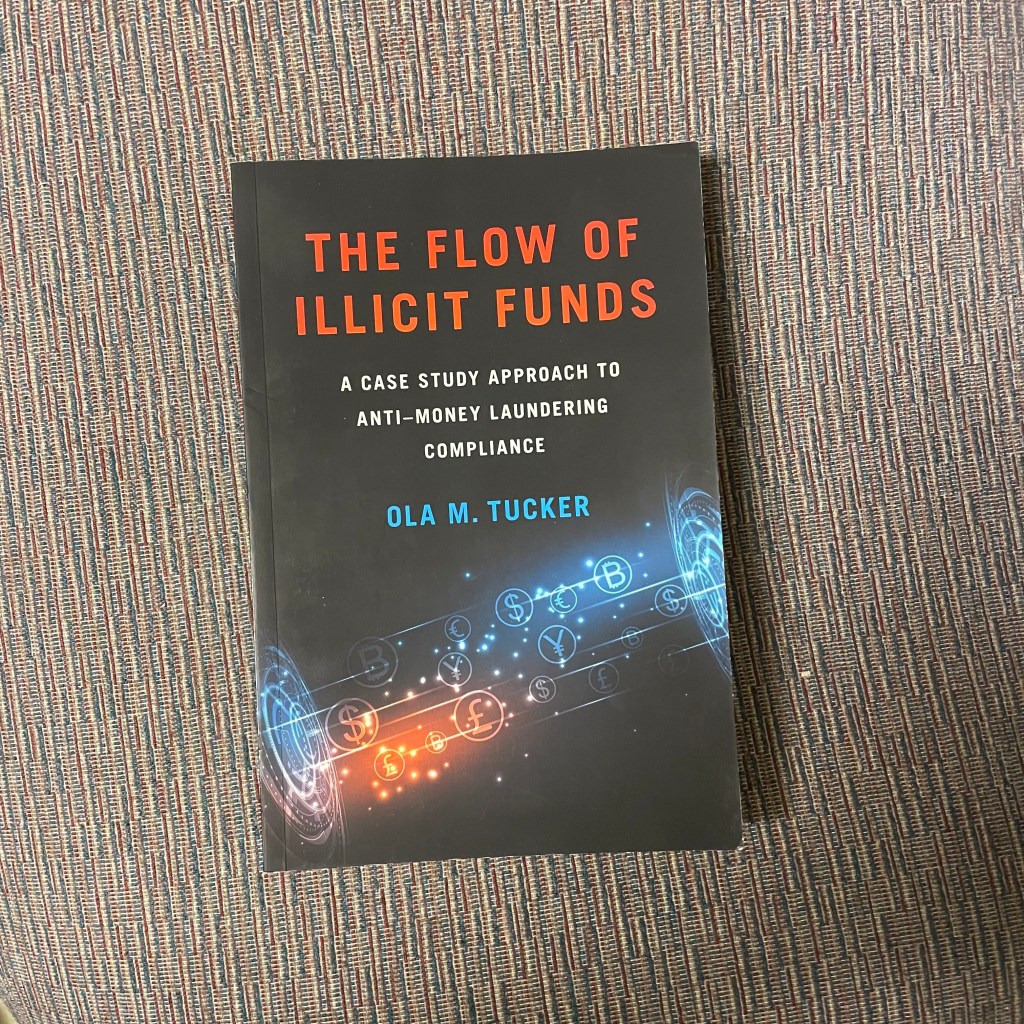
    Tucker, Ola M. The Flow of Illicit Funds: A Case Study Approach to Anti-Money Laundering Compliance. Washington, DC: Georgetown University Press, 2022.

    I read this book partly because it is tangentially related to my work, partly out of genuine curiosity. It is probably as good a general introduction to the subject as one is likely to find and is informative without being overly technical. It is geared towards compliance professionals at financial institutions whose job it is to try and spot transactions that may be related to money laundering; it certainly isn’t a how-to manual for doing money laundering.

    The book is billed as a “case study approach.” The “case studies,” though, are really brief illustrations of concepts the author first explains abstractly and they do not fundamentally drive the discussion. In this respect the case studies are nowhere nearly as substantial as those one encounters in, say, medical ethics literature. If you are looking for detailed, concrete examinations of money laundering schemes and how they were detected and unraveled, this book could be disappointing.

    I don’t work in compliance for a financial institution, so I can’t speak to how well this book succeeds in providing such professionals with tools for spotting signs of money laundering in the wild. I dare say that it is at least helpful on that score. As a general reader who is just curious about money laundering and its role in the global financial system, though, it makes for depressing reading. Tucker relates that at most 1% of money laundering activity is detected and interdicted. The overall picture she paints is of dedicated bank compliance officers valiantly bailing out the ocean with teaspoons.

    Part of the problem is that money laundering in most cases greatly resembles what wealthy individuals do with their money on a regular basis. Many of the techniques used by money launderers, especially by the ones who launder a lot of money, are not inherently unlawful. What that means is that many of Tucker’s suggestions for how to combat money laundering involve suggestions for statutory, regulatory, or financial institution policy change. These calls for change were probably quixotic in 2022 when the book was written, but now that Trump is in the White House in the United States the US has either frozen steps for change in this area or taken decisive steps backward.

    Take, for instance, beneficial ownership registration for anonymous shell corporations. One of Tucker’s policy suggestions, and one which has been implemented in jurisdictions outside the US, is the maintenance of a registry of “beneficial owners” of anonymously incorporated business entities. These are just the sort of entities that are useful to money laundering operations, since it is difficult to trace the entities back to a specific individual or group of individuals. A beneficial ownership registry would require all corporate entities to register a “beneficial owner”—that is, a natural person or persons who benefit from the enterprise. The registry would not be viewable by the public, but it would be accessible to law enforcement and to financial institutions for the performance of due diligence and compliance (especially for compliance with government sanctions).

    During the Biden Administration, the U.S. Treasury Department’s Financial Crimes Enforcement Network (FinCEN) enacted just such a beneficial ownership registry (the “BOI Registry”). In fact, it came within a hair’s breadth of becoming a requirement for all domestic business entities. (I know this because in December 2024 I was preparing to assist my employer in filing its registration with the BOI Registry.) But once Trump took office, all bets were off. It announced to the public in February 2025 that it would not issue fines or penalties for entities that failed to comply, and then in March it announced that it would remove the requirement entirely for U.S. companies and U.S. persons. (In the name of “reducing regulatory burdens,” naturally.) Foreign corporations doing business in the U.S. still have to comply, but that won’t stop money launderers: if you can get the money into the U.S., the U.S. remains a very friendly environment for multiple stages of the money laundering process. It’s almost as if Trump wants it that way.

    Which he undoubtedly does. More than one of the case studies discusses the role of Deutsche Bank as a serial money-laundering recidivist. This book describes the role of Deutsche Bank in enabling Jeffrey Epstein’s human trafficking operation, and Deutsche Bank comes up again and again as a major bank with a lax view of its due diligence and compliance obligations. It is probably no coincidence that Deutsche has for years played the role of lender of last resort for the perennially messy operations of Donald Trump himself.

    There are echoes in this book of other efforts Trump II has made to bring the US in line with other countries where public corruption, and its associated money laundering, is endemic. Tucker, for example, discusses the role that “pay for citizenship” schemes in countries with lax financial regulatory environments play in money laundering schemes. As has been widely reported, Trump II has instituted just such a scheme, the “Gold Card,” here in the U.S. (Not coincidentally, a foreign national purchasing the “Gold Card” would likely also purchase an exemption to registering their business entities with FinCEN’s BOI Registry. It’s a wealthy money launderer’s dream.)

    Tucker herself opines in the final chapter that the sheer scale of money laundering is such that the largest banks in the world may not be able to survive without it. Tucker is clear-headed enough to realize that combating money laundering effectively will require a truly global commitment to transparency and accountability; otherwise launderers will simply retreat to jurisdictions with lax oversight and entrenched regimes of privacy. We do not yet live in such a world, and since this book was published in 2022, the United States under Trump has committed itself to making such a world much harder to realize.

  • Only an (AI) God Can Save Us?

    Only an (AI) God Can Save Us?

    Last Friday, my son and I attended the opening night of Tron: Ares, the third installment in the Disney computer movie franchise. (The CGI one, not The Computer Wore Tennis Shoes.) Readers of this blog are well aware of my somewhat irrational 80s-kid love for the 1982 Tron and its 2010 sequel, Tron: Legacy, so it’s no surprise that I would be on hand for its opening night, watching it in IMAX 3D, no less.

    Having watched it, I can say that while Tron: Ares is certainly a sensory spectacle, it isn’t the strongest film in the franchise, which, depending on your feelings about the first two movies, may not be saying much. Behind the sunny optimism that prevails at the end of Tron: Ares is a bleak counsel of desperate surrender in the face of the very forces that are pulling the world apart.

    ***

    Warning: Spoilers for the movie follow.

    As Tron: Ares opens, we find that ENCOM, the software company featured in the 1982 and 2010 films, is locked in a technological race with recently spawned competitor, Dillinger Systems. Both companies are in a race to develop technology that will allow them to synthesize virtually any object using modified versions of the particle lasers that, in the first two films, beam people into the virtual world. The lasers work like 3D printers, printing everything from orange trees to super-hardened military hardware, and they can even create embodied real-world avatars of programs akin to the ones that populate the virtual world of “the Grid,” the long-standing designation in the Tron universe for the inner world located inside computer networks.

    There is one catch to this amazing synthesizing technology, though: both companies have hit a theoretical limit for how long their creations can endure in the real world. After twenty-nine minutes, the created objects, no matter how simple or complicated they are, crumble into pixelated dust.

    However, ENCOM and its young CEO Eve Kim (Greta Lee), have an advantage: they know where to find the “Permanence Code” that would allow these synthesized objects to last indefinitely. Julian Dillinger (Evan Peters), the whiny, temperamental CEO of ENCOM rival Dillinger Systems, desperate to win lucrative military contracts, will stop at nothing to get the Permanence Code from Kim. So, Dillinger fires up his 3D-printing laser matrix, works up avatars of his master control program, Ares (Jared Leto), and Ares’ chief lieutenant, Athena (Jodie Turner-Smith), and sends them to collect the code from Kim. (In twenty-nine minutes or less, of course.)

    Here, though, Ares begins to have realizations that Dillinger didn’t prepare for. Ares is an AI computer program, and in the course of his training (since our current expectations of AI is that it has to be trained iteratively) he has developed curiosity about the real world as well as feelings, and more than anything a desire to be something more than just a program carrying out the imperatives of Dillinger. Dillinger, though, makes it clear that however much he values Ares’s support, he views Ares himself as expendable, and Dillinger obtaining the Permanence Code will not change that. So, rather than execute Dillinger’s order, Ares abruptly changes sides and joins forces with Kim to keep the Permanence Code out of Dillinger’s hands.

    Jeff Bridges’ Kevin Flynn lives (sort of).

    After a fairly convoluted series of events, which include Kim and ENCOM beaming Ares into the preserved Grid from the original 1982 Tron (silly but fun for the fans) and becoming himself imbued with the Permanence Code by the preserved avatar of no less than Kevin Flynn himself (Jeff Bridges, reprising his role in the first two Tron films with the same gee-whiz tics he’s been using since 1982), Ares returns to the real world as a messianic figure. The change registers visually by the neon highlights on Ares’s suit turning from red to white, much like Gandalf the Grey returning from the other side of death as Gandalf the White. But the movie has tried to telegraph this messianic moment from the very beginning; Jared Leto’s Ares spends the entire film with shoulder-length hair and a beard that makes him look like a youth pastor at a seeker-sensitive church cosplaying Jesus, after all. Permanence Ares, together with Kim, ultimately save the day, Dillinger’s world crumbles around him, and order is restored. Kim and ENCOM go on to use the Permanence Code to synthesize, not military hardware and supersoldiers, but instead things that solve the problems of humanity—feeding the hungry, curing cancer, things like that. All’s well that ends well!

    ***

    There is a certain techno-optimism baked into the basic premise of all of the Tron movies that is hard to maintain in the enshittified world of 2025. In this sense, Tron: Ares is as much a victim of the desperately long timeframe it took to move from development to production as anything. Older, more quaint techno-optimism notwithstanding, the core of the thematic appeal (such as it is) of the first two movies is a search for transcendence beyond technology. At the core of the original Tron movie is the struggle against the nakedly totalitarian Master Control Program, whose mission is to usurp the role of the human users and to bend all computer programs to its will. (True to its roots in the Cold War Reagan-era United States, Tron represents the MCP as ideologically bent on destroying the “religion” of the users, much like the aims of the religion-destroying Soviet Union as reflected in Western propaganda. The MCP’s lieutenants and minions even glow red.) Tron and Flynn win out over the MCP and hence restore the natural subservience of program to user to the Grid. The “religion of the user” flourishes once again, and programs are once again just useful tools for humans to use.

    Sark from the 1982 Tron (David Warner) is an apparatchik for the techno-Stalinist MCP.

    Tron: Legacy takes the same theme in a new direction. Now it is Kevin Flynn, the hero of Tron, who has succumbed to the proto-totalitiarian impulse to create what he terms the “perfect system” that will (somehow) help humanity to overcome the imperfections of the real world. He disappeared in 1989, leaving behind his son, Sam Flynn, to grow up fatherless and alienated. In the course of following up clues as to his father’s ultimate whereabouts, Sam learns where his father is, why he left, and what he has learned in the course of his enforced captivity inside his own Grid. He has learned that his desire to implement the perfect system, implemented by sentient program Clu, was chimerical because it led him to devalue his relationship with Sam and to abandon the imperfect, but irreplaceable, real world. It also led to the destruction of the Isos, “isomorphic algorithms” which spontaneously and unexpectedly manifest within the Grid, showing Flynn that perhaps the messy imperfection he sought to repress is ineliminable from even the Grid itself. Of all the Tron movies, Tron: Legacy comes closest to speaking to the social pathologies of current Big Tech while at the same time portraying a set of humans with legible, human-sized motivations and struggles.

    The trajectory of Ares from Dillinger’s master control program to messianic program at large in the real world is, I think, meant to explore a similar theme to that of Flynn’s enlightenment in Legacy. The problem, though, is that Tron: Ares underdevelops the theme. Some of that is due to Jared Leto’s limited acting range: he plays Ares with the flat affect of HAL-9000 in 2001: A Space Odyssey and doesn’t let us into Ares’ internal conflict. The real limitation of Tron: Ares, though, is that Ares’ enlightenment and defection is just one more plot point in the service of, at bottom, a straightforward, but utterly overstuffed, white-hat/black-hat techno-Western. The movie rarely gets a chance to breathe, to allow us to sit with the characters and develop any sense of what is at stake for them, and for us as the audience. In the midst of all this, Ares remains ultimately a handsome cipher with fearsome combat skills. Mindless wall-to-wall action is fine if you’re in a Fast and Furious movie that isn’t even trying to be credible. But for all its winks and nods to the Tron nostalgists out there, Tron: Ares ultimately lacks any sense of humor about itself.

    What is really at stake in Tron: Ares is, despite the title, not Ares—his trajectory is really just a sideshow—but instead a struggle between two tech CEOs for corporate dominance. If you’re a tech CEO, I guess that plot really speaks to you, but otherwise, not so much. Of course, the movie seeks to engineer our loyalties at every turn. ENCOM, the white hats of the piece, are the geeky, fun, diverse company who is seeking the Permanence Code to help solve the world’s problems. Eve Kim is not only a nice, relatable woman, but is also grieving her dead sister and trying to use the Permanence Code to further cancer research in her sister’s memory. ENCOM’s color palette is all warm blues and its design sense is curvilinear and organic. Dillinger Systems, by contrast, is all angry reds, blacks, and grays and boxy, angular, spiky designs. Julian Dillinger is a peevish brat with a genuinely unhealthy relationship with his domineering mother (Gillian Anderson, trying her level best with this part),[1] and Dillinger wants the Permanence Code to develop a next generation of unstoppable weapons of war and supersoldiers.

    The difference between our protagonists and their spheres of influence is not remotely subtle. And yet, they are both ultimately just tech CEOs struggling for corporate advantage. We are supposed to derive comfort from the fact that the good CEO wins out over the bad CEO. But at the end of the day it’s all just CEOs—and of course, Permanence Ares, who ends the movie wandering Mexico on a motorcycle learning about human life. Nice work if you can get it.

    It’s hard to derive much solace in 2025, though, from a movie that tells us that the only thing that can stop a bad tech CEO is a good tech CEO. We are living through the reality that there really aren’t any good tech CEOs, certainly none with the power and influence wielded by the real-life analogues of Julian Dillinger. Instead of the messianic promise of AI becoming sentient like Ares and trying to affect a rapprochement between the imperatives of technological growth and the claims of humanity, we have people like Elon Musk and Peter Thiel who have thrown their lot in with authoritarian government, genocide, and carbon-induced climate disaster. We even have Thiel giving private, secretive lectures which, in the absence of any historical or theological evidence or warrant, claims that opponents of AI are servants of the antichrist. It’s hard to be celebratory about the actual state of AI technology; far from curing cancer and synthesizing orange trees on the Alaskan tundra, it’s turning most of the Internet into a soup of misinformation and poorly written slop, jacking up electricity prices, and hastening our ongoing climate catastrophe, all to help college students cheat on writing assignments and to save mid-level office workers a few minutes a day in writing meaningless reports.

    Tron: Ares has precisely nothing to say to any of these actual problems. That would be fine if it were just a big dumb action flick. But it isn’t; whether it wants to be or not, it’s a film about tech CEOs and AI screening in 2025 in a world set on fire in large part by the very forces it celebrates. It’s impossible not to have a sense of the tonal disconnect between the sunny world at the end of this movie and the one in which we find ourselves, and it’s hard to swallow the answer this movie proposes, which is the non-choice choice of Thomas Hobbes’s Leviathan:Don’t like your absolute ruler? Start again with a new absolute ruler and hope for the best!

    ***

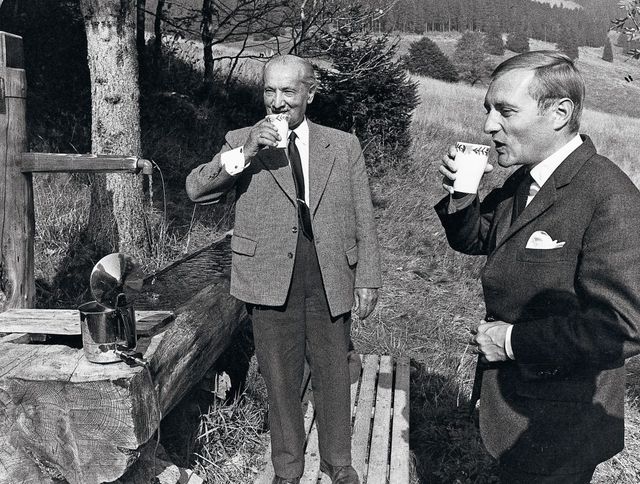
    In 1966, Martin Heidegger, the first Nazi rector of Freiburg University and also an influential philosopher, consented to an interview with the German newsweekly Der Spiegel in which he agreed to break his longstanding silence about his complicity with the Nazi regime. In the interview, only published five days after Heidegger’s death in 1976 by Heidegger’s stipulation, Heidegger is famously evasive and misleading on the subject of his tenure as a Nazi official, seeking instead to paint it as a sadly misdirected application of his philosophical thought. Striking a quietist pose reminiscent of the late Hegel’s famed statement that “the owl of Minerva spreads its wings only with the falling of dusk,” Heidegger tells his interviewers:

    [P]hilosophy will be unable to effect any immediate change in the current state of the world. This is true not only of philosophy but of all purely human reflection and endeavor. Only a god can save us. The only possibility available to us is that by thinking and poetizing we prepare a readiness for the appearance of a god, or for the absence of a god in [our] decline, insofar as in view of the absent god we are in a state of decline.

    Heidegger with Rudolf Augstein, one of the interviewers who conducted the 1966 Der Spiegel interview.

    In a strange irony, the decidedly anti-technological thought of the late Heidegger became a seminal influence on the intellectual ethos of Silicon Valley. The quietist project of preparing for the advent of a god that Heidegger espouses in his Spiegel interview becomes, in the hands of today’s tech overlords, an effort to “move fast and break things,” to “disrupt,” to force history open at its joints so that the god may enter. Tron: Ares is 2025’s cinematic depiction of the current state of this half-baked Silicon Valley messianism. If anything, the emptiness of the film may have ultimately done us all a favor: the digital messiah for which our tech overlords have prepared us is, like Jared Leto’s Ares, probably nothing but a vapid bore.


    [1] I, for one, sensed shades of the vaguely incestuous Raymond Shaw/Eleanor Iselin dynamic from the 1962 adaptation of The Manchurian Candidate in that relationship. The movie barely devotes any real interest to it, though, and in the process wastes Gillian Anderson’s talent.

  • Two Strategies for Reading Fiction

    Two Strategies for Reading Fiction

    My latest reading project has been completing the fiction of Jane Austen. In order to organize my thoughts about Austen’s works themselves, I found myself needing to clarify, as a sort of preparatory exercise, my thinking on two different, but interrelated, strategies of reading. If you are interested in theory or abstraction, may you find this helpful or at least of mild interest. If you aren’t, expect some writing about Jane Austen in the coming weeks.

    Although it’s probably an oversimplification, I often entertain in my own thinking a distinction between two strategies of reading fiction. This distinction helps me make sense of not only my own reading, but also the proliferation of discussion of it in our times.

    The first such strategy I call reading as a technology of identity consolidation. This strategy of reading centers upon the reader’s wants, desires, wishes, social location, and agency. The questions to which it seeks answers in fiction center partly on satisfaction—Am I enjoying the experience of reading this book? Do I like the characters? Do I identify with them? Do I find them “relatable”? Does the work help me to confront, or perhaps to escape, aspects of my own reality I find oppressive? Do I think the author is someone I might like? Some of what this strategy seeks to get out of fiction, though, can involve personal aspiration or improvement: Does this book provide role models to help me shape and direct my ambitions? Is the author telling a story that, for political or ideological reasons, I think needs to be told to a wider audience? Is the author exploring some aspect of identity that is underrepresented in fiction, and doing so in a way that supports ideals of dignity and increased understanding?

    The common thread running through this diverse set of questions and expectations is, I believe, a singular preoccupation: How can fiction help me be the sort of person I should be, by helping me figure out who I really am, how I should act, what I should do, what I should believe? In other words, its preoccupation is the reader’s sense of their own identity, and the critical touchstone it recommends is the extent to which a book helps or does not help achieve that goal. (Also, by implication, it can evaluate books based on the extent to which the book or its author are compatible with the sorts of political or moral aspirations we should have, which lends this attitude towards a certain censoriousness about books that is no doubt familiar to anyone reading this on the Internet in 2025.)

    I call this sort of reading a technology because, on this view, the work of fiction is a sort of tool or device the reader uses to achieve other goals that go beyond the work of fiction itself. What’s more, reading fiction is not even the sole means to achieve those goals; other people who aren’t devoted to reading achieve them by watching movies or television, chatting up strangers on the Internet, backpacking across the American West, or some other thing. Perhaps reading fiction is the best way to figure out who you are and who you want to be, or at least has certain advantages over other ways[1], but it isn’t the only way.

    Although the most recent public site where this strategy of reading is on full view is undoubtedly #BookTok and its related social media communities, the strategy of reading as a technology of identity consolidation is by no means new. The explosion of the novel as a popular literary form in the 18th century in Europe, and its appeal to young, impressionable people living through the upheavals of the crumbling of absolute monarchy, Sturm und Drang pre-Romanticism in culture, and a general transformation in how the world appeared to intellectuals[2], led to a sense of moral panic not dissimilar to those that swept post-World-War-II America. When novelists of the 19th century incorporated the pitfalls of this kind of subjective investment in reading fiction within fiction itself—Catherine Morland in Jane Austen’s Northanger Abbey and Emma Bovary in Gustave Flaubert’s Madame Bovary are two salient examples—they were already taking place against the backdrop of a social debate with a long history. By the mid-20th century the cultural place of the novel was well cemented, but Vladimir Nabokov, himself no opponent of fiction, was lampooning what he polemically took to be the excesses of “bad reading” (reading aimed at identification with characters, concentrating on the “socio-economic angle,” etc.) among his students and contemporaries.[3]

    While I agree that a singular focus on fiction as a technology of identity consolidation is limiting, I don’t reject it entirely or think that it is an illegitimate way of reading across the board. For what it’s worth, I think that this strategy of reading represents something ineliminable from anyone’s experience of, and interest in, reading fiction. I will return to that point below.

    For now, I will be content to contrast this strategy of reading fiction with another I call reading as an inquiry into cultural artifacts. This strategy of reading tends to bracket the reader’s personal identitarian investment in, or response to, the work of fiction and instead seeks to appreciate the work of fiction as an artifact embedded in its own multilayered context. The implied metaphor of an archaeological dig is deliberate, as the work of fiction’s contexts are numerous, interrelated, and take sometimes dirty work to decipher if one is to do it well. Reading fiction as artifact can, for instance, dwell on the author’s broader aims: Is the author preparing a brief for a moral or political case? If so, what is it, and does the work forward that goal of persuasion? How does the work relate to other work by the author—as a departure, a continuation, a repetition? Does the work reflect the author’s inner state or personal biography, and if so, how? Some of its questions are the familiar territory of academic literary criticism: What are the work’s structural or formal qualities, and how do these qualities relate to other works? What are the inherent aesthetic qualities of the work, and on what standards might we judge its quality? How does the work relate to similar works produced in a historical time, place, or era? Some of the questions this strategy of reading asks veer off into history, philosophy, sociology, economics, and other social sciences: What factual information does the work of fiction tell us about its time (even if “its time” is right now)? What does it convey to us about what it was like to be a subject in its time and place: the characters’ sense of their own agency and choices for action, how they imagined themselves and their world (and sometimes the distance between their imaginations and reality), what sorts of radical options were open to them or foreclosed?  How was the book read (or misread), received or rejected, in ways that illuminate both the work itself and its subsequent history? Does the book illuminate or provide unique traction on a philosophical problem, like free will, the nature of justice, or religious belief?

    Obviously, what I am calling the strategy of reading as an inquiry into cultural artifacts is a wide umbrella over a vast range of diverse interests, questions, and curiosities. It covers the aims of the hack political pundit’s obtuse commentary on contemporary novels, the integrative work of the cultural critic or public intellectual, and the minute, detailed research of the humanities academic. I know full well that many people whose interest in fiction lies in the general direction I am describing would chafe at being associated even loosely with some of the other preoccupations I am grouping together under this umbrella. This strategy is far too broad to be called a “method”; it’s more a general orientation, a tendency.

    I don’t call the strategy of reading fiction as a cultural artifact a “technology” because, unlike the strategy with which I am contrasting it, the work is not being used as a tool or an implement to achieve an end. However, it does share with that technology of reading, though, a certain tendency to lose focus on what we might call, in an old-fashioned sort of way, the “work itself.” Reading as a technology of identity consolidation tends to view the work as a sort of mirror or lens that is trained squarely upon the reader’s selfhood. The properties of the mirror or lens only matter to the extent that they help the self see itself more clearly. Reading as an inquiry into the book as cultural artifact, though, tends, at its extremes, to dissolve the work itself into a mere set of illuminations of its contexts, as one more data point in the service of a broader thesis about whatever historical, philosophical, or sociological interest the reader brings to the work.[4]

    Fiction writers themselves have perhaps been less worried about the drawbacks of this attitude towards fiction than about the drawbacks of its contrasting attitude. Certain fiction authors and works certainly portray the dissolution of the traditional novel into other discourses and registers, though. The most well-known examples are the works of modernist authors like Joyce or Beckett, but there’s also Tolstoy’s War and Peace, a fictional work (Tolstoy denied it was a “novel”) which shades over its great length into a work of history and philosophy. At the extreme, we have the French nouveau roman as well as Burroughs’ cut-up trilogy, with long passages that consist of literal cut-up and scrambled texts from newspapers and magazines (and which Burroughs also denied were “novels”).

    I must confess that the habits of mind that govern my choice of fiction reading tend more towards the appreciation of fiction works as cultural artifacts than towards identity-consolidation. (Perhaps being a middle-aged man who thinks he is blessed with an adequate degree of self-awareness explains this: I am not looking to fiction as a form of therapy or to figure out who I am, or even to get away from who I am.) But I am not personally above reading fiction that is escapist, or relatable, or blatant wish-fulfillment, or just plain entertaining. In the end I suspect that these two strategies of reading I have identified can scarcely be divorced from one another entirely. For lack of a better terminology, the subjective pole and the objective, the personal and the impersonal, care of the self and concern for the world, can’t be pulled apart neatly. Both sets of motivations and interests confronts all of us when we read fiction to some extent. They are like the charged electrical field in the midst of which we engage with the work of fiction, which then blocks, amplifies, reflects, and redirects those energies into different directions.[5]

    When it comes to talking about fiction and literature, what I abhor is the insistence on a single strategy of reading as the only one that is worthwhile, or else the sheer predominance of a single strategy of reading by the volume of commentary and conversation that exclusively presupposes it. (If you haven’t guessed, I endured maybe ten minutes of browsing on #BookTok before abandoning it in frustration.) I am, generally speaking, a maximalist when it comes to reading, a “let a thousand flowers bloom” sort of person. I sometimes intentionally seek out negative reviews of books I love, and sometimes they even change my mind. When they don’t, I still find them instructive as idiosyncratic readings or misreadings. When people present me with excessively rigid reading methodologies or otherwise seem to have a perpetual blind spot in their critical judgment, I just think, “Hm, OK,” and then keep on reading what I want for whatever reasons interest me.

    With all that in mind, my next post will reflect on the one author whose public and academic reception in modern times best exemplifies both of these strategies of reading at once: Jane Austen.


    [1] Reading novels certainly entails less physical risk than embarking on a career of libertinage among the demi-monde of Paris. To pick an example.

    [2] One of the central theses of Michel Foucault’s The Order of Things is the transition of episteme he identifies in the late 18th and early 19th centuries, in the very way that the discourse surrounding knowledge was subtly reorganized and transformed.

    [3] Vladimir Nabokov, “Good Readers and Good Writers,” in Lectures on Literature (ed. Fredson Bowers; New York: Harvest, 1980), 3ff.

    [4] Yet another target of Vladimir Nabokov’s critical polemic in “Good Readers and Good Writers” are people who insist on using Jane Austen’s novels as a source of information about “landowning England with baronets and landscaped grounds when all she knew was a clergyman’s parlor” (p. 2).

    [5] Without getting too far into it, I suspect that the relation between these two strategies of reading is broadly dialectical (though not in a rigidly Hegelian or Marxist sense). What I will say is that, pace certain cultural critics who have dotted the landscape throughout my lifetime, I am not convinced that either strategy is inherently prone to, or exclusively guilty of, the closed-mindedness, epistemic closure, or sheer obtuseness significant swaths of the reading public constantly exhibit. Reading for escapism or sheer entertainment value can teach one things about oneself and the world that one didn’t know before (maybe even things that one doesn’t really want to know at all), or it can simply reinforce one’s existing feelings and prejudices. Reading for aesthetic merit or for cultural significance can lead one to broader insights about the world and one’s own place in it, or it can devolve into a rigid exercise in policing the boundaries of a canon or an interminable collection of grist for one’s preferred mill. What makes for this difference is a more basic personal disposition on the part of the reader, not the strategy of reading they employ.

  • The Bee Gees vs. … Fascism???

    The Bee Gees vs. … Fascism???

    On Sunday morning I woke up out of a funny dream that involved the soundtrack album of the 1978 film Sgt. Pepper’s Lonely Hearts Club Band. My first thought after waking was, “wait a minute, was this a film that was actually made, or is this some sort of Mandela-effect thing in my mind?”

    I duly verified that, yes, the Sgt. Pepper movie actually exists. I am party to my fair share of conversations about schlocky cinema, but I never hear anyone talk about this one. I distinctly recall that my family owned the double-LP soundtrack album to this movie when I was a little kid, but that was literally my sole reference point for it. It seemed to have been excised from the cultural conversation, for better or for worse.

    After this dream, I realized I had to watch Sgt. Pepper. Thanks to the magic of Internet streaming services, on Sunday evening my wife Candi and I sat down and watched it. She was a grown adult when the film was released but she did not even remember it happening. (The effort to memory hole this movie seems to have succeeded!)

    Online reviews of Sgt. Pepper are savage, so I was prepared for a bad film. I was not completely prepared for what I saw. It was…a mess, for sure. But it was also a fascinating artifact of late-1970’s entertainment, and it had a surprising political subtext as well.

    Let me begin by saying that I am about as friendly an audience for this movie as it could get. I love movie musicals. I never stopped loving the Bee Gees or disco. I like the Beatles and the Sgt. Pepper album well enough (Sgt. Pepper is actually the only one I ever bought), but I am far from a Beatlemaniac. Peter Frampton I can take or leave, but I don’t hate him. I am not scared of high-concept ridiculousness in films. (Case in point: no one else I know is as enthusiastic as I am about Wim Wenders’ five-hour director’s cut of Until the End of the World.) If I can’t warm up to a jukebox musical that recasts discofied Beatles songs as the soundtrack for a morality play about the music industry, who can, really?

    In my opinion, the chief problems with Sgt. Pepper come from the flawed structure of its story, not from the acting or production values. I will summarize the story as tightly as I can here, spoilers included. (Content warning: reference below to attempted suicide.)

    Peter Frampton and the Bee Gees as Billy Shears and the Sgt. Pepper’s Lonely Hearts Club Band (redux).

    Billy Shears (Peter Frampton) and his backup band (the Bee Gees) are a revival of the original Sgt. Pepper’s Lonely Hearts Club Band from Heartland, U.S.A. Back in 1918 Sgt. Pepper’s band somehow brought about the end of World War I with the uplifting power of their music. Years later, after the death of Sgt. Pepper himself, Billy and his band take up the Sgt. Pepper mantle, ostensibly representing the forces of peace, love, and harmony in contemporary times.

    As the film begins, Billy and company leave the innocence of Heartland, U.S.A. to go to Los Angeles along with their manager, Dougie Shears (Paul Nicholas), at the summons of B.D. Brockhurst (Donald Pleasance, of all people!). In doing so, Billy leaves behind his lady love, Strawberry Fields (Sandy Farina), to whom he is devoted, but apparently not as much as he is to his music career. The story quickly begins to assume a familiar form: Billy and the band, the disciples of peace, love, and harmony, quickly find themselves seduced by the glamour and fast life of the music industry. They sign a record contract with B.D.’s label BD Records at a drug-fueled dinner straight out of Fellini’s Satyricon. Under B.D.’s influence, our heroes fall in with an all-woman disco/funk band on BD Records called Lucy and the Diamonds (Stargard), who are portrayed as siren-like temptresses (at one point Lucy herself even gets described as “wicked”). Our heroes are quickly on their way to becoming vapid showbusiness phonies when Strawberry Fields shows up to try to call them back to themselves.

    So far so good, perhaps. A bit hackneyed, about as silly as an episode of The Monkees, and definitely unfair to Lucy and the Diamonds, but you can see where it’s going.

    But then the story leaves the rails almost completely.

    After Billy and the boys leave for LA, a certain Mean Mr. Mustard rolls into Heartland on a ramshackle bus. (Frankie Howerd, the British comedian, plays Mustard in his only US film credit.) Mustard, an awkward middle-aged man whose bus includes two robot assistants (!) and a large video screen from which he receives orders, proceeds to corrupt wholesome, upright Heartland via real estate transactions (he opens burger joints! 24-hour mortgage lenders! video arcades!!!!) and develops a genuinely creepy romantic fixation on young, sweet Strawberry Fields.

    The height of Mustard’s perfidy, though, is that he, along with his henchman, Brute (Carel Struycken, the giant waiter from Twin Peaks), steal the instruments of the original Sgt. Pepper band (you know, the ones they played to end World War I) from the Sgt. Pepper museum in Heartland. Why? Well, it’s not entirely clear. They seem to have some sort of talismanic significance for the F.V.B. (“Future Villain Band”), from whom Mustard takes his marching orders. The F.V.B. and its fellow travelers have an oft-repeated motto: “We Hate Love, We Hate Joy, We Love Money.” Mustard steals the instruments and distributes them among the main players in F.V.B.’s cabal. When Billy and the boys receive news of the theft, they, with Strawberry Fields in tow, set out to recover the stolen instruments.

    The introduction of the F.V.B. and the “recover the talismanic instruments” storyline destroys whatever narrative coherence the movie had, but it also generates, oddly enough, the most compelling sequences in the film. Billy and the band first confront Dr. Maxwell Edison (Steve Martin, at the height of his manic “wild and crazy guy” period), holder of the stolen silver cornet, who runs a clinic of sorts that turns “ugly old corrupt people into handsome young corrupt people.” Steve Martin, as Dr. Maxwell, does an over-the-top version of “Maxwell’s Silver Hammer” to a chaotic, frankly frightening sequence in which his energized silver hammer converts, at a tap on the forehead, old people in surgical gowns into young, perky clones wearing khaki shirts and shorts and orange neckerchiefs. (The uniforms’ resemblance to those of the Hitler Youth is too great to be coincidental.) The whole scene plays like yet another outtake from Fellini’s Satyricon, which I mean here as a sincere compliment.

    Steve Martin’s Dr. Maxwell Edison singing and dancing in front of newly minted Hitler Youth.

    Billy and the boys then recover the stolen tuba from Father Sun (Alice Cooper), who is running a sort of brainwashing academy for the newly minted Hitler Youth. They pause to play a benefit concert back in Heartland headlined by Earth, Wind & Fire, but during the concert Mustard and Brute kidnap Strawberry Fields. After a genuinely creepy scene in which Mustard sings “When I’m Sixty-Four” to a bound and gagged Strawberry, he takes her to F.V.B. headquarters. Billy and company rush off (in a hot air balloon, a byword for speedy travel if there ever was one) to confront the F.V.B. itself—played by Aerosmith. During the showdown, Aerosmith does its now-famous cover of “Come Together,” which is one of the two really compelling performances in the film (the other being Earth, Wind & Fire’s cover of “Got to Get You Into My Life”). During the showdown, Billy overcomes the lead singer of the F.V.B. (Steven Tyler), but Strawberry Fields unfortunately dies in the melee as well. The boys, as well as a chastened BD Records cohort, go back to Heartland for Strawberry’s funeral. The band then begins to put its life back together, but Billy, still distraught over Strawberry’s death, climbs onto the roof of a building on Heartland’s town square and—he actually jumps off.

    But then. (It’s a huge “but then.” We need to pause over it for a second.) But then the Sgt. Pepper weathervane on top of the Sgt. Pepper Museum on the Heartland town square comes to life! The magical Sgt. Pepper is none other than Billy Preston, who sings “Get Back” as he drifts down from the roof of the museum (on clearly visible wires), zapping Billy with his magic electrified finger, lifting him back onto the roof he just jumped from mid-fall, and to boot curing his inconsolable dejection. As he sings and dances, Preston zaps away the remaining traces of Mustard’s corruption of Heartland and—if that weren’t enough—zaps into existence (I kid you not) a resurrected Strawberry Fields, seemingly none the worse for being dead and reanimated. (For this feat I dubbed Billy Preston’s finger the Magic Finger of Resurrection.) By the end, all is right with the world, and the show ends with a chorus of about 100 celebrities appear to sing the finale/reprise of “Sgt. Pepper’s Lonely Hearts Club Band.”

    Billy Preston as Sgt. Pepper, complete with his Magic Finger of Resurrection.

    Suffice it to say that the story is a lot. A lot a lot. It raises so many questions that it doesn’t even try to answer.[1] The movie also has problems of dramatic pacing as well as mediocre acting by people such as Peter Frampton who aren’t career actors. The fundamental structural problem with this movie, though, that makes the other flaws more obvious is that a third of the way through it exchanges, without explanation, one major dramatic conflict—the “seductions of the music biz vs. love and authenticity” one—for  another, and neither conflict resolves convincingly or is even seriously tied to the other one. Billy and the gang start the movie on a clear, if a bit overdone, success/fall/redemption entertainment-biz story arc, only to get derailed into a magical (but politically coded) quest against existential evil in which the vile tempters of the first arc are transformed into passively supportive allies. And all of it with minimal exposition, no dialogue, and a Beatles soundtrack!

    No movie could have fulfilled such a brief coherently. It’s so incoherent, such a jumble, that I am left wondering how this entire production even happened. No one has undertaken a thorough exploration of that question that I know of, but the answer undoubtedly lies with the producer, the impresario and media mogul Robert Stigwood. Stigwood in effect owned the Bee Gees as well as the rights to use several Beatles songs and wanted to use both to make a buck. (Or, as we would say today, to maximize ROI on his IP holdings.) Anonymous rumors on the Internet claim that the project was difficult to get off the ground: many actors and bands passed on appearing in it, the Beatles themselves had nothing to do with it, and the Bee Gees, smelling a flop, wanted to back out two weeks into shooting. But Stigwood not only had extensive production experience but also a great deal of power and connections from producing Grease and Saturday Night Fever, and so the film made it into theaters. It’s at least mildly amusing, if not baffling, to observe that the character of B.D. Brockhurst, the unsavory record producer atop BD Records, is a not-very-flattering parody of media moguls like Stigwood himself. The logo of BD Records in the movie even transparently recalls that of RSO Records, Stigwood’s music label.

    Sgt. Pepper is really two different movies, two different stories, both underdeveloped and sandwiched together uncomfortably. The music-industry morality play storyline is hackneyed no matter how you cut it, but the F.V.B.-cabal storyline is strange and unexpected and generates the best (if most disturbing) moments in the film. Shorn of the music-industry plot and liberated from the mandate to shoehorn the story into Beatles lyrics, that story could have made for a good movie, maybe even a great one. From the perspective of the USA’s descent into 2025’s fascist-inspired madness, the political subtext of the F.V.B. cabal subplot feels urgent. The narrator characterizes the F.V.B.’s goals as: “poison young minds, pollute the environment, and subvert the democratic process.” Dr. Maxwell’s remolding of “ugly, old corrupt people” into an army of Hitler Youth as part of their program incisively portrays the repackaging of old reactionary hatreds and desire for repression into an eye-pleasing package for newer generations. (It felt a bit like the mission of Charlie Kirk’s Turning Point USA, honestly.) That a major studio film would portray this dynamic just two years before the advent of Ronald Reagan and his recasting of the conservative revolution, whose shadow lingers large over us still, feels almost prophetic.

    Sgt. Pepper is not a good film. But as a cultural artifact, it contains so many bits and pieces that are food for thought. If what you want is compelling entertainment, look elsewhere, but if you want to explore a forgotten episode in cinematic history, you can find it on Blu-Ray or rent or buy it digitally on Amazon Prime.


    [1] Just some of the unanswered questions here: Why were the original Sgt. Pepper’s instruments so important that they were worth stealing? Was it the instruments themselves that gave Sgt. Pepper’s Lonely Hearts Club Band the ability to end World War I and make peace? Since we are being this ahistorical, did World War II even happen? Or did the peace and good vibes of the Sgt. Pepper band keep the Treaty of Versailles and the troubles of the Weimar Republic from giving National Socialism a foothold? If Sgt. Pepper’s instruments were so important, why weren’t they better secured—or, even better, why didn’t our heroes take them instruments with them to ensure their success? If the weathervane on top of the Sgt. Pepper museum is really a godlike Billy Preston with the power to undo death itself, why doesn’t he intervene at literally any point in the preceding chaos to set things straight?

  • The Victory of Armed Lifeboat Politics

    The Victory of Armed Lifeboat Politics

    This piece is one of the myriad “why did Trump get re-elected” pieces out there, but I originally began writing it about a month before Election Day. Back then, it was obvious that the election would be close, and I set myself the task of wondering why. My conclusions represent, though, the grappling I have been doing since 2016 with Trump and his continued presence in US politics.

    I propose a fairly broad explanation for Trump’s re-election: Trump was re-elected due to the anxieties produced by climate change and its consequences. I think that the other rivals I am seeing for explaining the election—racism, misogyny, economic anxieties—are all part of the picture, but the real driver here is climate change. It’s a broad theory, but I want to signal at the outset that it’s a tentative theory also. I don’t feel confident that I have every aspect at play here identified or given the proper weight. All of which is to say: take this as the tentative offering it is; if it helps, great; if I have gone astray, I am certainly open to hearing about it.

    I

    In his 2016 book The Great Derangement: Climate Change and the Unthinkable, novelist Amitav Ghosh argues that part of the failure of humanity and its institutions to contend with climate change is a deep failure of our personalistic, “novelistic” narrative expectations, which were created in the modern era at the dawn of capitalism, to reflect the supra-personal processes that drive climate change. Ghosh’s book is written in the first instance as literary criticism. It asks the question, how would the narrative expectations of the novel have to change in order to give the popular imagination the tools it needs to make climate change a human and tractable problem?

    Theories already abound for what led to Donald Trump’s victory in the 2024 Presidential election this past Tuesday. Most I have heard seem compelling, so far as they go, but something still eludes those of us who desperately need a narrative to explain what happened. I have come to think that what is eluding us is that very same narrative limitation Ghosh diagnoses in the contemporary novel: the difficulty of crafting a narrative that relates climate change to our other political concerns. I have come to believe that the chief reason Trump won was, incredibly enough, the fact that climate change is not only here, but is palpably worsening. Something is wrong in our country, in the world. Its effects are all around us, and yet we struggle to concoct a narrative that renders it available and urgent for people. Trump, though, managed to craft a narrative that captured the feeling of what is wrong. His narrative was—is—vague, riddled with lies and distortions, embroidered with seemingly every variety of bigotry, chauvinism, and plain meanness. It neither identifies the actual problem nor proposes any solutions for it. But—it’s a narrative that acknowledges the feeling of malaise and makes sense of it. Harris, and Democrats more generally, have struggled to craft a narrative that has the same urgency. A majority of voters simply went for the more compelling narrative.

    II

    In The Great Derangement, Ghosh briefly discusses the theory of Christian Parenti, author of the 2011 Tropics of Chaos, of the “politics of the armed lifeboat” in response to climate change. Poorer countries and countries in the global South are, whether by geography or political engineering, or both, especially vulnerable to the shocks of global climate change. Understandably one of the consequences is that, as climate change worsens, dwindling prospects for a livable future in poorer and hotter countries drive migration to wealthier and cooler regions. “Armed lifeboat” politics is a response to that situation: rather than working in collaboration with other nations to ease the impacts of climate change and work towards a livable future for all, wealthy nations in the global North “arm the lifeboat” by sealing their borders, shutting out immigrants, and preserving scarce resources for those already within their borders they deem most worthy.

    I contend that what we are seeing from the contemporary right—its embrace of nationalism and state sovereignty in its most violent forms; its isolationism and populism; its tense relationship with traditional laissez-faire upward-wealth-transfer conservatives; its professed distrust of elites—is best explained as “armed lifeboat” politics. The special mix of urgency and terror MAGA politics embodies is, among other things, an effect of, and response to, the realities of our warming climate as they begin to register in American society.

    But, you say, this can’t be correct! The contemporary American right has inherited from its right-wing ancestors the inability to admit that climate change is possible, much less than that it is already happening. How can an entire political movement be a response to something whose existence it officially denies? I think there are really complicated (possibly even psychoanalytical) answers one might give to this question. The simplest answer, though, is that the reality is there to be responded to, whether you acknowledge it for what it is or not. Trumpism of course doesn’t acknowledge climate change directly, because doing so seriously would entail that we adopt drastic, and likely strongly coercive, measures to reduce carbon emissions among the corporate class, who are the biggest polluters by a wide margin. What Trumpism does instead is to declare that certain of the symptoms of climate change—chief among them migration—are themselves the illness that needs fighting.

    Think about the MAGA contingent’s response to the recent disasters spawned by Hurricanes Helene and Milton for a moment. It wasn’t the standard line of Republican climate change denialism at all. That standard line is, or at least has been, to point to hurricanes and other climate disasters in the past and say that what we have now is just within the standard variations in climate we have experienced for hundreds or thousands of years, not to worry! Helene in particular made it difficult to take that standard line because it was so destructive in a part of the world so far from the coast. (That, and it would be impolitic during an election year in a swing state to tell its disaster-stricken residents that a storm the likes of which had not been seen in that area in recorded history was somehow “normal.”) Instead of the standard climate change-denialism line, the American right in the wake of Helene and Milton instead floated conspiracies that Biden and Democrats have the power to create and direct hurricanes towards communities that historically vote Republican. Liberals always on the lookout for a cheap shot observed that attributing a comic book supervillain’s weather control machine to Biden seems to sit ill with saying that human activity doesn’t influence the weather. But that’s the point: the MAGA contingent is shifting towards the recognition of human-induced climate change in the only way it knows how—by attributing it to a deliberate conspiracy by its enemies.

    The “weather machine” narrative is ludicrous, easily falsifiable in all its details. But—it’s a narrative. It puts a human face on what is otherwise a diffuse, complicated phenomenon.

    If I am right, I think we have to give Trumpism credit for one thing: its fear derives ultimately from something worth fearing. We should all be afraid of the already-beginning climate crisis. This doesn’t mean that we should be mastered by our fear or that we should lash out indiscriminately. Trumpism is dysfunctional politics because it is a “vibes only” kneejerk reaction to fear that only exacerbates the problems to which it responds. I suspect, though, that Trumpism is not the first political program that fails to deal constructively with the social ills that are really its enabling condition.

    III

    So much for what animates Trumpism. Why, though, does this have anything to do with why Trump won on Tuesday? Why did more Americans vote for the dysfunction, the callousness, and the bigotry of Trump than the alternative?

    I see two chief theories for explaining Trump’s victory, all of which I think have a certain merit. The first credits economic anxieties, and specifically the lingering effect of post-COVID inflation on household budgets. This is the “Milk and Eggs” theory. There are crude, reductive, memeified versions of this theory, of course, but before the election happened I shared an article by economist and historian Adam Tooze on Facebook that in a more nuanced way predicted that so-called “felt” inflation might have an impact on this election.

    The second theory credits racism, sexism, or the intersection of both known as misogynoir for Trump’s win. Due to the gender and race of his opponent, so this theory goes, America reverted to its endemic and systemic racism and misogyny to reject a Black woman candidate. Again, I find these explanations undeniable. America still struggles with the legacy of its historic anti-Black racism and its sexism, and Trump himself has a way of channeling, and normalizing, some of the most vile and reactionary strains of racist and sexist behavior to be encountered in the US. Trump’s campaign resorted to racist, sexist claims at virtually every possible juncture it could have done so.

    Why, then, would climate change be my candidate for why Trump won? Actually I don’t think it’s that simple. I think economic anxieties, racism (including racist attitudes towards immigrants), sexism, and other forms of bigotry all had an indispensable role to play in Trump’s winning the election. No explanation of what happened on Tuesday is complete without them. The deep fear and malaise caused by the pressure that climate change is putting on not just US society, but societies all across the world, though, is, I think, the anxious energy driving the US society to abandon the better angels of its nature and instead drag its historically bigoted attitudes back out of storage.

    Allow me to make an analogy to a hurricane. (It seems apt on so many levels.) A hurricane forms out in the ocean as at first a normal storm. Under the right conditions, that storm begins to rotate and draws energy off of warm ocean water, thus increasing in power until it becomes massive and powerful. Storms happen all the time, but it’s the other enabling conditions in the environment, chiefly the late summer heat trapped in the ocean, that make them into hurricanes.

    This is, I think, how the deep malaise Trumpists feel—the specter of “American carnage” from Trump’s first inaugural speech—becomes a phenomenon that breaks through the barricades formerly erected around the John Birch Society fringes of extreme right-wing politics. All of Trumpism’s bigoted politics is, as we are often reminded, of very old vintage as far as its substance goes. (The Harris campaign’s slogan “Not Going Back” was an apt acknowledgement of that reality.)  Trumpism becomes a widespread populist movement that utterly takes over one of the two major political parties in the US when it encounters that widespread, deep malaise and, like the storm drawing warm water off of the ocean, reinforces and redirects it. Racism and sexism are part of that energy too, as well as the blatant transphobia that Republicans generally exploited; their tools, their way of seeing the world, are ready to hand everywhere around us in the US. The whole thing then coalesces into a hurricane of more than 72 million people voting for someone who promises to wreck US civil society at large by promising to make a certain very white sector of society safer.

    IV

    The pressures of climate change on US society are, so far, still indirect and quite diffuse. This is what makes it hard for everyone to see them for what they are. Trumpists mistake the symptoms of the pressures for the pressures themselves, but at least they are feeling the pressures! Why Harris lost is, I think, that she and her most ardent followers failed to show that they feel any of those pressures very much at all. Something is deeply, fundamentally wrong in the US: a global crisis threatens to devour the world as it currently exists. While Trumpists might claim that the things that they think are wrong are caused by liberals (scapegoating is part of its fundamental error), liberals, whether consciously or not, communicate the message that the chief thing wrong in the US is…simply the Trumpists themselves and their fevered, bigoted imaginations. That’s the difference.

    Put differently, I think Harris’s chief message is that she was the defender of a competent, intelligently technocratic, benevolent status quo that, under Biden, successfully navigated us out of the COVID-19 pandemic and its economic aftershocks. True enough! But Harris’s vision was, truth be told, deeply conservative in its own way, and the Harris campaign’s active solicitation and promotion of its endorsements from the likes of Dick Cheney reinforced that impression. It’s also an appeal that reinforced liberals’ annoying tendency towards smugness, self-congratulation, and patronizing dismissal of its opponents. Nothing is wrong, the Harris campaign seemed to be saying, that we can’t fix with plucky grit and good cheer! If only those deplorable Trumpists would come to their senses and see how good and smart we are over here, there’s nothing we couldn’t do! It’s definitely a sunny, pragmatic, optimistic view of the world and its problems. (The contrast of this sunny optimism with Biden’s and Harris’s near-unconditional material support of Israel’s ongoing genocide in Gaza was jarring, but they hoped people wouldn’t dwell on that too much.) It’s a view of the world that isn’t afraid of anything, isn’t troubled by anything—except, of course, by people who are afraid and troubled and what they might do under the influence of a demagogic con man.

    Perhaps I sound unfair to liberals here. Maybe I am, at least a little bit. (We can often be hardest on those who are closest to us.) Aren’t liberals the ones who actually think climate change is real and are at least nominally willing to do something about it? Well, yes, but to hear most liberals I know talk about climate change, it’s just another one of those pesky problems that technocratic know-how and incrementalist solutions could lick in no time flat, if only their opponents would let them do it. Their talk about the problem is mostly couched in the anodyne language of NGOs: treaty targets for CO2 emissions, graphs of historical temperature changes, reports made by international bodies at fancy conferences. It’s rarely made concrete: half of Pakistan’s farmland flooded, villages in Germany and China wiped off the map, Asheville, North Carolina devastated. The Greta Thunbergs of the world who confront the measured pronouncements of international institutions with a concrete cry for urgency are subjected to endless mockery, and not just from conservatives.

    I think that at the end of the day voters in the US chose the candidate who is channeling a sense of something being deeply wrong, however utterly misdirected his unease might be, over the candidate who seemed to take offense that anyone could feel that way.

    V

    Let me be absolutely clear: I do not think that a majority of my fellow voters in the US were right to vote for Trump. I hope it is abundantly clear that I think Trumpism blatantly misidentifies the problems we face as a society and that his proposed “solutions” will only exacerbate the very real problems we have. The “armed lifeboat” will not save us. Harris would have been better; she is less erratic and malevolent and more sympathetic with the radically democratic deliberation that is, in my view, the best way out of the dangers of a warming world. She would have proven an obstacle to more progressive policies, as every Democratic president since 1980 has been. But she would have been less blatantly, obscenely bigoted, less authoritarian, less eager to sacrifice queer and trans folk as propitiatory sacrifices to quell the destructive forces they refuse to understand.

    Nor am I advocating for a facile, context-free “can’t we all just agree to disagree?” posture. If anything, I want the center-left in the US to be more confrontational, to start having the courage of its convictions! At the same time, the US center-left needs to cope with its addiction to cheap moral superiority. Sure, the memes and the John Oliver and Jon Stewart routines are funny enough, but they stand in the way of the deep listening and grappling we need to do. Deep listening involves paying attention to what the Trumpists say—and what they don’t say. The silences, the unintentional admissions, the rhetorical shifts. This task can, but need not, involve having conversations with Trump-supporting family and acquaintances. If your health and well-being don’t allow for those kinds of interventions, then by all means don’t. Block and unfriend and set boundaries however you must. (Lord knows I have!)

    Most of all, this is a moment for embracing a kind of deep humility. The difficulty of translating the climate crisis into a compelling human narrative knows no ideology. The isolationist right and the neoliberal left are struggling about equally with this problem from where I sit. I don’t have any sure-fire solutions to propose myself! The first step, though, is admitting we have a problem, as the saying goes. Once we admit our problem, those of us who care about having a future not structured around chaos and cruelty might even come up with a way forward.

  • Needed Perspective: On the Nonfiction of Haruki Murakami

    Needed Perspective: On the Nonfiction of Haruki Murakami

    I.

    Haruki Murakami is one of those authors I can’t help liking. He is among the best-selling living authors in the world, a fact which would ordinarily make me wary of his work. (Danielle Steel has sold a lot of books, but that doesn’t make them good.) Popularity notwithstanding, there are some serious and well-known critiques of his fiction which in my opinion frequently hit their target. His portrayal of women frequently ranges from the absurd to the reductive. His novels are fast-paced but ultimately insubstantial. I acknowledge all of the criticisms and to some extent share them. Murakami isn’t for the most part “Great Literature.” I cringe a bit each year whenever it’s time for the Swedish Academy to announce the Nobel Prize for Literature because I know the “will Murakami win it this year?” discussion and the “why did he get snubbed by the Academy again?” discussion will follow back-to-back. Murakami isn’t a Nobel-laureate kind of author. Nor do I think he is trying to be.

    Despite all this, though, I enjoy his writing. Three years ago, I decided, having read about half of his books then available in English, that I would read the rest. I didn’t set myself a timeline or anything. There is so much else to read, and I lack the commitment to read one author’s books, or even one kind of book, one after the other for long stretches of time. I finished this project last week, giving me plenty of time to spare before his newest, The City and its Uncertain Walls, is released in English in November.

    Murakami’s stock-in-trade is a particular kind of surrealism: quirky characters, uncanny journeys, psychosexual exploits. Occasionally he approaches a conversation with the spirit of his times. There is his subterranean conversation with Yukio Mishima’s nationalism and suicide and the student movement of 1968 in Hear the Wind Sing and Pinball, 1973, his overt contending with Japan’s atrocities in Manchuria in The Wind-Up Bird Chronicle, his ongoing grappling with fringe religious cults in 1Q84 and elsewhere. But Murakami’s social address in his fiction is largely indirect, reflected mostly through the encounters his characters have with the basement dwellers of that realm where the individual and collective subconscious meet. None of Murakami’s fiction fits the mold of the so-called “social novel.”

    When he talks about himself in print he usually refers to himself as a “novelist.” I find that title apt, even if it isn’t entirely accurate: besides novels, he has published numerous short-story collections and four works of nonfiction. Yet his novels are not only numerically the largest part of his work but are also (in my opinion) by far the best. His short stories always feel cramped and incomplete by comparison. His writing flourishes when applied to a large canvas. Murakami’s particular brand of suggestive surrealism is so recognizable that among his fans “Murakami-esque” is a common epithet. This recognizable “vibe” in his fiction means that he is one of those authors whose fictions all seem to be much the same.

    II.

    One might reasonably expect that a writer whose novels and stories are filled with so many bizarre characters and scenarios might be personally tortured, complicated, mercurial, unhappy. But then one reads his nonfiction and encounters there someone who seems startlingly…normal.

    Murakami’s most revealing statement concerning himself is Novelist as a Vocation (2021). Here we find that Murakami has a rather modest view of himself and his work. He vehemently denies having any interest whatsoever in literary prizes. He isn’t a tortured genius with a turbulent personal life like Kafka or Dostoevsky. He loves baseball (especially his favorite team, the Yakult Swallows) and music, runs as often as possible, and regularly sits down at his desk to work for hours a day. Many other writers describe having a similar sort of discipline when it comes to their work—Thomas Mann comes to mind for me—but Murakami, for his part, lacks Mann’s enormous sense of world-historical self-importance, his hypochondria, and his closeted sexuality. In his (self-described) personal habits he oddly resembles any number of successful Japanese men I have known personally or by reputation. Instead of working an office job or running a business, though, Murakami writes bestselling novels. Go figure. No one seems to be more surprised at what he does for a living than Murakami himself, at least to hear him tell it.

    The image of himself Murakami presents to the world is down to earth, and, dare I say it, pretty likeable. I would want to go to dinner with the guy. I don’t know Murakami personally and have never met him; perhaps his down-to-earthness is all an enormous put-on. But some of his other nonfiction suggests otherwise.

    Imagine, if you will, other writers with an international following. V.S. Naipaul. Barbara Kingsolver. Salman Rushdie. J.M. Coetzee. Reaching further back, Simone de Beauvoir, or the aforementioned Thomas Mann. Their essays and nonfiction are quite ambitious: the injustices of history and patriarchy, the ethics of human treatment of animals, our relationship to nature in an era of climate change, how to read the great books, the political best way forward. Just the sort of thing one expects from a “public intellectual.” By contrast, Murakami has written exactly two nonfiction works besides Novelist as a Vocation which consist of exclusively his own writing and ideas. The first, What I Talk About When I Talk About Running (2007), is about his obsession with long-distance running. The second, Murakami T: The T-Shirts I Love (2021), collects a series of short, whimsical essays on his T-shirt collection. Pleasant enough, but not exactly “public intellectual” stuff.

    It would be easy to knock Murakami for self-indulgence in publishing books like those. Murakami enjoys worldwide fame, has book sales and a fan base few other authors have ever had in their own lifetimes, and he capitalizes on that by writing about…marathon running and T-shirts? Does he think his audience will buy literally anything with his name on it? Such a criticism, though, is perhaps a little unfair, a bit puritanical even. It was the fashion magazine Popeye who approached Murakami and pitched to him about writing about his T-shirt collection. The essays that resulted suggest that Murakami himself fully understood the absurdity of the task, even as he performed it. As for marathon running, well, the guy loves running and gets a lot out of it. The book is about nothing more than running’s joys and challenges. It doesn’t purport to be anything else—it doesn’t suggest that running is the key to reducing carbon emissions or the solution to social injustice or anything like that. What more could you want, really? Perhaps the charge of self-indulgence amounts to the suggestion that it would have been better if Murakami hadn’t published these books at all, which is, well, certainly an opinion. It’s easier to feel that way if you don’t care about men’s fashion or running. If you’re an amateur runner, though, you might find the book on running terribly valuable. (I wouldn’t know; I only run when chased, which mercifully happens infrequently.) As it is, I found it perfectly readable and pleasant. It didn’t inspire me to run, but then again it disclaims any ambition to inspire non-runners like me to run in the very first chapter.

    Maybe one would prefer for authors with massive “platforms” (in the parlance of our time) to use them to do “something more”—to effect concrete, positive change in the world, rather than writing books that discuss their personal obsessions and in doing so indirectly remind us of their ample leisure time and disposable income. Maybe. I would counter that, though, by observing that I only want this ambitious “something more” from authors who actually have something important and worthwhile to say. Plenty of writers with large “platforms” succumb to the temptation of using their “social capital” on crusades that far outstrip their ability to understand what is at stake and make a coherent, meaningful contribution. Take J.K. Rowling, for example. (No, please: take her.) By comparison, all Murakami is guilty of in these books is being unironically enthusiastic and relentlessly positive about things that may not be terribly important. The guy loves what he loves. If you need him to sort out the meaning of Life, the Universe, and Everything for you, that’s on you, not him. As for me, I am fine with Murakami being Murakami. There’s a lot of other good writing out there on changing the world, anyway. If I feel reasonably satisfied that Murakami’s politics isn’t, say, fascist or aggressively nationalistic (and it doesn’t seem to be), and if he isn’t a serial abuser or online troll (again, not to my knowledge), I am happy for him to publish whatever he wants about his hobbies.

    III.

    Murakami has flirted with publishing nonfiction with a higher purpose in mind, though, and it came long before his books about running and T-shirts. In 1997 and 1998, Murakami published, in two parts, his book Underground: The Tokyo Gas Attack and the Japanese Psyche, his one true attempt at social criticism.

    On the weekday morning of March 20, 1995, commuters packed Tokyo’s subway trains to commute to work. Among the commuters, however, were members of Aum Shinrikyo, a secretive, syncretistic religious sect that fused elements of Hinduism, Buddhism and Christianity. Aum, under its leader Shoko Asahara, developed into a sort of eschatological doomsday cult. In order to accelerate Asahara’s prophesied end-of-days battle between Japan and the United States, Asahara and the leadership of Aum masterminded a series of attempted attacks from 1990 forwards involving chemical and biological weapons. Most either failed or had minimal effects, although an attack using sarin on June 27, 1994 in Matsumoto killed seven people and injured 144 others. By March 20, 1995, however, the Japanese authorities had not yet successfully connected the Matsumoto attack to Aum, and the incident had receded from the headlines. On the morning of March 20, five members of Aum boarded five different Tokyo subway trains with bags of liquid sarin. The plan was to puncture the bags with umbrellas right as the trains reached stops and exit the trains as quickly as possible, leaving the sarin to aerosolize and fill the trains. The plan wasn’t executed quite as intended—some of the bags of sarin never got punctured, some spilled on a platform instead of in the subway car—but the attack nevertheless killed twelve people and caused serious injuries to hundreds of others.

    The attack, which quickly got linked to Aum Shinrikyo, shocked Japan, a society that prided itself on its peacefulness and security. In the attack’s wake, the social conversation in Japan focused intensively on the security and investigative failures that led to Aum’s ability to pull off an attack of this magnitude. The conversation became even more heated once it became clear that Aum was responsible for the Matsumoto attack and the authorities had failed to “connect the dots.”

    The first part of Underground, published in 1997, focused exclusively on interviews with victims of the attack. He describes his motivation for this exclusive focus, rather than on trying to investigate Aum Shinrikyo or its adherents, as what he saw as a silence, or even erasure, of the victims of the attack in the Japanese media coverage. Murakami himself retreats almost entirely into the background; the results of the interviews are presented as a series of victims’ monologues with little to no obvious editorial intervention. The first part of Underground was published in Japan separately in 1997 and received criticism for being too “one-sided” a portrayal. So, in order to “balance” out the account, Murakami wrote a slightly shorter second part consisting of interviews with members of Aum. These bear a little more journalistic and editorial intervention from Murakami than the victims’ interviews in the first part, but not by much.

    It’s hard for me, an American who has only ever visited Japan twice (in 1997 and 1998), to comment on Murakami’s intervention in the conversation and debate within Japan about the subway gas attack. He paints a picture of a society desperate for answers as to what happened, but also subtly embarrassed about the lingering effects of the attack on its victims and wanting not to be reminded of them or what happened to them, instead wanting to pack the whole incident away as just the work of the lunatic fringe. Murakami’s (somewhat un-Japanese) motivation was to counter that tendency to turn away from the hurt Aum caused in embarrassed silence, on the theory that the traumas and ghosts societies refuse to acknowledge are precisely the ones that continue to haunt and torment them. Better to bring everything out into the light instead and deal with it, in the hopes that, as Murakami put it in a 1997 interview, we might give disaffected people a “good story,” a better story. (It also seems to have provided Murakami himself in the late nineties an opportunity to reconcile with Japan itself after a certain alienation he himself felt from the country and after many years spent living abroad.)

    I cannot say whether Murakami’s intervention in Underground helped bring about the change he wanted to make in Japan, but he did explicitly link that aim with the aims animating his fiction. The characters in Murakami’s novels are frequently confronting what amount to projections of their own repressed desires, fears, memories, and historical legacies. Whether Underground brought about a more constructive conversation around the entirety of the Tokyo gas attack, it certainly didn’t seem to damage his reputation as a writer in the long term. It also stands, however, as his only attempt to date at substantive social criticism. It renders the book an outlier in Murakami’s work, but it’s also a priceless window into certain themes that fill the rest of his books. No serious reading of Murakami can, in my opinion, bypass Underground.

    IV.

    Another thing that fills Murakami’s fiction is musical references. The title of his breakout novel, Norwegian Wood (1987), is a Beatles song. The novels and short stories bristle with so many musical references that a playlist on Spotify purporting to contain every musical reference in his books (to date) is 238 hours long. Murakami is famous for his voracious record collecting, and his tastes lean heavily towards the jazz and classical end of the musical spectrum.

    Which is why, when Murakami published a book containing a series of conversations with Seiji Ozawa, the renowned past conductor of the Boston Symphony Orchestra, it made sense. Absolutely on Music: Conversations with Seiji Ozawa (2011) consists of (edited) transcripts of six conversations Murakami had with Ozawa in 2010 and 2011, made possible by Ozawa’s need to slow down due to illness. (He died in February 2024.) The conversations are not, as one might fear, woolgathering sessions with two accomplished men trading observations about whatever comes to mind. They are instead focused: Murakami and Ozawa listen to recordings and discussing the issues of composition and musical performance they raise. Murakami the famous novelist recedes into the background, bringing to the fore Murakami the obsessive collector and close listener with good (albeit a bit conservative) taste. The guy knows a lot about classical music recordings, especially from the 1950’s to the 1990’s. Ozawa, of course, brings the perspective of the trained and knowledgeable musical professional, the one who knows the scores of Brahms or Messiaen and how to bring them to life. Murakami is a surprisingly good interviewer, able to draw Ozawa out on not only the music itself but also what it was like to work with Leonard Bernstein, Herbert von Karajan, Glenn Gould, and so many other greats of the classical music world of the late 20th century.

    This book is decidedly not an introductory text meant to inspire those who are indifferent to classical music to give it a chance. If you don’t like classical music or don’t know much about it, this book probably won’t inspire you to learn more. There is too much “inside baseball” here, not only about how orchestral performance works but also about specific conductors and performers. The conversations presume at least an acquaintance with the pieces of music under discussion and a great deal of interest from the reader. If this describes you, this book will please you.

    The conversation on Gustav Mahler is especially useful. Ozawa was present at the origins of the late 20th century Mahler revival as an assistant conductor to Leonard Bernstein, for whom reviving Mahler was a long labor of love. By the early 1960’s Mahler, who had been a successful conductor in Vienna and New York before his death in 1911, had fallen out of the repertory of the great orchestras. The Nazis banished Mahler, a Jew, from the German orchestras’ concert repertories, and after the war the German orchestra establishment, led by conductors such as Karl Böhm and Herbert von Karajan, had little use for Mahler’s music. (My personal take is that the kitschy nostalgia of the Adenauer years in postwar West Germany probably contributed to this artistic choice.) Bernstein, however, made it his mission to revive Mahler’s music, and in particular the symphonies, starting with his groundbreaking performances with the New York Philharmonic in the sixties. The rest is, as they say, history, and it is a history to which Ozawa was a witness. Lovers of Mahler will find Ozawa’s observations of great interest.

    V.

    Murakami’s nonfiction is certainly not the best, or the most celebrated, part of his work. Nothing in his nonfiction disturbs Murakami’s own judgment that he is, first and foremost, a novelist. Now that I have finished reading all of Murakami’s books in English to date, though, I can’t imagine his work without these five books. In our days, the Author whose obituary Roland Barthes wrote in 1967 has returned from the grave, for better or for worse. Maybe we aren’t quite back to the bad old days of 19th-century French critic Charles Augustin Sainte-Beuve, who held that an evaluation of the author’s person, preferably through eyewitness accounts, was necessary for an evaluation of their work. But we readers these days seem to want to know something about our authors. Murakami’s nonfiction gives us a glimpse of the author behind the novels that provides needed perspective to counter r the overvaluations and undervaluations readers sometimes insist on making of his work.

  • Three Thoughts on the Felony Convictions of Donald J. Trump

    Three Thoughts on the Felony Convictions of Donald J. Trump

    Donald J. Trump, 45th President of the United States, was found guilty in New York state court on Thursday, May 30, 2024 of thirty-four felony counts of falsifying business records. His sentencing is set for July 11, 2024. He will no doubt appeal the ruling, but for now journalists can say without fear of libel charges that Trump is a convicted felon, indeed the first current or former President of the United States to be convicted of a felony.

    I not only have a thought about this historic moment, but I have three. In no particular order, they are:

    1.

    I am glad he was convicted. So glad. I mean, the guy is so transparently guilty, not only of this but of virtually everything else he is accused of doing. And yet I really have no profound appetite to see Trump go to prison, for the simple reason that I have no real appetite to see anyone go to prison. I am still thinking over whether I am a prison abolitionist, full stop, but I am pretty close to it. The vast majority of people in prison simply shouldn’t be there, not because they are all innocent of any wrongdoing, although there are plenty of literally innocent people in prison, and plenty more who are in prison for things that should have never been illegal, like possession of marijuana. (Not to mention the people who are in prison for far longer than they should be due to their race, due to mandatory minimum sentencing regimes, due to overcharging and the crushing pressure on criminal defendants to accept plea bargains.) Even for people who have done unquestionably bad things, though, prison, especially the way we do it in the US, doesn’t reduce crime in my view so much as it redistributes it inequitably, mostly along all-too-familiar lines of class and race.

    I understand the urge to gloat in seeing Trump, a man whose social commentary started with calling for innocent nonwhite teenagers, the Central Park Five, to be jailed for crimes they didn’t commit, a man who heads the “law and order” party in US politics despite being a transparent fraud, brought to justice by the very carceral state he longs to weaponize against, well, seventy-five percent of the country. But dislike and schadenfreude are, last I checked, not sufficient reasons for incarcerating someone. Nor are they sufficient reason for forgetting whatever other principles one might claim to espouse in calmer moments.

    I don’t want anyone to mistake what I am saying as in any way entailing that I sympathize with Trump’s political aims. Far from it. What I really want is for Trump, and for that matter every last one of his fellow travelers, to be kept well away from the levers of political power, now and henceforth.  Trump would just be one of US politics’ oddballs, a punchline like Ross Perot or RFK Jr., if it weren’t for the large swath of white Christian nationalists in the Republican Party who decided that he was their man. That white Christian nationalism has deep roots; arguably they reach all the way back to the nation’s founding.[1] Putting Trump in jail won’t pull his political movement up by the roots. It might temporarily impair Trump’s ability to serve as its rallying point. But it won’t even bar him from running for President in 2024!

    Republicans in the Senate could have removed Trump’s hands from the levers of power if they had just voted to convict him on impeachment charges after the January 6 insurrection. But they failed to do so out of sheer, craven cowardice, out of their desire to keep their offices at all costs even if it meant placating the very people who stormed the Capitol building with dreams of summarily executing the Vice-President of the United States if he would not abdicate his Constitutional responsibilities. The criminal justice system cannot erase that political dereliction.

    2.

    Trump’s influence over US politics is, above all else, infantilizing. This infantilizing influence not only affects his supporters, but also his most vociferous enemies. US politics did not need Trump, though, to be juvenile. American exceptionalism, an attitude by no means limited to Trump supporters, is an invitation to perpetual, self-obsessed political adolescence, of the belief that what happens here is utterly unlike what happens elsewhere. There’s also the fact that our putatively “democratic” politics is, as a structural matter, not only barely democratic from the standpoint of any functional concept of democracy, but our most vehement latter-day public defenders of so-called “democratic norms” seem to lose little sleep over this situation. “Democracy” in the US seems to be a matter of which team we most trust to maintain the largely insulated self-running machine of neoliberal technocratic institutions. On the one hand, there is the team, the Republicans, who delights in the inequities and opportunities for cruelty inherent in our form of government and seek to amplify them, and on the other, the Democrats, who at least have the taste to be ashamed of them and just hide the very same cruelty under a smiling cloak of secrecy and talk of dealing with “unpleasant duties.” So much of US politics is political kayfabe designed to fill the vacuum left by the fact that the scope of political choice available to the public is so thoroughly constrained.[2] Trump, the former wrestling performer, is a master of this exploitative kayfabe, but again, he didn’t invent it. He just has the best instincts for exploiting it, for keeping our politics juvenile, the equivalent of a Marvel movie.

    Perhaps it’s overly idealistic for me to say this, but my hope is that having a former President convicted of a felony will strike a blow, however, small, for political maturity in the United States. It’s actually fairly common for current or former heads of state to be prosecuted of crimes in their countries. Americans look at this fact and often their first instinct is to conclude that our system is superior to theirs—look at all that chaos, all that recrimination! Surely we are above all that! USA! USA! USA!—except that we shouldn’t be, since prosecutions of criminal political leaders is, or can be, an occasion for political honesty that is sorely lacking here. The “political norms” of gentility and decorum so prized by the Democrats have, from where I sit, barred us from a honest reckoning with the crimes of our political class, from Ford’s pardon of Nixon to the rampant war crimes and crimes against humanity of the Bush 43 administration. (Not to mention the Biden administration’s continuing to arm the right-wing nationalist government of Israel to pursue ostensible genocide against the Palestinians of Gaza and the West Bank, even going to far as to falsify the findings of its own bureaucracy in order to justify continued arms shipments in violation of its own stated policy.)

    3.

    I hope that Trump’s inevitable appeal of his conviction proceeds quickly. There is a compelling public interest for expediting the appeal. No matter what you think or feel about Trump, the public needs to know whether one of the two major candidates for President of the United States is going to have a felony conviction that will prove durable after appeals are exhausted.

    Let’s keep it moving, folks.

    Photo Credit: Eduardo Munoz, Reuters


    [1] Historian Gerald Horne, in his book The Counter-Revolution of 1776: Slave Resistance and the Origins of the United States of America (NYU Press, 2014) makes the provocative argument that the American Revolution was in essence a counter-revolution, a revolution of colonists whose economy was founded on chattel slavery to preserve the system against Britain, which by the 1770’s had tired of the indignities and contradictions its creation of the slave economy of the American continent and the Caribbean had unleashed and were moving to put the slave trade, its lifeblood, to an end. A running theme of Horne’s analysis is to try to answer the question of how a group as diverse and fractious in its interests and temperaments as the colonists of the United States managed to develop sufficient solidarity and political will to break away from Britain. Horne identifies whiteness as the key to this solidarity. “Whiteness,” over against the blackness of the continent’s vast and threatening slave population, became between 1688 and 1776 a way for colonists eager to continue with the slave economy as it existed to paper over the divergent interests of merchants and plantation owners, religious Protestants of varying confessions and “free-thinkers,” and more besides. Horne (see e.g. Counter-Revolution, p. 166) even tantalizingly suggests that the early origins of religious freedom in Rhode Island and elsewhere in the colonies were just the other side of the coin of this project of white solidarity: the project of whiteness required that the intra-religious squabbles of the Old World be put aside in the name of white unity against revolts of the enslaved—the very enslaved that Rhode Island and other colonies brought to the continent en masse to fuel the slave economy’s productivity and its greed. The project of “whiteness” did not have to turn out like it did—the category sought to paper over profound differences of nationality, class, and religion—but the American Revolution is, in Horne’s account, what cemented its triumph as an organizing principle of American society.

    [2] I need to point out here that what I am calling “political theater” here, unlike pro wrestling kayfabe, has real victims who undergo serious harms, even to the point of literal death. The evolving “wedge issues” that the Right in the US seeks to exploit are the best example of this. In the 1980’s through the 2000’s cis gays and lesbians were made into the wedge issue in ways that contributed to their financial, social, and psychological harm, and even their literal death (e.g. the AIDS epidemic). Now that social acceptance of cis gays and lesbians has increased to levels where overt homophobes are on the defensive, the wedge issue is now transgender adults and children. It makes a difference to trans folk who you vote for in November, make no mistake. But it makes a difference not because the right in the US really has some principle at stake in reinforcing pseudobiological theories of gender, but because they think trans folk are so contemptible to respectable opinion that they see a political opportunity in forcing their opponents to choose between their humanity and their desire to remain within the bounds of respectable opinion. When trans folk become more socially understood and accepted, the right will move on to someone else. Until then, though, trans folk will be the most vulnerable, exposed victims of the political ploy, of the theatrical performance in which they are made to perform for the benefit of others. What I am calling “political maturity” here does not entail ignoring these fact; it entails recognizing them, insisting on the validity and importance of trans experience and identity, and bringing trans folk into the overall political conversation.

  • My Ten “Desert-Island” Albums

    My Ten “Desert-Island” Albums

    The very premise of this post dates me, I get it. Listeners who use Spotify and other music streaming services are awash in about as much music as they can handle at their fingertips all the time. What would it mean to be restricted to… just ten albums? Also, while the “album” isn’t completely dead, I would argue that with the advent of widely-available digital music “listening to an album” is not how most listeners, most of the time, listen to or conceptualize music.

    What can I say, though? My music-listening habits were forged in the late 1980’s with the advent of CD’s. Most of my music listening still involves listening to one album from start to finish, even if I am listening to them digitally from my phone. (I only created playlists for the first time a month ago.)

    I come from a time, in other words, where the question “if you were stuck on a desert island and could only take ten albums with you, what would you take?” made more sense. Realistically, we stood no better chance of being stranded on a desert island with ten albums and working stereo equipment than we did getting caught in quicksand. At least, though, the first clarifying question we would have asked would not have been, “Hey, do I get to have my phone with me?”

    Anyway. In no particular order, my ten “desert-island” albums are:

    The Velvet Underground, Loaded (1970)

    The last Velvet Underground studio album, and the only one without John Cale, is a lighter, poppier effort than their earlier classics. Arguably it is not their best work. Those are arguments I would be willing to entertain. And yet Loaded is my sentimental favorite, the one I return to over and over again. From the earnestness of “Sweet Jane” and “Rock and Roll” to the ridiculousness of “Lonesome Cowboy Bill” to the urban desolation of “Oh! Sweet Nuthin,” Loaded reaches me in a place that the drug-addled Nelson Algren/William Burroughs vibe of The Velvet Underground & Nico and White Light/White Heat just doesn’t. (Not that I don’t love those albums, much less William Burroughs! It’s just that I have never danced alone in my room to them, whereas—confession time—I have to Loaded.)

    Alfred Schnittke, Concerto Grosso No. 1, Quasi una Sonata, Moz-Art à la Haydn. Gidon Kremer, Tatiana Grindenko, Yuri Smirnov, The Chamber Orchestra of Europe, Heinrich Schiff (Deutsche Grammophon, 1988)

    Schnittke is the only composer I know of whose music often makes me laugh. To be clear, I am laughing with it, not at it. Schnittke is able to write music with an actual sense of humor! The music on this album is probably his most famous, and it’s Schnittke at his playful best: his “polystylism” gives him resources for packing in virtually every timbre and sonic texture imaginable. To have the audacity to write a “Concerto Grosso” in 1977, and then load it full of John Cage-esque prepared piano, tango, baroque trills and harpsichord flourishes, and much else? The result is playful, histrionic, bleak, daft, and fun in a way that so much classical music isn’t.

    Beck, Sea Change (DGC, 2002)

    Sea Change makes the list not only because it’s Beck, but because it inhabits a crucial place in the annals of break-up music. The songs reputedly date from the end of a long-term relationship, and to call the overall tone of this album bleak is an overstatement. It’s especially restrained and elegiac in light of the overall gonzo tone of the rest of Beck’s catalog. Is it Beck’s best music? Probably not. But I still come back to the overall emotional space Beck creates on Sea Change as a way of exploring my own emotions about relationships’ endings. I love Adele, but I feel like Beck captures a vulnerability here that Adele’s most famous love-gone-wrong songs don’t.

    Gustav Mahler, Symphony No. 6 in A Minor, “Tragic”. Vienna Philharmonic, Pierre Boulez (Deutsche Grammophon, 1995)

    Man is it hard for me to include only one Mahler recording on here! Half this list could have been Mahler. But if I have to pick one (since that is the rule I set for myself), I have to pick Boulez and the Vienna Philharmonic doing Mahler’s 6th. First off, the music itself. I am apparently one of the few Mahlerians who prefers the relative classical restraint of his middle symphonies (the 4th through the 7th) to the elephantiasis and bathos of, say, the 2nd and 3rd. Mahler reaches the pinnacle of this middle period in the 6th, a relentless, driving colossus of a symphony that well earns the apocryphal title of “Tragic.” And then there is this recording of it, which won numerous awards and accolades after its release. I have heard several recordings of the 6th by this point, but none of the others have the spaciousness and sonic edge of this one. As a friend in graduate school said, “I listen to it and ask myself: How did they do that?” The rest of Boulez’s mid-90s Mahler cycle on DG is hit or miss (one reviewer, I remember, asked rhetorically, “I wonder if Boulez actually likes this music”; ouch), but the 6th is a definite keeper.

    Vikingur Olafsson, Debussy-Rameau (Deutsche Grammophon, 2020)

    I can’t say that I was a big fan of Debussy before hearing this album, not to mention that I had heard virtually no Jean-Philippe Rameau. Olafsson, though, fully inhabits this music, showing that these two French composers, separated by centuries, complement one another. I don’t know if it’s Olafsson’s piano performances or the recording, but this may be the most intimate-sounding piano recording I have ever heard, almost painfully so. It exposes the inner life of the music like the exposed nerve-and-blood-vessel pulp of a tooth.

    Sonic Youth, Daydream Nation (Blast First, 1988)

    I bought Daydream Nation in 1989 on the strength of the song “Candle,” which was either the first or second single to be released from it. I listened to the whole CD and, with the exception of “Candle” and “Teen Age Riot,” the two big college-radio singles from it, it left me cold. I could not comprehend what so many critics loved about this album. I didn’t listen to the whole thing again until my mid-thirties, probably the same age as those critics who loved it back in ’88 and ’89, and I finally got it. The camp drama and overproduction of ‘70s rock meets alt-jazz on Daydream, and the mixture still feels fresh and vital to me. No one ever asks me to explain the United States in the 1980s, but if someone did I would tell them to listen to Daydream Nation and Guns ‘n Roses’ Appetite for Destruction. The entire corrupt undercarriage of 1980s America, its diseased subsoil, its addiction to power and to self-delusion: it’s all in there.

    Edward Elgar, Cello Concerto, Sea Pictures, Jacqueline du Pré, Dame Janet Baker, London Symphony Orchestra, Sir John Barbirolli (EMI/Gramophone, 1967)

    This is one of those classical albums that always makes the best-of lists, and for good reason: du Pré’s performance on this recording singlehandedly made Elgar’s Cello Concerto a household name (as it were). Only twenty years old when she recorded it, du Pré performed with such confident virtuosity that even almost sixty years and numerous recordings later, many still consider this the definitive recording of the Concerto. Of course, there is no performance without Elgar’s composition, which is probably my favorite Elgar: dramatic and complex. Dame Janet Baker’s performance of the Sea Pictures is certainly fine, but make no mistake, this is du Pré’s show.

    Richard Strauss, Tod und Verklarung, Metamorphosen, Four Last Songs. Gundula Janowitz, Berlin Philharmonic, Herbert von Karajan (Deutsche Grammophon, 1974)

    Richard Strauss was an egotistical, Nazi-collaborating, antisemitic train wreck of a human being. This needs to be said. And yet, I can’t help but love his music. The real star of this album is Gundula Janowitz’s performance of the Four Last Songs, which will haunt me for the rest of my life. No other performance I have ever heard of the Songs comes close to Janowitz. Metamorphosen is a masterpiece of musical elegy, especially if you can forget for a moment that Strauss likely wrote it to memorialize his feelings on the Allied bombing of the Munich Opera House in 1944. (I mean, there is a lot to lament or criticize about the Allied bombing campaigns in Germany at the end of the war—hello, Dresden? Anyone read Slaughterhouse-Five?—but the fact that Strauss summoned his feelings and considerable artistic temperament to mourn a building feels emblematic of a lifetime of really skewed priorities to me.)

    Keith Jarrett Trio, Still Live (ECM, 1986)

    I am one of those people who isn’t much into jazz, but I know what I like. Since I bought this double album in 1987 (or was it 1988?), I have loved it. Jarrett and his trio (Jack DeJohnette on drums, Gary Peacock on bass), in a live concert in Germany in 1986, take jazz standards (“My Funny Valentine,” “The Song is You,” “Someday My Prince Will Come”), together with some original Jarrett compositions, then transmogrify them through all kinds of unexplored musical territory. The sonic texture of this recording is astounding—it was a fairly early instance of full-digital recording—and it is engineered to an energetic sheen. Still Live also gives the listener one of Jarrett’s controversial performance tendencies—his near-constant vocalization while he plays. It’s not subtle or otherworldly, like just catching Glenn Gould’s breathing on his classic recording of the Goldberg Variations. No, he grunts, howls, squeals; it’s like someone is forcibly wringing the music out of him. A lot of people find this aspect of Jarrett distracting, but I honestly don’t. I can’t imagine this live album without it—it adds to its irresistible energy. Plus, if John Cage taught us anything he taught us that the ostensibly “non-musical” aspects of musical performance, its accidents and extraneous noises, are an irreducible part of the actual music that gets made. Jarrett’s audibly squeezing the music out of himself is an example of Cage’s insight.

    Joe Hisaishi, A Symphonic Celebration: Music from the Studio Ghibli Films of Hayao Miyazaki. Royal Philharmonic Orchestra (Deutsche Grammophon, 2023)

    OK, there is a lot of sad, dark, and/or heavy music on this list, so let’s end on a (mostly) cheerful note. I love Miyazaki movies, but I have to confess that at least half of my love of them is love of Joe Hisaishi’s music. Hisaishi has been collaborating with Miyazaki on film scores since Nausicaa of the Valley of Wind (1980), and I cannot imagine the films without his music. Nothing else quite sounds like Hisaishi to me. In 2023, DG gave Hisaishi an orchestra and the opportunity to rearrange selections from over forty years of film scores, and the results are fantastic. On my imaginary desert island, there is a lot of Hisaishi music missing from this album that I would miss, but this would give me the essentials.

    A Concluding Word

    I hope it’s clear by now that this exercise isn’t the same as “pick the ten best albums ever recorded.” Not really, anyway. I hope it comes through that I think these ten albums are pretty great, and I would love it if you listened to them because of what I say about them, but that’s not the same as an attempted critical judgment of absolute quality (whatever that is). Rather, it’s another way of answering the question “What albums do I, Brian Cubbage, like the most? Which ones have stayed with me over the course of constant listening and re-listening? Which ones best express what my emotional life is like?” The answer to those questions is a mixture of critical judgment, the limitations engendered of when and where I was born, and the sheer happenstance of when I heard (or really understood) a particular album for the first time.

    Many people have a tendency to overidentify with the music they like. There is a truth, though, in this tendency: music can serve as a social handle that we hope others can grab in the right way. Music expresses the texture of one’s emotional life in ways that little else can. Maurice Merleau-Ponty belittled music by saying it was too on the other side of the world to disclose to us the world and perception, which was of course his real cherished interest; it refers to little else but itself.[1] I’m not sure Merleau-Ponty’s take is entirely right. It overlooks the capacity music has to connect us with the inner lives of other people, which is a pretty tremendous achievement if you ask me.

    This list, then, is offered in the spirit of anyone who is curious what it is like to be inside my head, what handle you might hold onto to grasp the weirdo who writes all the other stuff posted here.


    [1] Perhaps this oversimplifies what Merleau-Ponty says about music a little bit. In a radio lecture from 1948, he accords to music the privilege of disclosing, as Proust said, the world of the musician, and beyond that the “great world of possible music, the region of Debussy, the kingdom of Bach.” But music does little more than that for Merleau-Ponty.