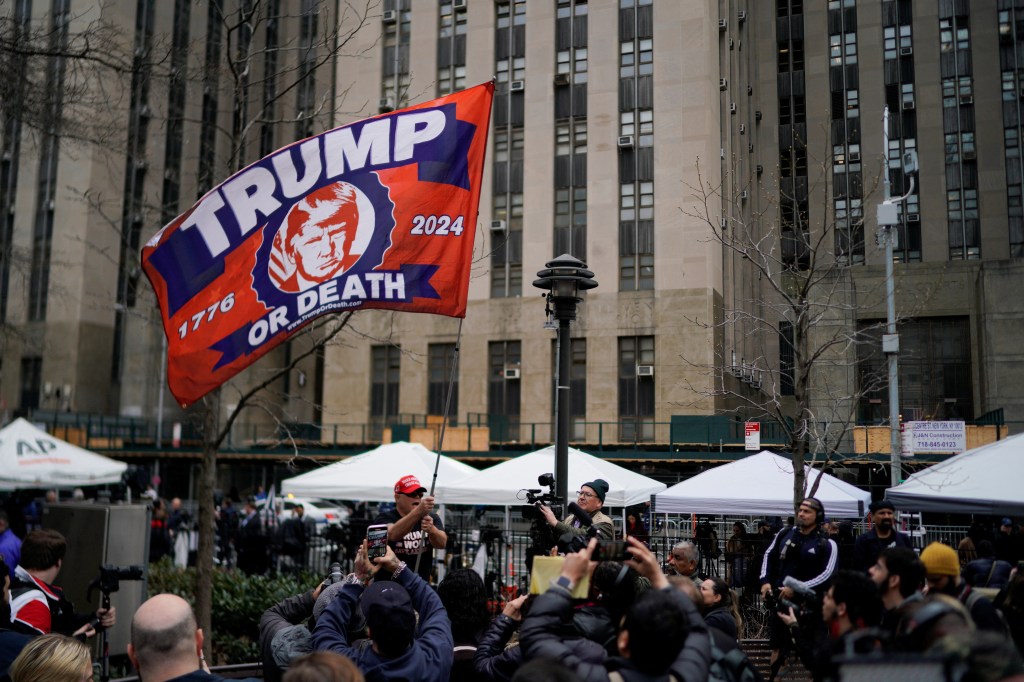
Donald J. Trump, 45th President of the United States, was found guilty in New York state court on Thursday, May 30, 2024 of thirty-four felony counts of falsifying business records. His sentencing is set for July 11, 2024. He will no doubt appeal the ruling, but for now journalists can say without fear of libel charges that Trump is a convicted felon, indeed the first current or former President of the United States to be convicted of a felony.
I not only have a thought about this historic moment, but I have three. In no particular order, they are:
1.
I am glad he was convicted. So glad. I mean, the guy is so transparently guilty, not only of this but of virtually everything else he is accused of doing. And yet I really have no profound appetite to see Trump go to prison, for the simple reason that I have no real appetite to see anyone go to prison. I am still thinking over whether I am a prison abolitionist, full stop, but I am pretty close to it. The vast majority of people in prison simply shouldn’t be there, not because they are all innocent of any wrongdoing, although there are plenty of literally innocent people in prison, and plenty more who are in prison for things that should have never been illegal, like possession of marijuana. (Not to mention the people who are in prison for far longer than they should be due to their race, due to mandatory minimum sentencing regimes, due to overcharging and the crushing pressure on criminal defendants to accept plea bargains.) Even for people who have done unquestionably bad things, though, prison, especially the way we do it in the US, doesn’t reduce crime in my view so much as it redistributes it inequitably, mostly along all-too-familiar lines of class and race.
I understand the urge to gloat in seeing Trump, a man whose social commentary started with calling for innocent nonwhite teenagers, the Central Park Five, to be jailed for crimes they didn’t commit, a man who heads the “law and order” party in US politics despite being a transparent fraud, brought to justice by the very carceral state he longs to weaponize against, well, seventy-five percent of the country. But dislike and schadenfreude are, last I checked, not sufficient reasons for incarcerating someone. Nor are they sufficient reason for forgetting whatever other principles one might claim to espouse in calmer moments.
I don’t want anyone to mistake what I am saying as in any way entailing that I sympathize with Trump’s political aims. Far from it. What I really want is for Trump, and for that matter every last one of his fellow travelers, to be kept well away from the levers of political power, now and henceforth. Trump would just be one of US politics’ oddballs, a punchline like Ross Perot or RFK Jr., if it weren’t for the large swath of white Christian nationalists in the Republican Party who decided that he was their man. That white Christian nationalism has deep roots; arguably they reach all the way back to the nation’s founding.[1] Putting Trump in jail won’t pull his political movement up by the roots. It might temporarily impair Trump’s ability to serve as its rallying point. But it won’t even bar him from running for President in 2024!
Republicans in the Senate could have removed Trump’s hands from the levers of power if they had just voted to convict him on impeachment charges after the January 6 insurrection. But they failed to do so out of sheer, craven cowardice, out of their desire to keep their offices at all costs even if it meant placating the very people who stormed the Capitol building with dreams of summarily executing the Vice-President of the United States if he would not abdicate his Constitutional responsibilities. The criminal justice system cannot erase that political dereliction.
2.
Trump’s influence over US politics is, above all else, infantilizing. This infantilizing influence not only affects his supporters, but also his most vociferous enemies. US politics did not need Trump, though, to be juvenile. American exceptionalism, an attitude by no means limited to Trump supporters, is an invitation to perpetual, self-obsessed political adolescence, of the belief that what happens here is utterly unlike what happens elsewhere. There’s also the fact that our putatively “democratic” politics is, as a structural matter, not only barely democratic from the standpoint of any functional concept of democracy, but our most vehement latter-day public defenders of so-called “democratic norms” seem to lose little sleep over this situation. “Democracy” in the US seems to be a matter of which team we most trust to maintain the largely insulated self-running machine of neoliberal technocratic institutions. On the one hand, there is the team, the Republicans, who delights in the inequities and opportunities for cruelty inherent in our form of government and seek to amplify them, and on the other, the Democrats, who at least have the taste to be ashamed of them and just hide the very same cruelty under a smiling cloak of secrecy and talk of dealing with “unpleasant duties.” So much of US politics is political kayfabe designed to fill the vacuum left by the fact that the scope of political choice available to the public is so thoroughly constrained.[2] Trump, the former wrestling performer, is a master of this exploitative kayfabe, but again, he didn’t invent it. He just has the best instincts for exploiting it, for keeping our politics juvenile, the equivalent of a Marvel movie.
Perhaps it’s overly idealistic for me to say this, but my hope is that having a former President convicted of a felony will strike a blow, however, small, for political maturity in the United States. It’s actually fairly common for current or former heads of state to be prosecuted of crimes in their countries. Americans look at this fact and often their first instinct is to conclude that our system is superior to theirs—look at all that chaos, all that recrimination! Surely we are above all that! USA! USA! USA!—except that we shouldn’t be, since prosecutions of criminal political leaders is, or can be, an occasion for political honesty that is sorely lacking here. The “political norms” of gentility and decorum so prized by the Democrats have, from where I sit, barred us from a honest reckoning with the crimes of our political class, from Ford’s pardon of Nixon to the rampant war crimes and crimes against humanity of the Bush 43 administration. (Not to mention the Biden administration’s continuing to arm the right-wing nationalist government of Israel to pursue ostensible genocide against the Palestinians of Gaza and the West Bank, even going to far as to falsify the findings of its own bureaucracy in order to justify continued arms shipments in violation of its own stated policy.)
3.
I hope that Trump’s inevitable appeal of his conviction proceeds quickly. There is a compelling public interest for expediting the appeal. No matter what you think or feel about Trump, the public needs to know whether one of the two major candidates for President of the United States is going to have a felony conviction that will prove durable after appeals are exhausted.
Let’s keep it moving, folks.
Photo Credit: Eduardo Munoz, Reuters
[1] Historian Gerald Horne, in his book The Counter-Revolution of 1776: Slave Resistance and the Origins of the United States of America (NYU Press, 2014) makes the provocative argument that the American Revolution was in essence a counter-revolution, a revolution of colonists whose economy was founded on chattel slavery to preserve the system against Britain, which by the 1770’s had tired of the indignities and contradictions its creation of the slave economy of the American continent and the Caribbean had unleashed and were moving to put the slave trade, its lifeblood, to an end. A running theme of Horne’s analysis is to try to answer the question of how a group as diverse and fractious in its interests and temperaments as the colonists of the United States managed to develop sufficient solidarity and political will to break away from Britain. Horne identifies whiteness as the key to this solidarity. “Whiteness,” over against the blackness of the continent’s vast and threatening slave population, became between 1688 and 1776 a way for colonists eager to continue with the slave economy as it existed to paper over the divergent interests of merchants and plantation owners, religious Protestants of varying confessions and “free-thinkers,” and more besides. Horne (see e.g. Counter-Revolution, p. 166) even tantalizingly suggests that the early origins of religious freedom in Rhode Island and elsewhere in the colonies were just the other side of the coin of this project of white solidarity: the project of whiteness required that the intra-religious squabbles of the Old World be put aside in the name of white unity against revolts of the enslaved—the very enslaved that Rhode Island and other colonies brought to the continent en masse to fuel the slave economy’s productivity and its greed. The project of “whiteness” did not have to turn out like it did—the category sought to paper over profound differences of nationality, class, and religion—but the American Revolution is, in Horne’s account, what cemented its triumph as an organizing principle of American society.
[2] I need to point out here that what I am calling “political theater” here, unlike pro wrestling kayfabe, has real victims who undergo serious harms, even to the point of literal death. The evolving “wedge issues” that the Right in the US seeks to exploit are the best example of this. In the 1980’s through the 2000’s cis gays and lesbians were made into the wedge issue in ways that contributed to their financial, social, and psychological harm, and even their literal death (e.g. the AIDS epidemic). Now that social acceptance of cis gays and lesbians has increased to levels where overt homophobes are on the defensive, the wedge issue is now transgender adults and children. It makes a difference to trans folk who you vote for in November, make no mistake. But it makes a difference not because the right in the US really has some principle at stake in reinforcing pseudobiological theories of gender, but because they think trans folk are so contemptible to respectable opinion that they see a political opportunity in forcing their opponents to choose between their humanity and their desire to remain within the bounds of respectable opinion. When trans folk become more socially understood and accepted, the right will move on to someone else. Until then, though, trans folk will be the most vulnerable, exposed victims of the political ploy, of the theatrical performance in which they are made to perform for the benefit of others. What I am calling “political maturity” here does not entail ignoring these fact; it entails recognizing them, insisting on the validity and importance of trans experience and identity, and bringing trans folk into the overall political conversation.
 Thought Required; Pants Optional.
Leave a comment