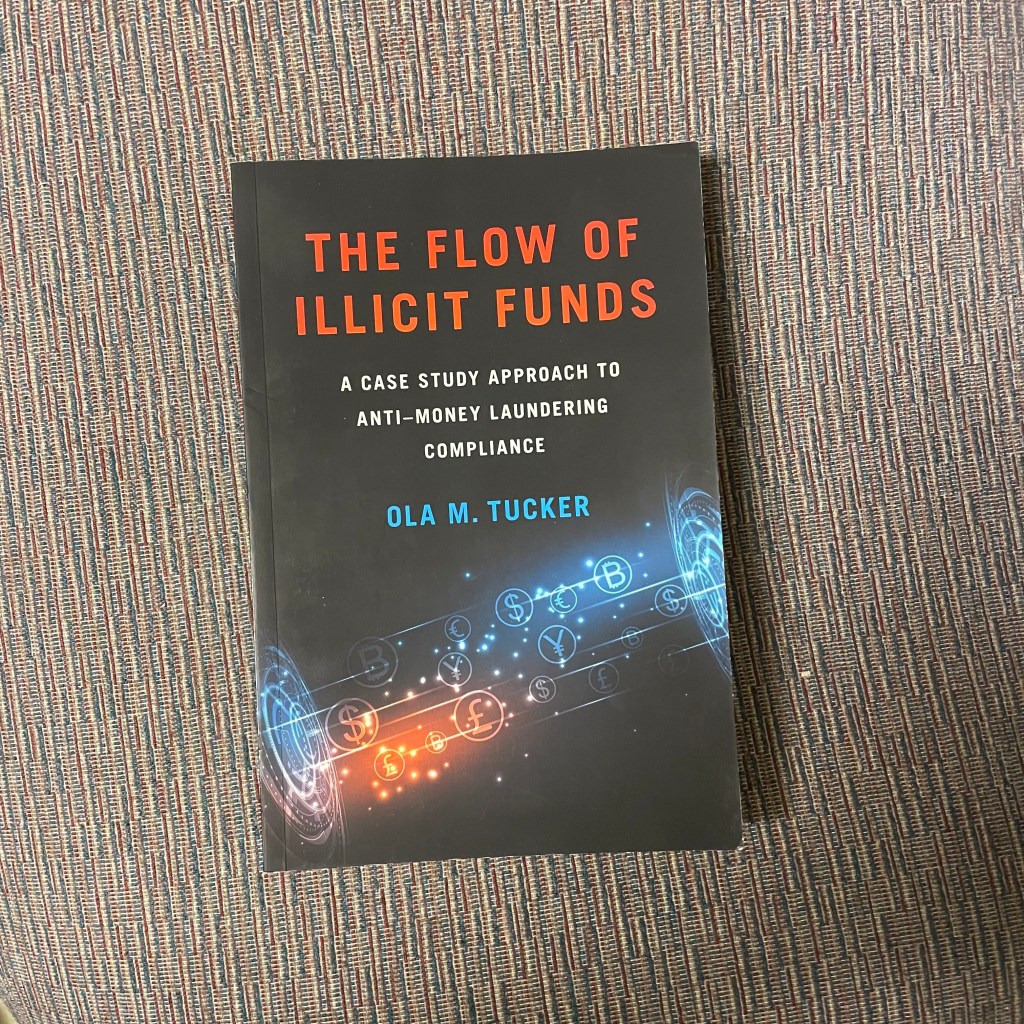
Tucker, Ola M. The Flow of Illicit Funds: A Case Study Approach to Anti-Money Laundering Compliance. Washington, DC: Georgetown University Press, 2022.
I read this book partly because it is tangentially related to my work, partly out of genuine curiosity. It is probably as good a general introduction to the subject as one is likely to find and is informative without being overly technical. It is geared towards compliance professionals at financial institutions whose job it is to try and spot transactions that may be related to money laundering; it certainly isn’t a how-to manual for doing money laundering.
The book is billed as a “case study approach.” The “case studies,” though, are really brief illustrations of concepts the author first explains abstractly and they do not fundamentally drive the discussion. In this respect the case studies are nowhere nearly as substantial as those one encounters in, say, medical ethics literature. If you are looking for detailed, concrete examinations of money laundering schemes and how they were detected and unraveled, this book could be disappointing.
I don’t work in compliance for a financial institution, so I can’t speak to how well this book succeeds in providing such professionals with tools for spotting signs of money laundering in the wild. I dare say that it is at least helpful on that score. As a general reader who is just curious about money laundering and its role in the global financial system, though, it makes for depressing reading. Tucker relates that at most 1% of money laundering activity is detected and interdicted. The overall picture she paints is of dedicated bank compliance officers valiantly bailing out the ocean with teaspoons.
Part of the problem is that money laundering in most cases greatly resembles what wealthy individuals do with their money on a regular basis. Many of the techniques used by money launderers, especially by the ones who launder a lot of money, are not inherently unlawful. What that means is that many of Tucker’s suggestions for how to combat money laundering involve suggestions for statutory, regulatory, or financial institution policy change. These calls for change were probably quixotic in 2022 when the book was written, but now that Trump is in the White House in the United States the US has either frozen steps for change in this area or taken decisive steps backward.
Take, for instance, beneficial ownership registration for anonymous shell corporations. One of Tucker’s policy suggestions, and one which has been implemented in jurisdictions outside the US, is the maintenance of a registry of “beneficial owners” of anonymously incorporated business entities. These are just the sort of entities that are useful to money laundering operations, since it is difficult to trace the entities back to a specific individual or group of individuals. A beneficial ownership registry would require all corporate entities to register a “beneficial owner”—that is, a natural person or persons who benefit from the enterprise. The registry would not be viewable by the public, but it would be accessible to law enforcement and to financial institutions for the performance of due diligence and compliance (especially for compliance with government sanctions).
During the Biden Administration, the U.S. Treasury Department’s Financial Crimes Enforcement Network (FinCEN) enacted just such a beneficial ownership registry (the “BOI Registry”). In fact, it came within a hair’s breadth of becoming a requirement for all domestic business entities. (I know this because in December 2024 I was preparing to assist my employer in filing its registration with the BOI Registry.) But once Trump took office, all bets were off. It announced to the public in February 2025 that it would not issue fines or penalties for entities that failed to comply, and then in March it announced that it would remove the requirement entirely for U.S. companies and U.S. persons. (In the name of “reducing regulatory burdens,” naturally.) Foreign corporations doing business in the U.S. still have to comply, but that won’t stop money launderers: if you can get the money into the U.S., the U.S. remains a very friendly environment for multiple stages of the money laundering process. It’s almost as if Trump wants it that way.
Which he undoubtedly does. More than one of the case studies discusses the role of Deutsche Bank as a serial money-laundering recidivist. This book describes the role of Deutsche Bank in enabling Jeffrey Epstein’s human trafficking operation, and Deutsche Bank comes up again and again as a major bank with a lax view of its due diligence and compliance obligations. It is probably no coincidence that Deutsche has for years played the role of lender of last resort for the perennially messy operations of Donald Trump himself.
There are echoes in this book of other efforts Trump II has made to bring the US in line with other countries where public corruption, and its associated money laundering, is endemic. Tucker, for example, discusses the role that “pay for citizenship” schemes in countries with lax financial regulatory environments play in money laundering schemes. As has been widely reported, Trump II has instituted just such a scheme, the “Gold Card,” here in the U.S. (Not coincidentally, a foreign national purchasing the “Gold Card” would likely also purchase an exemption to registering their business entities with FinCEN’s BOI Registry. It’s a wealthy money launderer’s dream.)
Tucker herself opines in the final chapter that the sheer scale of money laundering is such that the largest banks in the world may not be able to survive without it. Tucker is clear-headed enough to realize that combating money laundering effectively will require a truly global commitment to transparency and accountability; otherwise launderers will simply retreat to jurisdictions with lax oversight and entrenched regimes of privacy. We do not yet live in such a world, and since this book was published in 2022, the United States under Trump has committed itself to making such a world much harder to realize.
 Thought Required; Pants Optional.
Leave a comment