Blog Posts

  • Absence and the Heart

    20130228-232853.jpg

    Day 14 of Lent

    My son is on vacation with his mother this week. I miss him terribly. I have all this extra free time to myself, but all I seem to be doing with it is feeling tired. So, in lieu of a substantive post, I am posting a picture of him on his first day of kindergarten.

    Back tomorrow. Good night, everybody.

  • Playing Dice With the World

    Playing Dice With the World

    Photo Credit: Curtis Gregory Perry via Compfight cc

    Day 13 of Lent

    I am slowly working my way through Howard Zinn’s People’s History of the United States. It is powerful and sobering reading from the very beginning, in which he catalogs the greed and merciless cruelty that drove European colonizers to perpetrate genocide on the indigenous populations of the Americas. Zinn’s book is even more powerful in light of the fact that he reflects deliberately on his method. Rather than focusing on the official actions of states and of the powerful– the kind of history written by history’s “victors”–Zinn attempts to write history from the perspective of those who, in any particular time, are the most disadvantaged by it. Zinn makes clear that he is not engaging in gory spectacle simply for the sake of it, and in doing so says one of the most insightful things I have read in a long time:

    My point is not to grieve for the victims and denounce the executioners. Those tears, that anger, cast into the past, deplete our moral energy for the present. And the lines are not always clear. In the long run, the oppressor is also a victim. In the short run (and so far, human history has consisted only of short runs), the victims, themselves desperate and tainted with the culture that oppresses them, turn on other victims.

    The past two weeks have been a virtual pageant of privileged people arguing, over the protests of oppressed peoples, that everything is just fine, that they deserve all of the privilege that they have, that the only thing holding them back is themselves.

    There is the army of white people lining up to tell nine-year-old Quvenzhané Wallis that she should totally be OK with being called a “c**t” because, well, it would help them be ironic and subversive. (Ignoring, of course, that they aren’t nine years old, and black, and members of a group who is routinely hypersexualized in a way that white folk are not. AND NINE YEARS OLD. Did I mention that part?)

    There is Antonin Scalia telling racial minorities in states where Republicans routinely target their voting rights, “It’s 2013 already! Haven’t we done enough for you people already? What more do you want?”

    There is the obsession in the LGBTQ community with same-gender marriage as the exclusive focus of activism and commentary, which is often accompanied by an attempt to keep restive folk in line who disturb the narrative– queer folk who have no use for marriage, trans* folks who struggle to have their gender identities recognized and routinely struggle with threats of violence that cisgender gays and lesbians have an easier time avoiding.

    I can understand why oppressed people, “themselves desperate and tainted with the culture that oppresses them, turn on other victims.” A profound vein runs deep through American culture that only lets us feel good about ourselves if we can look at someone else who has it worse, compare ourselves to them, and then tell ourselves a story in which we deserve to have it better than they do. Those stories abound:

    “I have obviously worked harder than they have.”

    “No one gave me anything on a silver platter. I worked for what I have. And yet [INSERT OTHER GROUP HERE] get handouts.”

    “Oh, I am not like those people. I am just like the good people, except for harmless differences that we “good” people claim to be blind to anyway. I’m not [insert word here–promiscuous, unmarried, etc.]”

    I think that lots of people, myself included, have a deep-seated need to feel like what happens to them has something to do with what we deserve. Given the history of the United States, which has barely woken up from a past in which white folks were given an explicit legal and institutional leg up, merit and desert are a special preoccupation of white folks. We are haunted by the need to assert and prove that we deserve what we have.

    Usually, we frame the alternative to getting what we deserve as a matter of luck: Either we have good luck, like winning the lottery or being born attractive, or we have bad luck, like getting caught in a hurricane. In either case, the luck in question doesn’t upset our sense of morality, it merely impacts it from without; the universe grants us a tremendous windfall or an underserved setback. It disturbs us enough, though, to force us to try to domesticate it within the moral order of things by either clinging to being good, honest people despite the windfall or the setback and to convince ourselves that we are worthy of the good luck or undeserving of the bad.

    Most attributions of moral desert are distorted by the fact that they don’t take into account the extent to which our options are structured by power relations over which we lack control. Moral desert is tied to notions of autonomy and individual responsibility, but the field of options in which the individual finds herself are not within her control. In fact, they are far less within her control than we ordinarily would like to acknowledge. Above I referenced the legacy of institutional racism in the United States, a legacy that is still with us, Antonin Scalia’s protestations notwithstanding.

    But the distortions are just as much about present reality as historical legacy. I read something a few days ago that drove this point home for me. In a recent Rolling Stone article, “Gangster Bankers: Too Big to Jail,” Matt Taibbi discusses how representatives of HSBC, one of the largest banks in the world, spent about a decade laundering money for murderous drug cartels and named terrorist organizations. Taibbi isn’t making this up or overstating it; the U.S. Department of Justice has discovered ample evidence of this, and HSBC itself has essentially owned up to all of the conduct alleged.

    If HSBC were a country (it could be– it has greater wealth than a lot of countries), its conduct would undoubtedly earn it a reputation as a rogue or failed state. The discussion about it in the respectable developed democracies would center on whether to punish it with sanctions or to declare war on it and install a better regime. But HSBC is a multinational bank– transnational, arguably– and so the U.S Department of Justice determined that it was not only “too big to fail,” but also too big to prosecute, so powerful and so interwoven into human life in the 21st century that to hold it accountable for its actions would threaten to destabilize the world. The individuals responsible for HSBC’s crimes currently enjoy the inscrutable privilege of de facto immunity from prosecution.

    Even more thoroughgoing is the effort by UBS, the Royal Bank of Scotland, Barclays Bank, and others to collude to manipulate LIBOR, the interest rate at which banks lend one another money, to make their own institutions appear healthier than they were and therefore to make them more money. As Taibbi puts it:

    There is nobody anywhere growing weed strong enough to help the human mind grasp the enormity of this crime. It’s a conspiracy so massive that the lawyers who are suing the banks are having an extremely difficult time figuring out how to calculate the damage.

    British regulators released a cache of disgusting e-mails showing traders from many different banks cheerfully monkeying around with your credit-card bills, your mortgage rates, your tax bill, your IRA account, etc., so that they could make out better on some sordid trade they had on that day. In one case, a trader from an unnamed bank sent an e-mail to a Barclays trader thanking him for helping to fix interest rates and promising a kickass bottle of bubbly for his efforts: 

    “Dude. I owe you big time! Come over one day after work, and I’m opening a bottle of Bollinger.”

    Now that is privilege. The financial system structures everyone’s options in ways that most of us only dimly understand: The availability of credit, the actual cost of what we do, and who pays higher costs in life than others. There is this story that people pay high costs because they deserve to– because they behave in risky ways, because they don’t work hard enough, because they aren’t good enough– when in reality what they pay may depend on nothing more than some asshole who fudges a number to get a nice bottle of champagne. And states have declared themselves essentially powerless to bring banks within the purview of the ideals of justice and fairness they claim to safeguard.

    What is the conclusion here? It is just that to some degree, anyone who is likely to read what I am writing is in some sense a victim of late capitalism. There are transformations afoot that may not be the enlightened technological utopia of “world-is-flat” boosterism. Take, as an example, the eerily similar changes taking place in the old “professions”: law, ministry, medicine, and the professoriate. The war that capital has waged against labor for the past thirty years is now at the doorstep of this educated professional class, and the professional class obviously didn’t see it coming. From the academy’s increasing reliance on adjunct labor and business-style management, to “two-tiered” systems in the legal profession, to the increasing scarcity of full-time jobs in ministry, the old-style professions are being reorganized in novel ways.

    As in any time of fluidity and relative chaos, there are people in all of these areas that tout themselves as providing a creative way forward, as perhaps having the creative way forward. Yet what still hasn’t come about, as far as I can tell, is an awareness that these reorganizations, and the creative solutions people offer to them, are structured by trends that are bigger than individuals’ vice and virtue. They are structured instead by a deeper logic, one that systematically “prices up” secure professional work, prices down young professional and paraprofessional work, and directs increased profit upwards to the management class.

    And yet, those who find themselves disadvantaged by this deeper logic often crave the approval of those who are advantaged by it. They seek to prove themselves worthy, to demonstrate their good citizenship and their virtue. Yet they do this, not by reimagining and recasting good citizenship and virtue, but instead by, in Zinn’s phrase, “turning on other victims.”

    Einstein famously said of quantum theory that he didn’t think that God played dice with the world. Yet the powerful and privileged play dice with the social world with gleeful abandon. In the face of that reality, we can curry favor with the powerful and the privileged and hope they will have mercy on us if the roll of the die disfavors us. Or, we can stand in solidarity with the oppressed, with those who figured out a long time ago that the dice seem suspiciously loaded, in the name of a nagging suspicion that the game of the privileged and powerful is not worth playing, using whatever power and privilege we have to pursue a justice that doesn’t depend on the roll of power’s dice.

  • Good News, and a Plea for Feedback

    Good News, and a Plea for Feedback

    Photo: “Baal, El, Yahweh, and ‘His Asherah.’ Photo from Othmar Keel and Christoph Uehlinger, Gods, Goddesses, and Images of God in Ancient Israel. Minneapolis. Fortress Press. 1998, pp. 225-226.

    Day 11 of Lent

    I took the night off from blogging last night. I was exhausted, mentally and emotionally, and so I spent the evening in bed intermittently checking my Twitter feed for Oscars commentary (I wasn’t watching). I take solace in the fact that technically, Sundays aren’t part of Lent, so I haven’t broken my vow really. (That is my story and I am sticking to it.)

    So much has happened in the past couple of days that I couldn’t possibly hope to comment adequately on it all here. The biggest thing was the pageant of misogyny and racism known as this year’s Oscars, together with The Onion’s vile tweet during the telecast in which they “satirically” referred to nine-year-old Quvenzhané Wallis as a “c**t.” The Onion’s CEO apologized the morning after on the site’s Facebook page. However, the damage was done, and it became yet another instance over which familiar battle lines were drawn between people who find oppression and privilege objectionable, especially when it results in slurs being directed at nine-year-old girls, and those who think that “Hey it’s just a joke, it’s just comedy” gives them a blank check to assert whatever privileges they want. It was depressing, and disturbing, and by about midday today I was feeling tired and exhausted by the whole affair.

    Shortly after that, though, I received a rare bit of unambiguously wonderful news. I am excited to announce that I have been asked to teach a religious studies seminar this fall titled “Topics in Gender and Religion.” I am terribly excited! As long as the class makes enrollment, I will have an opportunity to teach about and discuss things I have been thinking and reading about pretty constantly for the last eighteen months or so.

    I would, however, appreciate some feedback from you if you would be so kind as to give me some. If you were taking a course on gender and religion, or teaching one, which topics would you want to discuss, and which books and papers would you want to read? I have my own ideas, of course, but I am curious about the sorts of things you would think worthwhile to include in an upper-level undergraduate seminar on gender and religion. I find it extremely helpful to step away from whatever assumptions I have about what I am inclined to do and hear what others would do.

    So, if you have thoughts, please leave me a comment! I would be most excited to hear what you think. In the meantime, expect more substantive posts, on this and other subjects, starting tomorrow.

  • RE: Bucket List (Revised) 02 23 13

    RE: Bucket List (Revised) 02 23 13

    Day 10 of Lent

    Dear Lifestyle Overlords,

    In reviewing my bucket list, which I last updated in September of 2011, I noticed that it needs some updating. It would be remiss of me not to be prepared to spring into immediate action in the event of my imminent death. I want to stand before your judgment seat in the vast halls of Hades with the ability to say in good faith that I attempted to cram my earthly existence as full as possible of random middlebrow achievements.

    My new list is below, with changes clearly marked. Please comment as necessary.

    1. Learn Attic Greek.
    2. Write a novel, preferably one that hasn’t already been written.
    3. Travel the Continent; learn what the heart is and what it feels.
    4. Learn to play the harpsichord sackbut.
    5. Give each and every one of you everyone except Larry Johanssen of 513 Ardmore Way, Alexandria, Virginia a great big hug and ask you to borrow $5 $7.19 due to inflation.
    6. Perform The Rolling Stones’ “Street Fighting Man” to a crowd of no less than 6,000 people.
    7. Wear a shirt that has been ironed.
    8. Burn down something, anything.
    9. Club several people upside the head with an extra-large, extra-heavy copy of Edward Said’s Orientalism.
    10. Sit at last above the surface of the earth, the sun shining brightly upon my face, serene in the knowledge that all is very well, and to abide in that moment. Then, to bask in the glory of having led the C.H.U.D.s to victory over all of you.
    11. Twelve bags of Doritos, a hotel room, and no questions asked.
    12. Finish bucket list.

    Best,

    Brian Cubbage


  • The Subtle Chemistry of Relationship

    The Subtle Chemistry of Relationship

    Photo Credit: everyone’s idle via Compfight cc

    Day 9 of Lent

    Tonight is another one of those nights when it is very difficult to keep up with this daily blogging vow. It has been a long day: A full day of work, followed by an evening with family, followed by getting my son in bed. This Lenten discipline is beginning to teach me why I sometimes go one or two months without writing much of anything at all. I am tired, but I am content.

    As my wild Friday night at home of watching cartoons and telling silly stories with my son drifts to a close, I am reflecting on several experiences I have had this week that have reinforced in my mind the importance of the “queer” label I use to identify myself. More and more I am convinced that, despite its vagueness (and perhaps because of it), it captures my experience better than any of the alternatives.

    A number of social scripts exist for life outside heteronormative gender and sexual norms. Some of these scripts trade on negative stereotypes; others are tied closely to the lives and stories of self-identified gays and lesbians, especially as gays and lesbians have gained greater social acceptance in the USA and elsewhere in the course of my lifetime.

    In some ways this makes sense. It strikes me that the emerging narrative around gays and lesbians, from the struggle for marriage equality to the rallying cry of “born this way,” is that gays and lesbians are like straight folk, just pointed in different directions. This isn’t to say that all gays and lesbians are the same. Just as there are many, many ways to be straight, there are many ways to be gay or lesbian; those who claim those identities resist tidy generalization. But the way they function as identities and as forms of relatedness seems to be very much the same. “Straight,” “gay” and “lesbian” seem to name stable, fixed dispositions, innate or formed very early in life, to relate emotionally and sexually to people of the opposite or same gender. The forms and patterns of relatedness are similar, just directed towards different characteristic objects. Bisexuality frequently gets cast in this same mold: as a fixed, stable disposition to form relationships with men or women.

    My own experience of relatedness, though, feels more fluid and diffuse than can be captured within the notion of a stable, fixed disposition. When I quantify over the entirety of my experience, I can say that I have felt related to both women and men. But it isn’t as if there has been any given time of my life when I have been disposed to relate to both women and men equally. I can reflect back on times in my life when I have been more attracted to women and times when I have been more attracted to men. I have known many people who have experienced this kind of fluidity over time in their patterns of attraction and relationship. Some of them identify as “gay” or “lesbian,” but make it clear that the time they spent in relationships with people of the opposite gender was based on genuine attraction.

    Another way that the notion of sexual orientation as a fixed, stable disposition feels confining to me is that it tends to isolate sexual and emotional attraction from the remainder of a person’s overall psychic life: the prevailing gender norms, the individual’s social location, effects of race and class, and still others. Just as chemical reactions take place under conditions that can expedite or impede them, attraction and relatedness happen in social conditions that either foster them, slow them down, or in some cases deprive them of some necessary ingredient and block them entirely. The identities we claim for ourselves help us steer ourselves through our lives like rudders, but the realities through which we steer can be fluid and shifting, as conducive to reactivity as a strong acid or as inert as water.

    For me, calling myself “queer” is my way of owning that fluidity in attraction and relationship and admitting that I am in it and it is in me. Rather than trying to analyze it under controlled conditions in a laboratory, isolating some facet of it in my life and identifying exclusively with it, I am trying to reflect upon the reality of it in my life in all of its complex, subtle lived chemistry. Describing it is a hard task; I still do not think I have found a language that describes my experience very well. Some of that is due to my own dim-wittedness, but some of it is due, I think, to the fact that as a culture we still have an impoverished understanding of gender and sexuality.

    Lots of good people, though, are struggling to change that. In the conversations I have with people, and the public discussions I witness, I am thankful for folks who include and take seriously the “Q” in “LGBTQ.” When people take the time to include explicitly queer-identified folk like me in their discussions and honor our experiences as being a legitimate part of the overall discussion of gender and sexuality, I notice. We queer folk have our own role to play in reflecting upon the subtle chemistry of human relationship.

  • Girl Scout Cookies of Resistance!

    Girl Scout Cookies of Resistance!

    Photo Credit: MoHotta18 via Compfight cc

    See updates below.

    Day 8 of Lent

    I was chatting with my dearest friend earlier about my Lenten blogging discipline and how this was the first day where writing was truly difficult. I am exhausted, and I have little coherent to say. I am out of fancy ideas and well-turned phrases.

    “Could you tell me what to write?” I asked.

    Without missing a beat, my friend asked, “What is your favorite Girl Scout cookie?”

    “Whatever Samoas are called now. Caramel Delites, I think.”

    “Then write about those.”

    So I am writing about Caramel Delites.

    I would feel more inspired if I actually had some right now– alas, I don’t– but I can also work from memory. I have eaten a lot of Caramel Delites. A lot of them. Generally I buy between three and five boxes every year. I then proceed to consume them at the rate of one box per day until they are gone. Usually I eat all but one or two of the cookies in the box in one sitting. I refrain from finishing the entire box, not because I am sated, but because I cannot quite admit to myself that I am capable of eating an entire box of Caramel Delites in one sitting.

    I then return an hour or two later and finish off the one or two remaining cookies in the box, patting myself on the back for eating such a small, sensible snack. Perhaps the secret ingredient is self-deception.

    Girl Scout cookies have been with me for about as long as I can remember. When I was a very young child, both of my older sisters were Girl Scouts, and my mother was a troop leader (I think that this was what it was called). My house was also the place where the delivery truck dropped the entire troop’s cookies. Once a year, our sitting room would fill with case upon case of cookies. My sisters and I would constantly rearrange them and build forts and bridges out of them. I have fond memories of those cookies.

    So much has changed about my life since then. My family moved out of the house with the cookie-filled sitting room almost thirty years ago. I have grown up to live in a world I would barely have recognized. I was a finicky eater as a child; now I am a vegetarian and eat things on a regular basis that my childhood self would have deemed a cruel punishment. But the cookies: the cookies have always been there. And the Caramel Delites– the Samoas of my childhood– are still my favorite.

    It comforts me to know that Girl Scout cookies, and the Girl Scouts, still exist. Their message of empowering girls, embracing their individuality and diversity, and encouraging independence, leadership, and self-esteem is as necessary now as it ever has been. The world still lines up to tell girls that they should feel uncomfortable inside their own bodies, that they aren’t capable of managing their own lives without the help of men. The Girl Scouts say otherwise.

    It is this very witness to the inherent worth and gifts of girls that has recently garnered them vitriolic criticism from conservative politicians and flacks. I think about these criticisms, and then I think about the Girl Scouts I know. My dear friend who suggested that I write this post is a Girl Scout. My sisters–both of them capable, strong, dedicated women–are Girl Scouts. These folks seem to want a country in which women like my sisters and my friend don’t exist. I don’t take such a suggestion well. At all.

    If Girl Scout cookies can help girls develop into women like my friend and my sisters, despite the forces that would hold them back, I will raise a cookie–or an entire box, or ten– to that.

    UPDATE 1: Friday, February 22 was World Thinking Day, an annual event when Girl Scouts and Girl Guides worldwide. This year’s theme is the reduction of child mortality rates worldwide. You can find more information at the link.

    UPDATE 2: Friends and family have pointed out that the caramel, coconut and chocolate cookies I so adore are still called Samoas in some regions of the country. The cookie names vary in some regions depending on the regional bakery that makes them.

  • Fairness Rally Day

    Fairness Rally Day

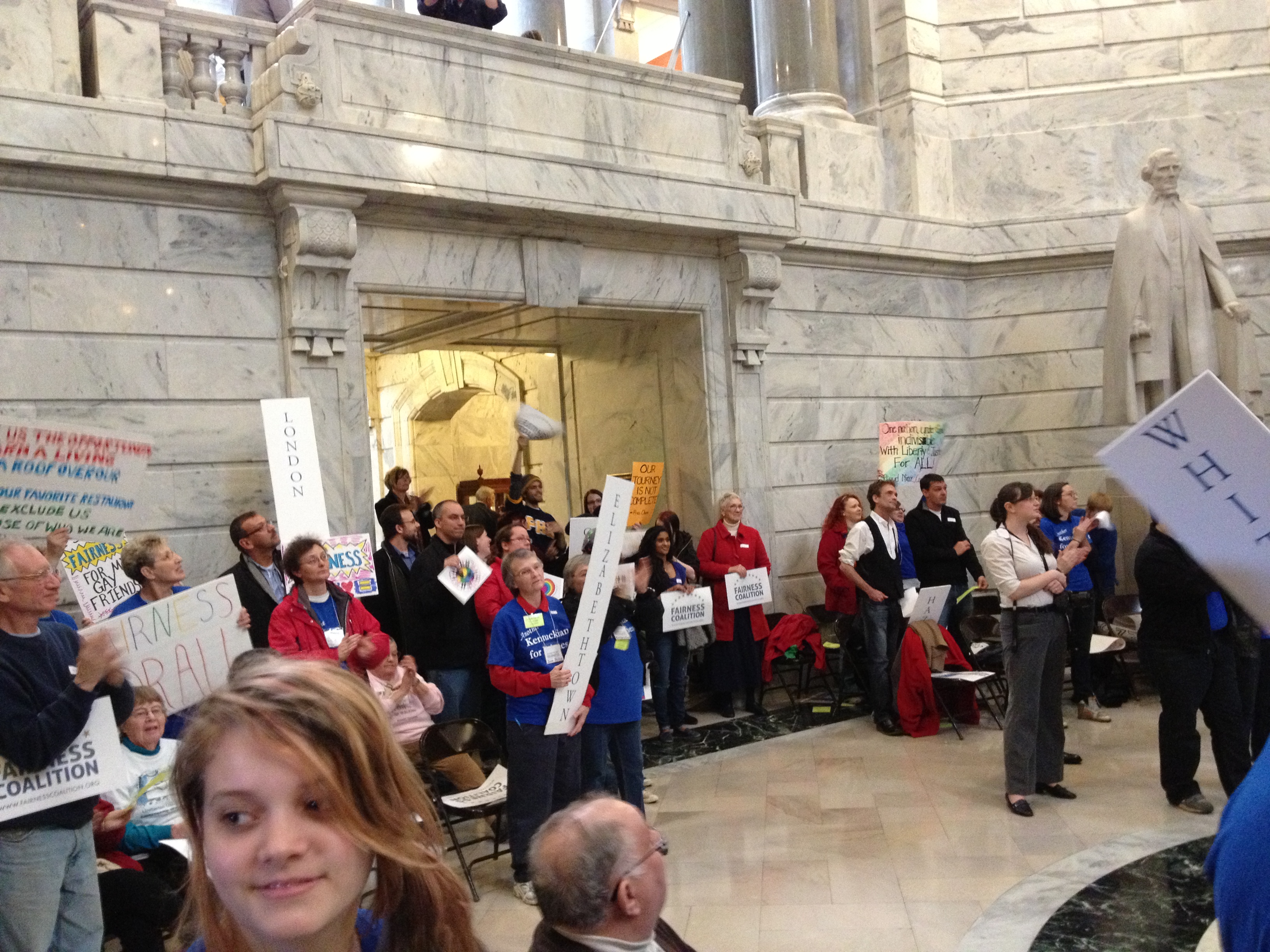
    Photo: The Rotunda of the Capitol Building in Frankfort, Kentucky. This photo and all others by the author.

    Day 7 of Lent

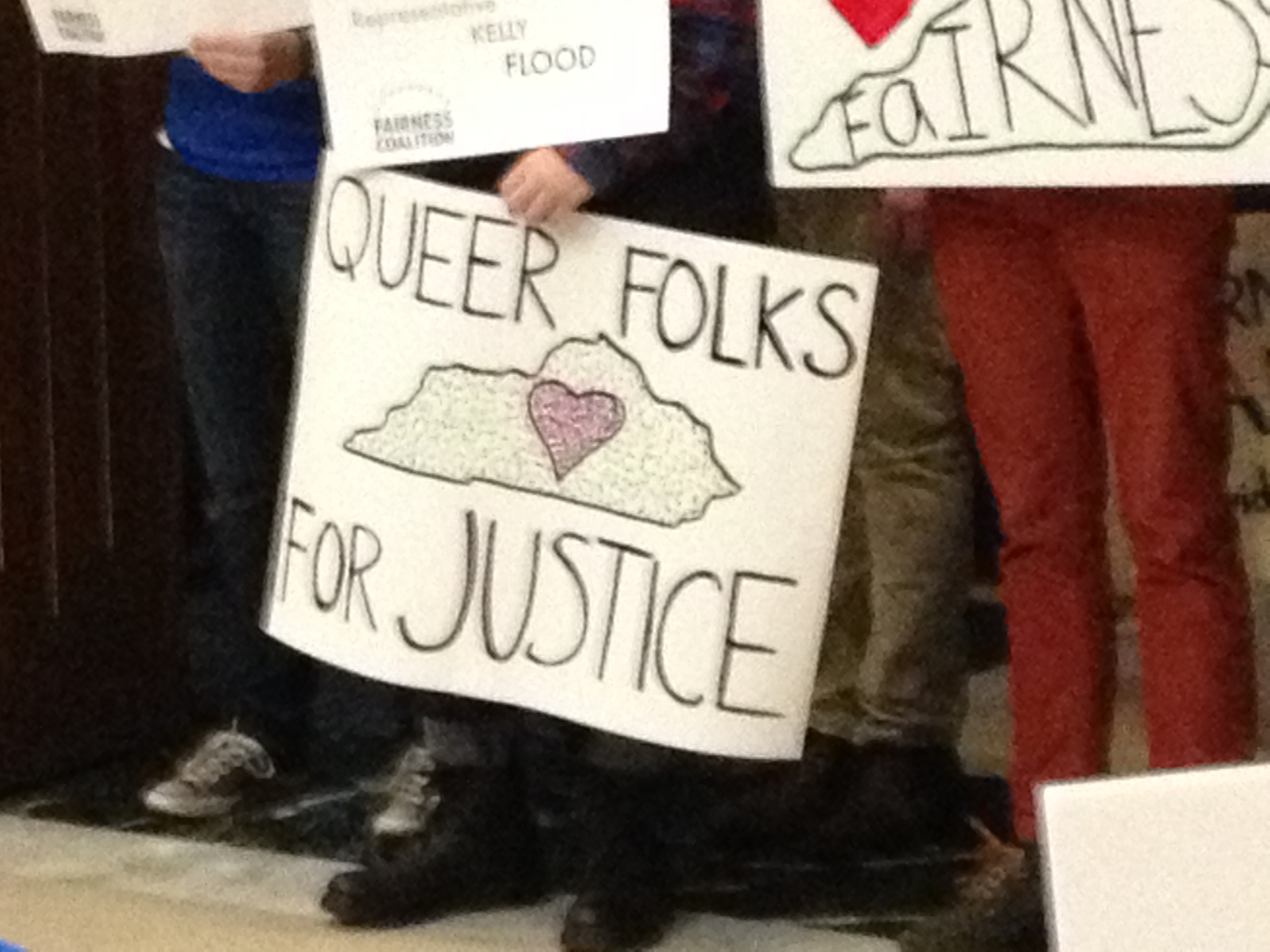
    Today I went to the annual Rally Day for the statewide Fairness Law in Frankfort, Kentucky’s state capital. The Rally Day is a citizen lobbying event sponsored yearly by the Fairness Coalition, which consists of the Fairness Campaign of Louisville, its allied organization Kentucky Faith Leaders for Fairness, The ACLU of Kentucky, the Kentucky Fairness Alliance, the Kentucky Commission on Human Rights, Bereans for Fairness, and several other allied fairness organizations across the state.This year the event attracted supporters of fairness for LGBTQ folk from all over the state, from Owensboro to Louisville through Lexington all the way to Prestonsburg, Whitesburg, and Vicco.

    141

    The main focus of the Rally Day is to pressure the Kentucky Legislature to pass a statewide anti-discrimination and fairness bill that would prohibit discrimination in housing, employment, and public accommodations on the basis of perceived sexual orientation and gender identity. In Kentucky, the cities of Louisville, Lexington, Covington, and (most recently) the small Eastern Kentucky town of Vicco (population 334) have fairness laws, but the remainder of the state does not. Such statewide legislation has been introduced each year for the past 15 years; this year, the bills are Senate Bill 28, sponsored by, among others, my senator Morgan McGarvey (D-Louisville), and House Bill 177, sponsored by, among others, my representative, Mary Lou Marzian (D-Louisville).

    The Fairness Bill has, in fifteen years, never even gotten a committee hearing, much less a vote on the floor of the House or Senate.

    The Rally Day also sought to advance progress on strengthening Kentucky’s already-existing anti-bullying law to include perceived sexual orientation, gender identity, and gender expression as specific, enumerated categories protected by the law. A similar bill was introduced last year and made significant progress, especially in light of multiple tragic suicides of LGBTQ youth who had been bullied in Kentucky schools, but the bill was ultimately defeated because lawmakers feared, without significant basis, that the bill would force the teaching of homosexuality in public schools.

    In addition to a news-media-worthy rally in the rotunda of the Capitol Building in the afternoon, Rally Day includes a citizen lobbying effort in the morning. The Legislature is currently in session, and legislators are in Frankfort, their schedules packed with committee hearings, caucuses, and meetings with constituents and lobbyists. In the morning, supporters from all over the state gathered and organized into teams whose goal was to get precious face time with their legislator to share why they, personally, want a fairness law. It is an opportunity for constituents to make a direct connection with their representatives on issues that matter to them.

    Of course, the Fairness Coalition is not the only one to use citizen lobbying. In fact, today the halls of the Capitol Annex, which houses legislators’ offices and the rooms where committee hearings take place, were full of multiple large, well-organized groups engaged in the same task of trying to speak to their legislators. I saw groups from the UFCW labor union, an association representing Kentucky’s public county libraries, the League of Women Voters, the AARP, and several others whose affiliation I couldn’t clearly identify. This made the halls of the legislators’ offices very chaotic:

    2013-02-20 10.51.21

    Some of us had difficulty even getting to speak to our legislators at all. Some of us had to buttonhole them in the hallway while they made their way to or from a meeting. Others of us, though, were able to go to meetings that had been scheduled in advance, especially those of us who have supportive legislators. It is an imperfect and sometimes chaotic process, but it at least serves the purpose of putting numbers of people and real faces on legislation.

    2013-02-20 13.32.34

    In the afternoon we gathered for the rally in the rotunda of the Capitol Building. I was at last year’s rally, and this year’s had a noticeably larger turnout. The news media was there from most of the major media markets in the state. I have already, as of this writing, seen one report from WTVQ in Lexington, which will give you a flavor of the proceedings. You will also see Rev. Maurice Bojangles-Blanchard and Rev. Derek Penwell (my minister), co-chairs of Kentucky Faith Leaders for Fairness.

    I was especially proud to meet a very large group from my alma mater, Georgetown College. In my day (I graduated in 1996), LGBTQ issues were decidedly not on the campus radar at the historically Baptist college. Very recently, though, it has formed advocacy groups for LGBTQ folk and allies, Campus Spectrum and the GC Non-Discrimination Work Group. As a queer alumnus, I was recently granted the privilege of membership in its online group, and today was the first time I got to meet the group in person. They are articulate, passionate, thoughtful, and engaged students, and they make me so incredibly proud of my alma mater. Here is their contingent at the rally (the background of the picture):

    2013-02-20 13.40.36

    I went to this rally last year. I would like it if I did not have to go to one of these next year, since that would mean that fairness laws were on the books, that the legislature had seen fit to recognize that queer folk still face discrimination and bullying, that we are in communities all over this state, working and going home at the end of the day and wanting nothing more than to live and to belong. Will this be the last year such a rally is necessary? My hopeful part wants to say yes, but my realistic part thinks that the odds are long. But momentum is clearly shifting.

    If you know me well or have read many of my posts on this blog, you know that I think the problems faced by queer folk are problems of privilege and social structures that legislation and political institutions alone are not likely to remedy. Law and politics are largely shaped by those social structures, and so they provide, in my opinion, a very limited site for contesting the oppression that exists within them. I am not entirely sure how to describe my politics in light of this assessment. It is informed by radical politics and open to radicalism, but I am not sure it is truly radical; having known many radicals I tremendously respect, I am not sure I have earned that label. I will have to let other radicals judge that. But my engagement with actually existing politics is definitely strategic and selective. It is tied to the wider project of liberation for all in the context of communities of integrity and mutual respect. To the extent that supporting a law or a candidate furthers that project, I feel comfortable proceeding forward; to the extent that the politics becomes an end in itself, or works against the goal, I am ready to part ways. To the extent that a statewide fairness law furthers liberation and communities of integrity and mutual respect, and I think it does, I am in favor of it.

    So, while we work towards the ideal, we keep pressing forward, one small step at a time. Especially when walking into stiff winds, small steps may be the only steps that one can take.

    2013-02-20 13.29.45

  • Of Noticing

    Of Noticing

    Photo: Interior of Louis D. Brandeis Hall of Justice of Jefferson County, Kentucky. Photo by the author.

    Day 6 of Lent

    I witnessed something today that still has me shaken.

    Today business took me to the Louis D. Brandeis Hall of Justice, the seat of various judicial functions in Louisville, Kentucky. I had a visit to pay to the District Civil and Probate Court clerks. The Hall of Justice is not what I would call a terribly happy place even on the best of days, although usually only a dull cloud of dreary necessity hangs over it, the persistent aroma of small criminal offenses and expungements and official records beyond count.

    Today, though, was different. I arrived at about 4 pm, near the end of the work day, when the place is nearly deserted and the clerks are getting ready to wrap things up. When I walked into the District Civil clerks’ office, there was a white woman, at least eighty years old, seated and sobbing uncontrollably. I don’t think I have ever seen anyone cry like that outside of a hospital emergency room. It was the kind of crying that had evidently been going on for a long time before I entered the room and was going to go on for a long time after. She was utterly consumed by some tremendous grief.

    Seated with her was a woman who appeared to be in her forties. I do not know the relationship of the younger woman to the older one, whether daughter or caregiver or simply friend. The younger woman was consoling the older one. Her voice was gentle and solicitous, but also patient, caring, and strong. She was a genuinely powerful, stabilizing presence for someone who desperately needed it.

    Her words, though, were not having any immediate effect. The older woman continued crying, utterly unable to speak, barely able to move.

    I stood there, not quite looking but also unable not to pay attention. A clerk behind me asked me quietly, “How may I help you?” Gaining my composure, I explained the nature of my business, and she then proceeded to help me with what I needed. In the meantime, the older woman, with her younger companion’s help, got up and went into the hallway outside.

    After they had left, the clerks, visibly shaken, discussed what had just happened. I do not know if they were accurate in their understanding, but, as it was a clerk of court’s office, one presumes the woman had been there on some legal business or other, and court clerks know legal business.

    The clerks said in hushed tones that the older woman was being abused by her own son. I heard them say that she did not want to take action against him, but that she was absolutely, utterly terrified of him and did not want to go home with him there. Yet it appeared that she was without any choice.

    I did not know whether their assessment was correct; I do not know whether the impasse the older woman had reached was because she had exhausted all of her legal remedies, or whether she had simply exhausted all of her moral and practical ones. In a way, it didn’t matter; whichever it was, the woman had obviously reached something like the end of the world, and there wasn’t anything left there that she could see.

    When I finished my business with the District clerks, I walked across the hall to the Probate clerks. The older woman and her companion were seated in the empty, cavernous hallway. The older woman was still sobbing uncontrollably, the younger still right there with her. I stood there for a moment, looking. It seemed a bit indecent to look, me a stranger to the woman’s grief. But it seemed far more indecent not to look, not to let it register, to go on across the hall oblivious to someone’s world ending outside. There was absolutely no one else out in that hallway, just the older woman and the younger and their grief. It was there, overwhelmingly present, raw. It would have taken someone inhuman to disregard it.

    I did go into the Probate clerk’s office, got what I came for, and went out. The women were gone.

    I walked down the cavernous concrete hallway, just a few feet down from where they had been sitting, and sat down. And I cried.

    There was nothing I felt I could do for the crying woman. She was scared and unbearably sad; her sadness cut through the hardened air of resignation and moral compromise of a municipal courthouse. I hoped that her companion would be able to help and shelter her, and that, in any case, God would be with her.

    I don’t know what moral to draw from this story. It weighs on my heart as I write this. I have never been near desperation that profound. I hope that she finds aid and comfort, but I fear I shall never know for sure.

    The best I can make of my part of the situation is this. I think that often there is little we can do. People and the world are very, very broken. We can struggle, we can fight for justice; we have to do these things in order to honor the humanity of others. But we none of us ever seem to stop this world from being the kind of place where sometimes adult sons abuse their mothers, and their mothers feel utterly, completely powerless to stop it.

    In that case, the best we can do sometimes– the best I felt I was able to do then– is simply to see it, to note that it happens. There is so much denial, so much erasure of abuse, of violence, of oppression, of injustice, of everything that multiplies human misery and leaves people staring out past the end of the world. It is hard to look at, and harder still to do so when you are implicated in it, when you are of it. But look and note we must. To do anything else is to surrender at last to inhumanity, to a world where such misery becomes routine, rationalized, and normalized.

  • The More We Get Together…

    The More We Get Together…

    Day 5 of Lent

    My son is in bed. The wind is howling outside. I am tired.

    I am feeling pretty numb and overwhelmed. I have a rather tremendous quantity of work that I have to do this week, and it is rendering my entire field of attention diffuse. I would write about that, but it would be very unprofessional for me to do that.

    I also feel some outrage fatigue. It feels like the last seven days have been busy ones for Satan’s accountants. I suppose they are always busy. I think I have been noticing things more. Lately my Facebook stream has been mostly harangues of some sort or another.

    I have also been noticing my very significant limitations. There simply isn’t enough hours in the day for me to live my life and to read and process everything I find interesting. I follow and am friends with a lot of very intelligent people on social media, so I benefit fom a constant stream of thought-provoking commentary and links. I also have a very diverse group of people with whom I interact, many of whom would probably not get along well if they were in the same room together. This doesn’t even include all of the people in my real-world life, most of whom don’t interact with me online. Multiple worlds collide in my space, and it can be a job of work sometimes managing the dissonance that creates.

    I sometimes feel guilty for getting tired. For not writing more. For getting fed up with being outraged and wanting to stick my head in the sand for a while. For not doing a better job of benefitting from all of the insightful things I get to read, the wonderful friendships I have, the rather unusual circumstances of my life. For not doing more to fight patriarchy, heteronormativity, racism, and oppression.

    Then it hits me: Those fights are not mine to wage alone. Feeling like the world is yours to save is a peculiar white cisgender Christian male trait, I think. To the extent that I even have a part in fighting oppression, my individual part is perhaps very small. Perhaps my role is perfected in listening, in saying less and acknowledging more, in sharing and reflecting what others have to teach.

    Philosopher Linda Martín Alcoff came to the University of Louisville today to give a talk. I didn’t go–I wasn’t even aware of it beforehand–but I caught a stream of tweets about it from the Anne Braden Institute (@ABIatUofL). Alcoff’s topic was “the future of whiteness.” One tweet really struck home for me: “Possible to operate in the public domain as “white” without delusion or self-erasure?” That captured a real truth about my experience. Is it possible to be public and white without deluding yourself with myths–that you deserve every privilege you have, that you pulled yourself up by your own bootstraps, that you are all sensitive and anti-racist and anti-oppression and therefore deserve social justice cookies–or without simply keeping your mouth shut?

    I couldn’t quite get a sense of Alcoff’s prescriptions from the Twitter feed, but I know that I struggle with the answer to this question. The best I can come up with on a tired, stormy night like this one is that I can just try to keep my head down and do the hard work of listening to folks and maintaining my relationships. More and more it feels like healing lies in relationship and community and less in posturing.

    As the childhood song goes:

    The more we get together, together, together,
    The more we get together, the happier we’ll be

  • Weekend Reading: Rant Edition!

    Weekend Reading: Rant Edition!

    First Sunday of Lent

    I am pleased to report that, after last night’s festivities, I thoroughly enjoyed myself, and I still hold out high hopes for mopping my kitchen floor. It hasn’t happened yet, but no doubt it will. Sometime.

    I have a lot on my mind today as a result of my weekend reading:

    • Micah Bales’ critique of Peter Rollins’ program of “giving up God for Lent,” a critique I think hits its target. He is most on target, I think, with the elitism he senses in Rollins’s project. I would also add that experiencing “atheism” as “desolation,” as the Atheism for Lent campaign seems to suggest, only makes sense at the end of the day if you are a theist. Most of the atheists I know don’t experience their atheism as “desolation” and would find that characterization rather insulting. They would also find it insulting for their atheism to be co-opted as merely something Christians can try on for six weeks to make themselves better Christians. As Bales points out, it seems to be an attitude that comes from a place of privilege, of being able to slum like an expat in cool edgy FreudMarxNietzscheZizekGodIsDeadTown before going back to take over the family business in Jesusville. I am a philosophy Ph.D. and have my own issues with employing a rather elaborate academic idiom to make points that maybe could be expressed more directly. I may be throwing stones out of a glass house here. But I at least try to take it seriously when people call me on my privilege. Lord knows I have plenty of it to be called out.
    • Discussion of Emory University President James Wagner’s bizarre attempt to justify his shameful attempt to hold up the Three-Fifths Compromise as an exemplary model of political compromise. There has been a lot of great discussion from academic commenters and from grad students and alums of Emory University. Check out Roopika Risam here; Tressie McMillam Cottom here; a thought-provoking Marxist analysis from Chris Taylor here; Brekke here; Gerry Canavan here. Best tweet I have seen goes to Tressie (@tressiemcphd): “Wagner asks would “we” have voted for 3/5ths compromise. I look at my black woman self. Laughter.” Pretty well sums it up.
    • I also read the Sunday NYT Magazine piece by Robert Draper on young Republicans’ attempts to rescue their party from obsolescence. My general reaction to it was a bemused shrug– I am long past caring whether Republicans can claw out of the deep hole they dug themselves– but one passage stuck out:

    To win, a reincarnated Reagan — or a Rubio or a Chris Christie or a Bobby Jindal — would still have to satisfy his base of hard-line conservatives and captivate a new generation of voters at the same time. I ran this quandary by Kristen Soltis Anderson. “It’s a big challenge,” she acknowledged. “But I think that if you can earn the trust of the people, there are ways you can say, ‘Here’s why I take this position.’ I don’t know that someone like Rubio, who may be young and attractive and well spoken, could attract young voters despite his views on gay marriage. I do think that in the absence of a very compelling reason to vote for a candidate, those social issues can be deal-breakers for young voters. The challenge is: Can you make a case that’s so compelling that you can overcome those deal-breaker issues? And I don’t know the answer to that question.”

    Nice to see that young Republicans see the rights of LGBTQ folk as a bargaining chip in the ongoing political hostage negotiation they have been waging with the entire country over austerity and neoliberal economics. It makes me feel…important.

    • It’s not exactly reading, but I also watched this great YouTube video today, “So God Made a Banker”:

    I sat down tonight with an idea to write about cooking, and recipes, and the bonds of community and trust that both form for me. But I am scatterbrained and tired. That will have to wait until tomorrow, I suppose. Think I’ll curl up and read Rumiko Takahashi’s Maison Ikkoku for, like, the millionth time. Later, friends.