I am currently feeling under the weather in a way that has me waking up at 3 am feeling slightly feverish. Sometimes my febrile state bubbles long-standing thoughts up to the surface. At 3 am this morning, it was this:
English seems to be an outlier in the European languages in the way it refers to a physically reproduced impression of a book.
The common word for an individual impression of a book in English is “copy”: “The book sold one million copies”; “I bought two copies of the book, one for me and one for a friend”; and so on.
Many European languages, though, use a different word for an individual instance of a book. For instance:
French: exemplaire
German: Exemplar
Spanish: ejemplar
Portuguese: exemplar
Now, all of these languages also have a word for “copy” (Fr. “copie”; Gr. “Kopie”; Sp. “copia”; Pr. “”cópia”). It’s just that the word is not used, or exclusively used, to refer to printed books. The dictionary of the Real Academia Española attests to the use of “copia” to refer to individual printed books (although it’s only the ninth of ten definitions!) and I think Italian may use its word “copia” this way also. But French and German, to my knowledge, almost never refer to a printed book as a “copie” or “Kopie” and almost always as an “exemplaire” or “Exemplar.”
In all of these languages, the cognates for “copy” connote an object that endeavors to reproduce as faithfully as possible all of the visible properties of an object. So, for instance, a copy of a painting in French would be a “copie.” Copies made by a Xerox machine would in German be a “Photokopie.” And so on. The implication is, I suppose, that typeset books aren’t “copies” of an author’s original manuscript in this sense; they don’t exactly reproduce the manuscript’s pagination, handwriting or typeface, etc. The word for “copy” in these languages also carries the negative connotations that “copy” in English sometimes carries, implying something fake, phony, knocked off, not as good as the genuine article.
The “exemplar” words in these languages do not, however, carry any of these negative connotations of phoniness. Their semantic range is limited to describing individuals of a similar or like kind. Individual copies of a printed book are obviously as nearly identical to one another as can be achieved, and so the individuals are “exemplaires,” “Exemplare,” etc. These words are also used to describe individuals in a species of animals, which obviously differ among themselves but have common species-related characteristics. In English, we tend to use the word “specimen” for this, if we use a specific word at all.
As far as I can tell, the European languages refer to manually produced (not printed) instances of a book or other writing as “copies.” So books produced before the advent of the printing press, copied by hand by scribes, could be referred to as “copies,” although modern usage may also refer to them as “exemplars.” Manuscript copies of a book or writing done by an author would definitely be referred to as “copies,” as they would be in English. Referring to the individual instances of a book as “exemplars” appears to postdate the advent of the printing press in Europe.
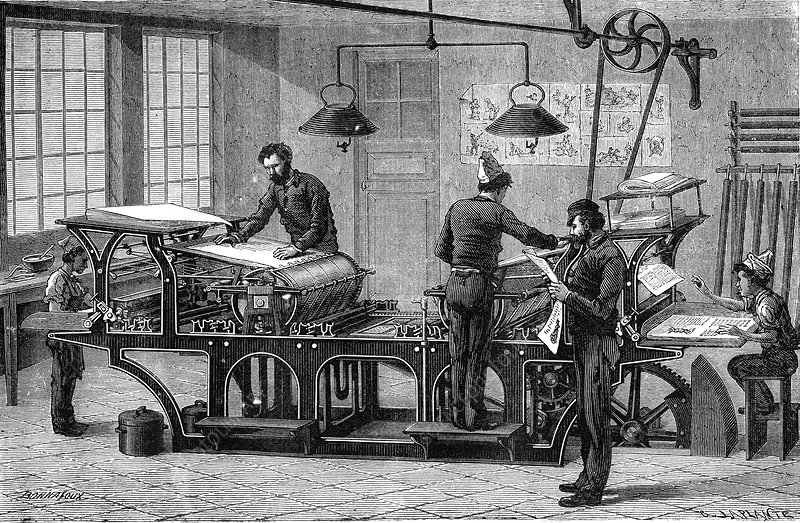
Printing press, 19th-century illustration. The printing press changed the course of history–did it also change the course of how Europeans talk about books?
In English, however, these distinctions which European languages use different words to track all get subsumed under the wide semantic umbrella of the single word “copy.” Manuscripts of ancient books are “copies”; forged artworks are “copies”; individual bound volumes of Dan Brown novels for sale at the airport are “copies.”
English of course has its own word “exemplar,” but it’s extremely rare or odd to hear it applied to individual books. In common parlance it is most often applied to people, not animals or things. It means something more like “ideal,” “paragon,” or “role model”: not just a copy, not even just an example, but an instance of something or someone so characteristic, so perfect in its kind, that it takes on a special status. An exemplary status! To my knowledge, the European languages don’t commonly use any cognate of “exemplar” to describe such a thing or person. (Littré’s major dictionary of French usage cites 16th- and 17th-century uses of “exemplaire” as a noun in this sense. Le Dictionnaire Robert gives this sense as a second separate meaning of “exemplaire” as an adjective with meanings similar to “exemplary” in English, but includes no substantival use of “exemplaire” in this sense.)
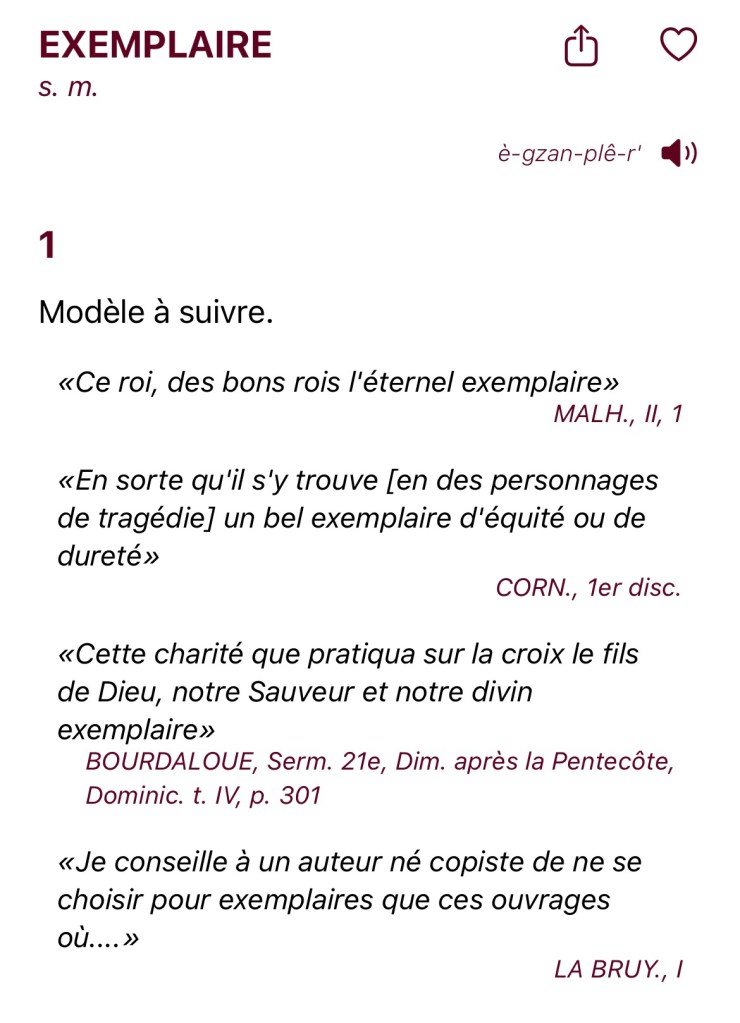
Littré’s first definition of “exemplaire”: “Model to follow.” As Louis-Ferdinand Céline once said, “Littre said it, and he is never mistaken.” (Céline’s remark is ironic, of course, but he has forgotten more about 17th-century French usage than I will ever know.)
There is one minor, but telling, exception to this. In Spanish and Italian, and possibly in some other languages, their cognate word for “exemplar” can be used to refer to a story or other example which conveys a moral or a warning to the reader or hearer. The Novelas ejemplares of Miguel de Cervantes use “ejemplar” in this sense. English has its own word for this, “exemplum,” which is quite rare and is derived directly from Latin. We do have shades of this meaning from other words and expressions in English: “exemplary punishment,” “making an example of someone.” From the 17th century onwards German used the word “Exempel” for this, although my understanding is that over the centuries this meaning, to the extent that it is still there, has become mostly absorbed into the more common German word for “example,” “Beispiel.”
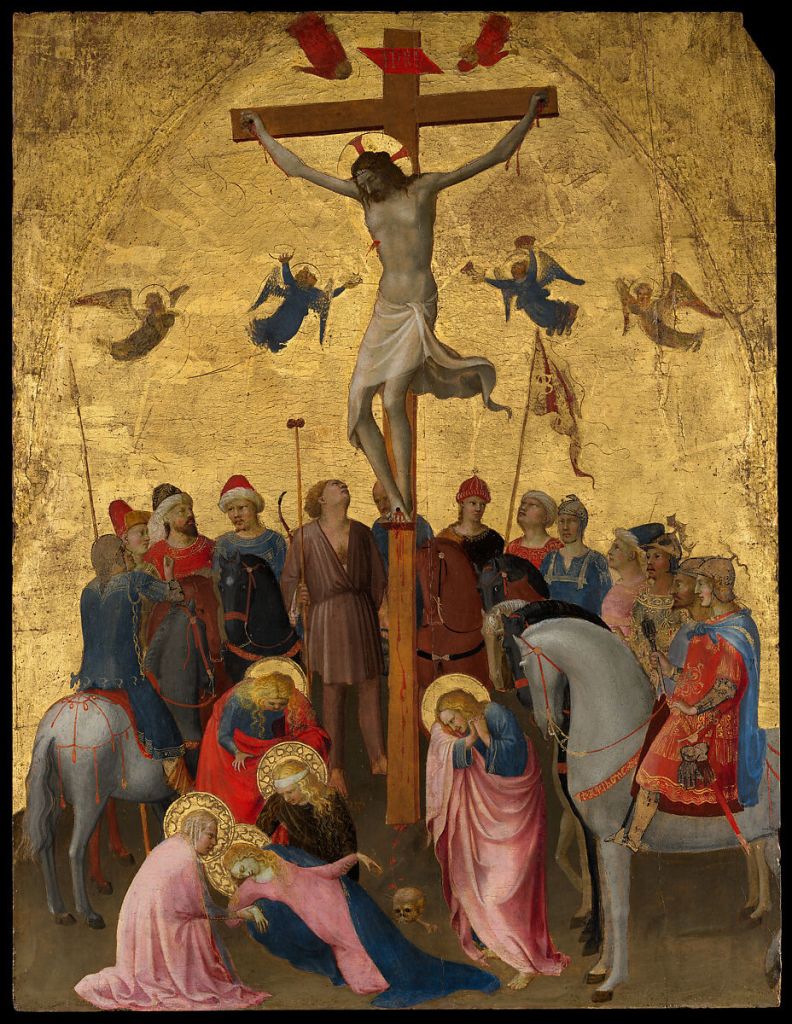
Fra Angelico, The Crucifixion. In the Roman world, crucifixion would have been a common form of exemplary punishment. The Latin term “exemplum” sometimes carries the sense of “warning” or “punishment,” although most often it means a “sample,” “imitation,” or “image.”
“Exemplar” in English also has a long-standing technical meaning in philosophy and theology to refer to an “idea” or “ideal object.” “Exemplarism” refers to a conception in medieval Christian philosophy whereby God creates and manages the world by means of eternal archetypal ideas in the divine intellect—exemplars—that are part of the divine nature. It’s also sometimes used to describe the theory of atonement from Peter Abelard through Protestantism in which Christ is sent to the world as an example to humankind, rather than as a substitutionary sacrifice. In the current philosophical world, dominated by work in the English language and only dimly aware of history, exemplarism is used by Linda Zagzebski and others to describe a moral theory in which the following of moral examples and imitation of exemplary persons can furnish a complete ethical theory. Since philosophy and theology are relatively transnational (and also somewhat insular) pursuits, this use of “exemplar” and “exemplarism” persists in philosophy, theology, and history written in the European languages. But this usage is only tangentially related to the wider usages of “exemplar” and its cognates to refer to books and moral examples.
André de Muralt’s book in which he recasts Husserlian phenomenology along the lines of Hegelian dialectic. He reads Husserl as advocating for a sort of “exemplarism,” as the subtitle makes clear.
What does all this linguistic and conceptual history mean? I haven’t been able to do the really deep dive into etymology required to tease out all of the relevant history. But at a glance it appears to me that sometime around the advent of mechanical reproduction of books in Europe, the languages on the continent responded to an unspecified pressure to distinguish printed books from “copies.” Perhaps it was to avoid the negative connotations of phoniness or untrustworthiness inherent in mere “copies.” For whatever reason, English did not respond to this linguistic pressure. The usage and development of its word “exemplar” trotted off in its own direction largely unknown on the continent, only intersecting occasionally in technical usage in the recondite precincts of international philosophy and theology.
I don’t know all of the European languages, and I don’t know the ones I know as well as I would like! If you know and speak a language of European origin and have read this far, what is your experience with this cluster of words for talking about books? Do you know any of the etymological and historical links missing from my account? Have I misstated relevant facts? Let me know in the comments!
[Image: Giacinto Brandi (1622-1692), Christ Buried by Joseph of Arimathea]
Just in time for Good Friday, I happened to read an off-color story from Petronius’ Satyricon this week that problematizes a seemingly minor detail in the Biblical narratives surrounding what happens to Jesus’s body after his death by crucifixion.
The four Gospels in the Christian New Testament agree on the detail that the evening after Jesus died on the cross, one Joseph of Arimathea went to Pontius Pilate, the Roman governor of Judea who sentenced Jesus to death, asked for Jesus’s body, and received it so that it could be buried. (The relevant Biblical passages are Matthew 27:57-60; Mark 15:42-47; Luke 23:50-56; John 19:38ff.) Joseph of Arimathea is identified as a member of the Jewish Council (Sanhedrin) of Jerusalem who, after Jesus’s arrest, decided to hand him over to the Roman authorities. The Gospels gloss Joseph’s wanting to give Jesus a dignified burial by stating that he either disagreed with the Council’s referral of Jesus to the Roman authorities (Luke), was sympathetic to Jesus’s prophetic mission (Mark), or was actually a secret disciple of Jesus (Matthew, John). Whatever his motivations, his actual acquisition of Jesus’s body is not that dramatic: he goes to Pilate, asks for the body, and Pilate says he can have it.[1]
Most of the commentary on these passages focuses on the person of Joseph of Arimathea—who was he? What was his relationship with Jesus? Just where is “Arimathea,” anyway? The commentaries I have found generally share the Gospel writers’ lack of curiosity about Pilate in this scenario. Specifically, why does he just give Jesus’ body to Joseph? Some commentaries mention the Torah’s prohibition of letting the bodies of those executed for crimes remain exposed overnight (Deuteronomy 21:23). This explains Joseph’s motivation, maybe, but why on Earth would Pilate care about what the Torah says? The best one might infer from reading the rest of the Gospel narratives is that Pilate is just granting a routine enough request.
We learn from a story in Petronius, though, that it was atypical for Romans to afford the privilege of such rapid burial to those it crucified—if, that is, they were ever afforded burial at all.
Petronius was a friend and courtier of the emperor Nero who is believed to have died around 66 CE. He was known in antiquity as “Petronius Arbiter,” or sometimes simply “the Arbiter,” due to his role as an influential literary and artistic critic. Tradition attributes to Petronius the authorship of the Satyricon, a bawdy, picaresque adventure that comes down to us in incomplete and fragmentary form. The tale follows Encolpius, a Roman, who (in a parody of, for instance, Homer’s Odyssey) finds himself cast about to the whims of fortune due to some offense he has caused the god Priapus. At one point in the story, Encolpius and his companions fall in with Eumolpus, a lecherous, crackpot poet whose middling verse routinely earns him showers of stones hurled by strangers and passersby.
In sections 111-112 of the Satyricon Eumolpus decides to tell a story. Once upon a time, there was a woman in Ephesus famous for her devotion to her husband. When he died, she was so grief-stricken that she tried to get buried with him and, failing in that, she kept constant vigil over his burial place. Around the same time, the Roman governor of the province had some criminals crucified not far from where the woman was keeping her sad and lonely vigil. “Next night”—and here is the important part for my purposes—”the soldier who was guarding the crosses to prevent anyone removing one of the corpses for burial noticed a light shining clearly among the tombs and, hearing the sounds of someone mourning, he was eager to know—a general human failing—who it was and what was going on.”[2]
Of course, he was hearing and seeing the woman of Ephesus’ vigil. The soldier goes to her and, in the process of exhorting her to give up her grief for her dead husband, seduces her (with the willing complicity of the woman’s maid). While the soldier is distracted night after night with the widow, though, “the parents of one of the crucified men, seeing the watch had been relaxed, took down the hanging body in the dark and gave it the final rites.”[3] When the soldier noticed the next day, he was terrified. “He would not wait for the judge’s verdict, he said—his own sword would carry out sentence for his dereliction of duty.” The widow, though, is now fond of the soldier and doesn’t want to have lost first her husband and then her lover. Saying “I’d rather hang the dead than kill the living,” the widow has the soldier hang her dead husband’s body on the cross in the criminal’s place. “The soldier followed the sensible woman’s plan, and next day people wondered how on earth the dead man had managed to get up on the cross.” Thus ends Eumolpus’s story.
It’s not entirely clear what to make of this. Eumolpus, and Petronius, are obviously playing things for laughs here. But the satiric, humorous part is in what the widow and the soldier do, not in the crucifixion. The background expectation taken for granted in the story is that the provincial governor of Ephesus would not only want crucified criminals left on their crosses, possibly to rot or be eaten as carrion, but would set a soldier to keep guard over them to keep their families from stealing their bodies and burying them. One must believe that the readers of this story would not have found the provincial governor’s official policy utterly beyond the pale. Otherwise that policy, not the widow’s actions, would have become the point of the story.
It’s easy to understand why a Roman provincial governor would leave dead bodies hanging on crosses. Crucifixion isn’t a sanitary, surgical form of capital punishment. It’s horrific and slow and painful. More than that, it’s a spectacle; people who might do what the crucified criminal did are meant to see it, to watch what might happen to them if they do likewise.
All of which lends new layers of complexity to Pilate’s apparent nonchalance about giving Jesus’s body to Joseph of Arimathea in the Christian Gospels. Compared to Petronius’s unnamed provincial governor of Ephesus, Pilate seems positively lax (or, more accurately, humane). In giving away Jesus’s body for a proper burial, Pilate is defying a common expectation of how victims of crucifixion will be treated, and he may even be violating official policy. All of which makes one wonder: what would the original readers of the Gospels have made of this detail about Pilate’s conduct?
A few possible theories come to mind:
1. Pilate the corrupt. All of the Gospel accounts make sure to include the detail that Joseph of Arimathea is a member of the Council, and hence that he is influential. Matthew even makes the point of reminding us that he is wealthy. Could Joseph have helped along Pilate’s willingness to give him Jesus’s body with a few well-placed denarii?
The overall narrative of Jesus’s death and resurrection in the Gospels needs Jesus to be in a tomb, not hung for days from a cross for all to see. It seems plausible enough that someone might bribe, or try to bribe, Pilate into releasing his body. Offering and taking a bribe over the crucified Lord’s body seems venal and petty, perhaps, but not that bad.
The Gospel texts either avoid raising the possibility of a bribe in exchange for Jesus’s body, or want to gloss it over, though, because the Gospels and early Christianity are strikingly ambivalent, if not outright negative, about money. I’m not just talking about the “the love of money is a root of all kinds of evil” thing (1 Timothy 6:10), although that’s part of it. In the Gospel narratives themselves, virtually everything that money touches is corrupted thereby. There is the “Give to Caesar what is Caesar’s” episode (Mark 12:13-17), where Jesus’s opponents try to put him in a bind about paying taxes and Jesus wriggles out of it by the observation that, since Caesar’s face is on the coin, one might as well give it back to him and give to God what is God’s. Judas is portrayed as betraying Jesus for the proverbial thirty pieces of silver, his motivation obvious greed, filthy lucre. And in the Gospel of Matthew, after Jesus goes missing from the tomb, the Jewish authorities bribe the soldiers tasked with guarding the tomb to spread the story that Jesus’s disciples came at night and stole his body (Matthew 28:11-15). Money dirties all it touches, and so a bribe furnishing the hinge of such a crucial detail in the story seems unthinkable.[4] But the potential trace of such a bribe is still there.
2. Pilate the savvy. Pilate has, let’s face it, an unenviable job: he governs one of the most far-flung provinces of the Roman empire on behalf of the Emperor Tiberius. Roman rule was never particularly pleasant, much less benevolent, and Judea’s population was notoriously restive and devoted to laws and customs at serious variance with Roman and Hellenistic paganism. One might repress the local population with an iron fist, but that’s a lot of work, and previous attempts hadn’t succeeded anyway. The Gospels portray a power structure that on its face includes the local population. Herod the Great, a puppet king installed by Rome, ruled over the Jews with the help of the Sanhedrin (Council). The Roman authorities are in the background keeping the affairs of Palestinian Jews within bounds but without being overly meddlesome.
In this scenario, Pilate surrendering the body of Jesus to Joseph of Arimathea is just savvy politics. Whether Joseph is simply concerned with upholding the mandate of Deuteronomy 21:23, sympathetic to Jesus, or even a crypto-Christian, Pilate might have plausibly seen his request as a way of keeping the peace. The Council got its execution, the followers of the dead man are spared the indignity and/or rallying point of his body being left to rot outside, and the situation need not escalate any further.
Few other sources testify as to Pilate, but those that do portray a far less diplomatic man. Philo and Josephus both describe an incident from the beginning, or nearly the beginning, of Pilate’s installation as governor in which he introduced either golden shields (Philo) or standards bearing effigies of the Emperor (Josephus) into Herod’s Jerusalem palace. Philo in particular describes this as an intentional provocation on Pilate’s part: “With the intention of annoying the Jews rather than of honoring Tiberius,” Pilate, “a man of inflexible, stubborn, and cruel disposition,” “set up gilded shields in Herod’s palace in the Holy City” (Legatio ad Gaium 299-300). In Philo’s account, Pilate only relents when the Emperor himself issues a direct rebuke ordering Pilate to reverse course. Josephus, however, chalks Pilate’s provocation up to ignorance or inexperience and has him relenting of his own accord once he witnesses the vehemence of the locals’ objections (Jewish War 2:174; Jewish Antiquities 18:59).
The incident of the shields/standards took place at the beginning of Pilate’s governorship. Perhaps by the time of Jesus’s trial and execution he had learned some tact? Perhaps?
3. Pilate the just, or Pilate the just powerless. The power-sharing regime in Roman Judea described above could just be savvy, realistic politics. But there is a thin line between finessing complicated political forces and outright powerlessness—a line early Christian narratives about Pilate ruthlessly exploit. As is fairly well known, the Christian Gospels insist on minimizing Pilate’s and Rome’s complicity in the outrage of crucifying the Son of God and instead do everything possible to place the blame on the opponents of the Jesus movement among the Jewish authorities. They can’t gloss over the fact that the final decision to execute Jesus could only be made by the Roman governor. They do go out of their way, though, to portray Pilate as either superciliously unconcerned about Jesus’s fate or actively convinced that he is innocent, but going along with the Jewish authorities’ desire to execute Jesus anyway.[5] Giving Jesus’s body afterwards to someone sympathetic to Jesus, possibly in contravention of official policy, might have been borne out of a sense of helplessness—or even a sense of justice?
Later Christian traditions about Pilate, even further removed from the events than the writers of the canonical Gospels, go to even greater lengths to absolve him or to portray him as powerless in the face of implacable Jewish authorities. The Gospel of Peter, written around 175 CE, depicts a Pilate who seemingly can’t do anything without consulting with the Jewish authorities first. This extends to the disposition of Jesus’s body. Pilate in this account can’t even dispose of Jesus’s body without asking Herod for it first:
[3] But Joseph, the friend of Pilate and of the Lord, had been standing there; and knowing they were about to crucify him, he came before Pilate and requested the body of the Lord for burial. [4] And Pilate, having sent to Herod, requested his body. [5] And Herod said: ‘Brother Pilate, even if no one had requested him, we would have buried him, since indeed Sabbath is dawning. For in the Law it has been written: The sun is not to set on one put to death.’
And, in a twist on the post-resurrection episode of the bribed centurions from Matthew, the Gospel of Peter has Pilate order his centurions to remain silent because he is afraid of Jewish reprisals if the story of Jesus’s rising from the dead gets out:
Having seen these things, those around the centurion hastened at night before Pilate (having left the sepulcher which they were safeguarding) and described all the things that they indeed had seen, agonizing greatly and saying: ‘Truly he was God’s Son.’
[46] In answer Pilate said: ‘I am clean of the blood of the Son of God, but it was to you that this seemed [the thing to do].’
[47] Then all, having come forward, were begging and exhorting him to command the centurion and the soldiers to say to no one what they had seen.
[48] ‘For,’ they said, ‘it is better for us to owe the debt of the greatest sin in the sight of God than to fall into the hands of the Jewish people and be stoned.’ [49] And so Pilate ordered the centurion and the soldiers to say nothing.
Later Christian efforts to absolve Pilate go even further in the direction of portraying him as an unwilling, and repentant, dupe. In an apocryphal “Letter of Pilate to Claudius”[6] appended to the Acts of Peter and Paul, Pilate pleads his innocence to his superiors, claiming that in the matter of Jesus he was the victim of the Jewish authorities’ deceptions and “wickedness.” And in the Paradosis of Pilate, a furious Emperor, incensed at the role Pilate played in the execution of Christ, has him brought to Rome as a prisoner to stand trial. Pilate explains that he only signed Jesus’s death warrant “on account of the wickedness and rebellion of the lawless and ungodly Jews.” The Emperor (who is inexplicably and ahistorically committed to the belief that Jesus is the Son of God) has no choice but to execute Pilate for his blasphemy. Before he is beheaded Pilate prays for forgiveness, and an angel of the Lord takes possession of his severed head right after it is lopped off. In the Ethiopian and Coptic Christian Churches, Pilate is revered as a saint, due partly no doubt to later traditions such as this one.
Such blatant fabrications so long after the fact are part of the well-observed phenomenon, apparent even in the Gospels, of early Christianity’s obvious eagerness to absolve the Roman authorities of Jesus’s death and instead to place the blame squarely on his Jewish opponents. While the authors of the Synoptic Gospels and the traditions to which they bear witness may have still been within the Jewish fold enough for it to be unfair to qualify them as antisemitic, full stop,[7] I think that the later blatantly antisemitic attempts to exonerate Rome and blame Judaism for Jesus’ execution certainly begin in the Gospel of John. [8]
I hope it goes without saying that any discussion of what we can take away from the extant texts that discuss Pilate’s release of Jesus’s body is not straightforwardly a discussion of what actually happened. No independent records or other archaeological evidence testify to any of the events surrounding the arrest, trial, crucifixion, or burial of Jesus of Nazareth, or, indeed, to anything else about his life. The Gospels we have were written at least decades after the events they purport to narrate, and as the discussion to this point makes clear, they were written and circulated with the aim of persuading, converting, inspiring, and motivating, not with the aim of journalistic reportage. The concern for factual accuracy was not unknown in antiquity, but modern standards of historiography certainly were unknown.
What I am concerned with here is not, or not just, what any of the characterizations of Pilate in the literature have to say about the actual Pilate (who does seem to have existed). I am concerned here with the light and shadow in the cloud of meaning surrounding historically influential texts: what “effective history” they have had in shaping the communities of interpretation that have gathered together to read and use them, both for better and for worse.[9]
What I often find is that sometimes the smallest details, the details like Pilate giving up Jesus’s body, that seem trivial at first blush are actually where the interest of a text is hiding. They are part of what makes the task of reading and interpretation so difficult, but also so fascinating and rewarding.
[1] Mark, the shortest Gospel, almost certainly the oldest, and one of the textual bases for the other “Synoptic” Gospels Matthew and Luke, includes a longer depiction absent from all of the other Gospels. Joseph of Arimathea in Mark goes to Pilate “boldly,” and we can infer from Pilate’s reaction why his request was “bold”: Pilate didn’t think Jesus was dead yet. He summons the centurion tasked with guarding Jesus, who tells him that, yes, Jesus really is already dead. But the outcome is the same as in the other Gospels; once he learns that Jesus is dead, he grant’s Joseph’s request seemingly as a matter of course.
[2] Petronius, The Satyricon and the Fragments. J.P. Sullivan, translator (Penguin, 1965), p. 120. Emphasis mine.
[4] Not to mention that in the Gospels money seems to be coded by its associations with the Jewish authorities and their collaborators (such as Judas). In other words, money is wrapped up in the proto-antisemitic project of blaming Jews for the death of Jesus (about which, see more below).
[5] This option gets us one step closer to Pilate the tormented petty official as he is portrayed in Mikhail Bulgakov’s The Master and Margarita. But that Pilate is, like David S. Pumpkins, “his own thang.”
[6] This letter, or “report,” obviously fabricated after the fact, doesn’t even get the name of the Emperor right: Pilate would have been reporting to Tiberius, not Claudius.
[7] See e.g. the discussion of the earliest Christian literature in Part Two of James Carroll’s Constantine’s Sword: The Church and the Jews, A History (Houghton Mifflin, 2001).
[8] See e.g. Elaine Pagels, Beyond Belief: The Secret Gospel of Thomas (Random House, 2003).
[9] I am also a believer, and so I am not just committed to textual interpretation, but that is a subject for another day.



 Thought Required; Pants Optional.