No author’s subsequent reception best exemplifies the two strategies for reading fiction I described in an earlier post than that of Jane Austen.
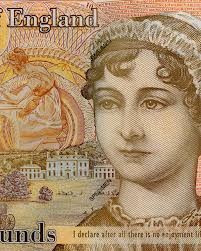
On the one hand, Austen’s works, especially perennial favorites such as Pride and Prejudice and Sense and Sensibility, have served millions of readers as a lens for bringing their own wishes, desires, and sense of themselves into greater focus. The dramatic romance of Elizabeth Bennet and Fitzwilliam Darcy, and the differently satisfied hopes of Elinor and Marianne Dashwood, continue to serve millions as a source of wish-fulfillment and literary identification. They have also left their indelible stamp upon the contemporary genre of the romance novel, many of whose cherished tropes, including the marriage plot and the necessity of the “happily ever after,” took their most recognizable forms with Austen. This aspect of Austen’s work has inspired an entire catalogue of imagined sequels, narrow or liberal rewritings and recastings, television and film adaptations, and literary festivals, not to mention the innumerable echoes of Austen throughout popular culture. Austen’s face even graces the back of the £10 note in the UK, on the other side of King Charles. Austen’s work is, for many, a door which beckons them to enter into and inhabit another world, an imagined one of greater gentility and courtesy, a world which in turn prods us to imagine our own world as something better.
The world depicted by Jane Austen, though, is, for all the relatability of its emotional content, not only very different than our own, but is also skillfully and minutely realized in its psychological, sociological, and historical details. Austen’s novels afford a point of entry into the state of men’s and women’s fashions in the Regency period of English history; the wide variety of carriages, coaches, carts, and other conveyances, and the roads on which they travelled; the societal and economic changes brought about by England’s developed colonial economy and by the Napoleonic wars, and in particular the fortunes made by naval officers in that conflict; and the English laws of inheritance, just to name a few. Far from just being background scenery, these aspects of Austen’s novels are regularly central to their plots and themes. More broadly, Austen’s novels portray the wide variety of constraints under which women in the Regency era lived their lives—the vast, nuanced network of social expectations shaped by wealth and class, economic and financial constraints (or the lack thereof)—and the way in which Austen’s characters imagine their own agency and choices in light of those constraints and reimagine and reconfigure those choices. Austen criticism in this vein draws insight not only from history at large, but also from Austen’s own biography and correspondence and the biographies of her family and other relations. Austen’s work, in other words, is a rich trove of cultural artifacts that one can unpack, examine, and relate to other such artifacts, and Austen criticism has risen to that task.
At the extremes, these two ways of reading Austen can lapse into one-sidedness or into apparent conflict with one another. Readings of Pride and Prejudice that over-identify with Elizabeth Bennet or merely use her as an imaginative prop for the reader’s own fantasies, on the one hand, clash with readings of the novels that see them as a collection of historical details organized loosely around a plot. As I said in my previous post, though, I don’t think these two strategies of reading fiction, and in particular of reading Austen’s fiction, need necessarily conflict. In fact, I am not convinced that any real engagement with Austen’s work can dispense entirely with either strategy. What makes Austen’s fiction so good is that the two poles towards which each strategy of reading gravitates—the inner life of imagination and the emotions, the outer world of society and history—are woven together in it into such tightly integrated wholes that one almost has to do perform surgery upon the texts, if not do violence to them, to extricate one or the other element.
Each of Austen’s finished novels could serve as an illustration of this point, even the widely exposed and thoroughly commented-upon Pride and Prejudice. The best single illustration of it, though, is Mansfield Park, in part because, whatever else one might say about it, it is definitely not a wish-fulfillment story. Which isn’t to say that it’s a tragedy. Its heroine, Fanny Price, does end up with her “happily ever after,” such as it is. Austen treats the ultimate steps whereby she obtains her happy ending, though, in such a cursory fashion, almost as in an epilogue, that they are obviously not Austen’s focus. Austen’s interest lays just to one side of rendering Fanny Price, and us as sympathetic readers of her tale, contented and happy. It is this tension between Austen’s narrative aims and the sympathetic reader’s expectations that makes Mansfield Park such a rich, and in some ways disturbing, work.
***
Austen’s heroines can be said to strike one or the other of two postures in her fiction. Austen herself announces the distinction in the very title of her first-published novel, Sense and Sensibility. On the one hand, there is the posture of good sense. Elinor Dashwood exemplifies this in Sense and Sensibility: cool, reasonable, grounded, aware both of her own feelings and the feelings of others, considerate, eager to keep herself and her actions within the bounds of proper conduct, ready to exhort others to proper conduct but not controlling, manipulative, high-handed, or sanctimonious. Often the Woman of Sense (as we might call her) is surrounded by characters who exist on a spectrum from the merely silly to the hypocritical and pig-headed. Anne Elliot in Persuasion, for instance, is the island of good sense in a family of vain, fatuous nincompoops. The Woman of Sense is not an unfeeling robot—her good sense is unimaginable without a significant degree of what we might today call “emotional intelligence”—but her judgment and actions are not controlled by her emotions. The Woman of Sense feels, and feels deeply, but is armed with self-knowledge and hence is able to keep her search for what she wants for herself within the bounds of propriety. After all, getting what one wants at the cost of burning one’s bridges with one’s family and friends and flouting the good opinions of society is, for the Woman of Sense, very much like not getting what one wants at all.
We see the opposite tendency in Marianne Dashwood, the personification of “sensibility” in Sense and Sensibility. In the idiom of early 19th-century English, being “sensible” doesn’t mean what it means in contemporary English, where it connotes clear-headedness, modesty or lack of extravagance, or sure-footed rationality. In Austen’s idiom it connotes almost the opposite, something more like “susceptible to powerful emotions” or “impressionable,” possibly to the point of self-indulgence. (I have to assume that this usage of “sensibility” owes a great deal to early modern psychological theory, itself indebted to the Aristotelianism of Scholastic philosophy and theology, which viewed emotions as “passions,” that is, states which the soul passively undergoes, as opposed to the “active” intellect.) Marianne is “sensible” in that she feels everything deeply and intensely, forms emotional attachments quickly, speaks and acts impetuously, and sets great store upon poetry, music, nature, or other pursuits that go beyond the realm of the immediately practical such as dancing, balls, and parties. The Impetuous Woman (let’s call her that) is not necessarily foolish, although she can be; Lydia Bennet in Pride and Prejudice comes to mind. She can in fact be quite clever, possibly smarter than most of the people around her. Emma Woodhouse in Emma is the perfect example: more vivacious and witty than any of her female company, but an Impetuous Woman nonetheless in her commitment to her ill-starred match-making projects.
I call these two general tendencies of character in Austen’s heroines “postures” because they aren’t necessarily mutually exclusive. Character isn’t necessarily a fixed quantity; Austen’s heroines aren’t allegorical figures who wandered in from Pilgrim’s Progress. Typically it’s the Impetuous Women who either gain hard-won sense (Marianne Dashwood, Emma Woodhouse) or follow their feelings into disgrace (Maria Bertram in Mansfield Park). However, in her last completed novel, Persuasion, Austen gives us the story of Anne Elliot, another Woman of Sense who allows herself in youth to be persuaded out of a marital attachment that her family views as risky, only to learn to trust and follow her feelings when her beloved returns to her life. The Woman of Sense in Persuasion learns when to set aside presumed good sense in favor of intuition and emotional receptivity.

Austen’s consistent preference, though, is for the Woman of Sense. Elinor Dashwood, and especially Elizabeth Bennet, are definitely spirited heroines, but in them good sense prevails. Each one exhibits awareness of others and, crucially, self-awareness. Awareness, however, doesn’t always imply actual knowledge; many of the decisive junctures of Austen’s plots involve the Woman of Sense being forced to act in situations of imperfect or incomplete knowledge of all of the relevant facts. (Elizabeth Bennet’s misjudgment of Mr. Darcy and of Wickham in Pride and Prejudice, and her consequent actions, are just the most well-known example of this.) The Woman of Sense is, however, best poised to profit from getting a more complete view of the facts, and least likely to act precipitously in the absence of material facts, and in Austen’s world this tends to allow her to emerge from sticky situations with a minimum of damage. Although Marianne Dashwood’s reproach of Elinor as cold, unfeeling, and unsympathetic in Sense and Sensibility is, and is portrayed as, unjust, there is an element of justice in Marianne’s complaint, perhaps; the Woman of Sense perpetually runs the risk of being priggish and convention-bound.
This is, in fact, just the view that much of the critical literature on Mansfield Park takes towards Austen’s consummate Woman of Sense, Fanny Price. She’s dull, she’s too passive, she is less interesting than the novel’s more spirited foil, Mary Crawford. Yet I find this reading of Fanny Price and Mansfield Park unnecessarily restrictive.
In my next Austen post, I will explain what I think Fanny Price really represents and why I find her, and the story of which she is the protagonist, are Austen’s richest creation.
 Thought Required; Pants Optional.