Tag: books

  • The Dualities of Jane Austen

    The Dualities of Jane Austen

    No author’s subsequent reception best exemplifies the two strategies for reading fiction I described in an earlier post than that of Jane Austen.

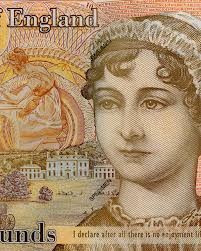
    On the one hand, Austen’s works, especially perennial favorites such as Pride and Prejudice and Sense and Sensibility, have served millions of readers as a lens for bringing their own wishes, desires, and sense of themselves into greater focus. The dramatic romance of Elizabeth Bennet and Fitzwilliam Darcy, and the differently satisfied hopes of Elinor and Marianne Dashwood, continue to serve millions as a source of wish-fulfillment and literary identification. They have also left their indelible stamp upon the contemporary genre of the romance novel, many of whose cherished tropes, including the marriage plot and the necessity of the “happily ever after,” took their most recognizable forms with Austen. This aspect of Austen’s work has inspired an entire catalogue of imagined sequels, narrow or liberal rewritings and recastings, television and film adaptations, and literary festivals, not to mention the innumerable echoes of Austen throughout popular culture. Austen’s face even graces the back of the £10 note in the UK, on the other side of King Charles. Austen’s work is, for many, a door which beckons them to enter into and inhabit another world, an imagined one of greater gentility and courtesy, a world which in turn prods us to imagine our own world as something better.

    The world depicted by Jane Austen, though, is, for all the relatability of its emotional content, not only very different than our own, but is also skillfully and minutely realized in its psychological, sociological, and historical details. Austen’s novels afford a point of entry into the state of men’s and women’s fashions in the Regency period of English history; the wide variety of carriages, coaches, carts, and other conveyances, and the roads on which they travelled; the societal and economic changes brought about by England’s developed colonial economy and by the Napoleonic wars, and in particular the fortunes made by naval officers in that conflict; and the English laws of inheritance, just to name a few. Far from just being background scenery, these aspects of Austen’s novels are regularly central to their plots and themes. More broadly, Austen’s novels portray the wide variety of constraints under which women in the Regency era lived their lives—the vast, nuanced network of social expectations shaped by wealth and class, economic and financial constraints (or the lack thereof)—and the way in which Austen’s characters imagine their own agency and choices in light of those constraints and reimagine and reconfigure those choices. Austen criticism in this vein draws insight not only from history at large, but also from Austen’s own biography and correspondence and the biographies of her family and other relations. Austen’s work, in other words, is a rich trove of cultural artifacts that one can unpack, examine, and relate to other such artifacts, and Austen criticism has risen to that task.

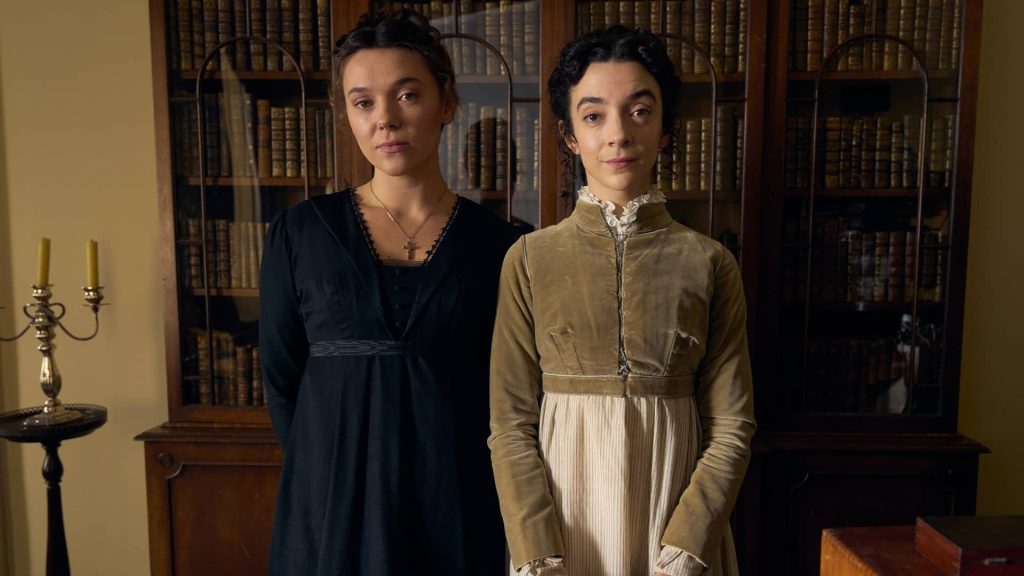
    Cassandra Austen (Synnove Karlsen) and Jane Austen (Patsy Ferran) from the recent BBC adaptation of Gill Hornby’s novel Miss Austen, which attempts to imagine the circumstances behind Cassandra’s famous destruction of much of Jane Austen’s correspondence. The search for biographical clues to the significance of Austen’s work has certainly survived the “death of the author.”

    At the extremes, these two ways of reading Austen can lapse into one-sidedness or into apparent conflict with one another. Readings of Pride and Prejudice that over-identify with Elizabeth Bennet or merely use her as an imaginative prop for the reader’s own fantasies, on the one hand, clash with readings of the novels that see them as a collection of historical details organized loosely around a plot. As I said in my previous post, though, I don’t think these two strategies of reading fiction, and in particular of reading Austen’s fiction, need necessarily conflict. In fact, I am not convinced that any real engagement with Austen’s work can dispense entirely with either strategy. What makes Austen’s fiction so good is that the two poles towards which each strategy of reading gravitates—the inner life of imagination and the emotions, the outer world of society and history—are woven together in it into such tightly integrated wholes that one almost has to do perform surgery upon the texts, if not do violence to them, to extricate one or the other element.

    Each of Austen’s finished novels could serve as an illustration of this point, even the widely exposed and thoroughly commented-upon Pride and Prejudice. The best single illustration of it, though, is Mansfield Park, in part because, whatever else one might say about it, it is definitely not a wish-fulfillment story. Which isn’t to say that it’s a tragedy. Its heroine, Fanny Price, does end up with her “happily ever after,” such as it is. Austen treats the ultimate steps whereby she obtains her happy ending, though, in such a cursory fashion, almost as in an epilogue, that they are obviously not Austen’s focus. Austen’s interest lays just to one side of rendering Fanny Price, and us as sympathetic readers of her tale, contented and happy. It is this tension between Austen’s narrative aims and the sympathetic reader’s expectations that makes Mansfield Park such a rich, and in some ways disturbing, work.

    ***

    Austen’s heroines can be said to strike one or the other of two postures in her fiction. Austen herself announces the distinction in the very title of her first-published novel, Sense and Sensibility. On the one hand, there is the posture of good sense. Elinor Dashwood exemplifies this in Sense and Sensibility: cool, reasonable, grounded, aware both of her own feelings and the feelings of others, considerate, eager to keep herself and her actions within the bounds of proper conduct, ready to exhort others to proper conduct but not controlling, manipulative, high-handed, or sanctimonious. Often the Woman of Sense (as we might call her) is surrounded by characters who exist on a spectrum from the merely silly to the hypocritical and pig-headed. Anne Elliot in Persuasion, for instance, is the island of good sense in a family of vain, fatuous nincompoops. The Woman of Sense is not an unfeeling robot—her good sense is unimaginable without a significant degree of what we might today call “emotional intelligence”—but her judgment and actions are not controlled by her emotions. The Woman of Sense feels, and feels deeply, but is armed with self-knowledge and hence is able to keep her search for what she wants for herself within the bounds of propriety. After all, getting what one wants at the cost of burning one’s bridges with one’s family and friends and flouting the good opinions of society is, for the Woman of Sense, very much like not getting what one wants at all.

    We see the opposite tendency in Marianne Dashwood, the personification of “sensibility” in Sense and Sensibility. In the idiom of early 19th-century English, being “sensible” doesn’t mean what it means in contemporary English, where it connotes clear-headedness, modesty or lack of extravagance, or sure-footed rationality. In Austen’s idiom it connotes almost the opposite, something more like “susceptible to powerful emotions” or “impressionable,” possibly to the point of self-indulgence. (I have to assume that this usage of “sensibility” owes a great deal to early modern psychological theory, itself indebted to the Aristotelianism of Scholastic philosophy and theology, which viewed emotions as “passions,” that is, states which the soul passively undergoes, as opposed to the “active” intellect.) Marianne is “sensible” in that she feels everything deeply and intensely, forms emotional attachments quickly, speaks and acts impetuously, and sets great store upon poetry, music, nature, or other pursuits that go beyond the realm of the immediately practical such as dancing, balls, and parties. The Impetuous Woman (let’s call her that) is not necessarily foolish, although she can be; Lydia Bennet in Pride and Prejudice comes to mind. She can in fact be quite clever, possibly smarter than most of the people around her. Emma Woodhouse in Emma is the perfect example: more vivacious and witty than any of her female company, but an Impetuous Woman nonetheless in her commitment to her ill-starred match-making projects.

    I call these two general tendencies of character in Austen’s heroines “postures” because they aren’t necessarily mutually exclusive. Character isn’t necessarily a fixed quantity; Austen’s heroines aren’t allegorical figures who wandered in from Pilgrim’s Progress. Typically it’s the Impetuous Women who either gain hard-won sense (Marianne Dashwood, Emma Woodhouse) or follow their feelings into disgrace (Maria Bertram in Mansfield Park). However, in her last completed novel, Persuasion, Austen gives us the story of Anne Elliot, another Woman of Sense who allows herself in youth to be persuaded out of a marital attachment that her family views as risky, only to learn to trust and follow her feelings when her beloved returns to her life. The Woman of Sense in Persuasion learns when to set aside presumed good sense in favor of intuition and emotional receptivity.

    Anne Elliot (Amanda Root) and Captain Wentworth (Ciarán Hinds) from the 1995 BBC adaptation of Persuasion. I view this adaptation as superior to the others for its balanced portrayal of Anne.

    Austen’s consistent preference, though, is for the Woman of Sense. Elinor Dashwood, and especially Elizabeth Bennet, are definitely spirited heroines, but in them good sense prevails. Each one exhibits awareness of others and, crucially, self-awareness. Awareness, however, doesn’t always imply actual knowledge; many of the decisive junctures of Austen’s plots involve the Woman of Sense being forced to act in situations of imperfect or incomplete knowledge of all of the relevant facts. (Elizabeth Bennet’s misjudgment of Mr. Darcy and of Wickham in Pride and Prejudice, and her consequent actions, are just the most well-known example of this.) The Woman of Sense is, however, best poised to profit from getting a more complete view of the facts, and least likely to act precipitously in the absence of material facts, and in Austen’s world this tends to allow her to emerge from sticky situations with a minimum of damage. Although Marianne Dashwood’s reproach of Elinor as cold, unfeeling, and unsympathetic in Sense and Sensibility is, and is portrayed as, unjust, there is an element of justice in Marianne’s complaint, perhaps; the Woman of Sense perpetually runs the risk of being priggish and convention-bound.

    This is, in fact, just the view that much of the critical literature on Mansfield Park takes towards Austen’s consummate Woman of Sense, Fanny Price. She’s dull, she’s too passive, she is less interesting than the novel’s more spirited foil, Mary Crawford. Yet I find this reading of Fanny Price and Mansfield Park unnecessarily restrictive.

    In my next Austen post, I will explain what I think Fanny Price really represents and why I find her, and the story of which she is the protagonist, are Austen’s richest creation.

  • Two Strategies for Reading Fiction

    Two Strategies for Reading Fiction

    My latest reading project has been completing the fiction of Jane Austen. In order to organize my thoughts about Austen’s works themselves, I found myself needing to clarify, as a sort of preparatory exercise, my thinking on two different, but interrelated, strategies of reading. If you are interested in theory or abstraction, may you find this helpful or at least of mild interest. If you aren’t, expect some writing about Jane Austen in the coming weeks.

    Although it’s probably an oversimplification, I often entertain in my own thinking a distinction between two strategies of reading fiction. This distinction helps me make sense of not only my own reading, but also the proliferation of discussion of it in our times.

    The first such strategy I call reading as a technology of identity consolidation. This strategy of reading centers upon the reader’s wants, desires, wishes, social location, and agency. The questions to which it seeks answers in fiction center partly on satisfaction—Am I enjoying the experience of reading this book? Do I like the characters? Do I identify with them? Do I find them “relatable”? Does the work help me to confront, or perhaps to escape, aspects of my own reality I find oppressive? Do I think the author is someone I might like? Some of what this strategy seeks to get out of fiction, though, can involve personal aspiration or improvement: Does this book provide role models to help me shape and direct my ambitions? Is the author telling a story that, for political or ideological reasons, I think needs to be told to a wider audience? Is the author exploring some aspect of identity that is underrepresented in fiction, and doing so in a way that supports ideals of dignity and increased understanding?

    The common thread running through this diverse set of questions and expectations is, I believe, a singular preoccupation: How can fiction help me be the sort of person I should be, by helping me figure out who I really am, how I should act, what I should do, what I should believe? In other words, its preoccupation is the reader’s sense of their own identity, and the critical touchstone it recommends is the extent to which a book helps or does not help achieve that goal. (Also, by implication, it can evaluate books based on the extent to which the book or its author are compatible with the sorts of political or moral aspirations we should have, which lends this attitude towards a certain censoriousness about books that is no doubt familiar to anyone reading this on the Internet in 2025.)

    I call this sort of reading a technology because, on this view, the work of fiction is a sort of tool or device the reader uses to achieve other goals that go beyond the work of fiction itself. What’s more, reading fiction is not even the sole means to achieve those goals; other people who aren’t devoted to reading achieve them by watching movies or television, chatting up strangers on the Internet, backpacking across the American West, or some other thing. Perhaps reading fiction is the best way to figure out who you are and who you want to be, or at least has certain advantages over other ways[1], but it isn’t the only way.

    Although the most recent public site where this strategy of reading is on full view is undoubtedly #BookTok and its related social media communities, the strategy of reading as a technology of identity consolidation is by no means new. The explosion of the novel as a popular literary form in the 18th century in Europe, and its appeal to young, impressionable people living through the upheavals of the crumbling of absolute monarchy, Sturm und Drang pre-Romanticism in culture, and a general transformation in how the world appeared to intellectuals[2], led to a sense of moral panic not dissimilar to those that swept post-World-War-II America. When novelists of the 19th century incorporated the pitfalls of this kind of subjective investment in reading fiction within fiction itself—Catherine Morland in Jane Austen’s Northanger Abbey and Emma Bovary in Gustave Flaubert’s Madame Bovary are two salient examples—they were already taking place against the backdrop of a social debate with a long history. By the mid-20th century the cultural place of the novel was well cemented, but Vladimir Nabokov, himself no opponent of fiction, was lampooning what he polemically took to be the excesses of “bad reading” (reading aimed at identification with characters, concentrating on the “socio-economic angle,” etc.) among his students and contemporaries.[3]

    While I agree that a singular focus on fiction as a technology of identity consolidation is limiting, I don’t reject it entirely or think that it is an illegitimate way of reading across the board. For what it’s worth, I think that this strategy of reading represents something ineliminable from anyone’s experience of, and interest in, reading fiction. I will return to that point below.

    For now, I will be content to contrast this strategy of reading fiction with another I call reading as an inquiry into cultural artifacts. This strategy of reading tends to bracket the reader’s personal identitarian investment in, or response to, the work of fiction and instead seeks to appreciate the work of fiction as an artifact embedded in its own multilayered context. The implied metaphor of an archaeological dig is deliberate, as the work of fiction’s contexts are numerous, interrelated, and take sometimes dirty work to decipher if one is to do it well. Reading fiction as artifact can, for instance, dwell on the author’s broader aims: Is the author preparing a brief for a moral or political case? If so, what is it, and does the work forward that goal of persuasion? How does the work relate to other work by the author—as a departure, a continuation, a repetition? Does the work reflect the author’s inner state or personal biography, and if so, how? Some of its questions are the familiar territory of academic literary criticism: What are the work’s structural or formal qualities, and how do these qualities relate to other works? What are the inherent aesthetic qualities of the work, and on what standards might we judge its quality? How does the work relate to similar works produced in a historical time, place, or era? Some of the questions this strategy of reading asks veer off into history, philosophy, sociology, economics, and other social sciences: What factual information does the work of fiction tell us about its time (even if “its time” is right now)? What does it convey to us about what it was like to be a subject in its time and place: the characters’ sense of their own agency and choices for action, how they imagined themselves and their world (and sometimes the distance between their imaginations and reality), what sorts of radical options were open to them or foreclosed?  How was the book read (or misread), received or rejected, in ways that illuminate both the work itself and its subsequent history? Does the book illuminate or provide unique traction on a philosophical problem, like free will, the nature of justice, or religious belief?

    Obviously, what I am calling the strategy of reading as an inquiry into cultural artifacts is a wide umbrella over a vast range of diverse interests, questions, and curiosities. It covers the aims of the hack political pundit’s obtuse commentary on contemporary novels, the integrative work of the cultural critic or public intellectual, and the minute, detailed research of the humanities academic. I know full well that many people whose interest in fiction lies in the general direction I am describing would chafe at being associated even loosely with some of the other preoccupations I am grouping together under this umbrella. This strategy is far too broad to be called a “method”; it’s more a general orientation, a tendency.

    I don’t call the strategy of reading fiction as a cultural artifact a “technology” because, unlike the strategy with which I am contrasting it, the work is not being used as a tool or an implement to achieve an end. However, it does share with that technology of reading, though, a certain tendency to lose focus on what we might call, in an old-fashioned sort of way, the “work itself.” Reading as a technology of identity consolidation tends to view the work as a sort of mirror or lens that is trained squarely upon the reader’s selfhood. The properties of the mirror or lens only matter to the extent that they help the self see itself more clearly. Reading as an inquiry into the book as cultural artifact, though, tends, at its extremes, to dissolve the work itself into a mere set of illuminations of its contexts, as one more data point in the service of a broader thesis about whatever historical, philosophical, or sociological interest the reader brings to the work.[4]

    Fiction writers themselves have perhaps been less worried about the drawbacks of this attitude towards fiction than about the drawbacks of its contrasting attitude. Certain fiction authors and works certainly portray the dissolution of the traditional novel into other discourses and registers, though. The most well-known examples are the works of modernist authors like Joyce or Beckett, but there’s also Tolstoy’s War and Peace, a fictional work (Tolstoy denied it was a “novel”) which shades over its great length into a work of history and philosophy. At the extreme, we have the French nouveau roman as well as Burroughs’ cut-up trilogy, with long passages that consist of literal cut-up and scrambled texts from newspapers and magazines (and which Burroughs also denied were “novels”).

    I must confess that the habits of mind that govern my choice of fiction reading tend more towards the appreciation of fiction works as cultural artifacts than towards identity-consolidation. (Perhaps being a middle-aged man who thinks he is blessed with an adequate degree of self-awareness explains this: I am not looking to fiction as a form of therapy or to figure out who I am, or even to get away from who I am.) But I am not personally above reading fiction that is escapist, or relatable, or blatant wish-fulfillment, or just plain entertaining. In the end I suspect that these two strategies of reading I have identified can scarcely be divorced from one another entirely. For lack of a better terminology, the subjective pole and the objective, the personal and the impersonal, care of the self and concern for the world, can’t be pulled apart neatly. Both sets of motivations and interests confronts all of us when we read fiction to some extent. They are like the charged electrical field in the midst of which we engage with the work of fiction, which then blocks, amplifies, reflects, and redirects those energies into different directions.[5]

    When it comes to talking about fiction and literature, what I abhor is the insistence on a single strategy of reading as the only one that is worthwhile, or else the sheer predominance of a single strategy of reading by the volume of commentary and conversation that exclusively presupposes it. (If you haven’t guessed, I endured maybe ten minutes of browsing on #BookTok before abandoning it in frustration.) I am, generally speaking, a maximalist when it comes to reading, a “let a thousand flowers bloom” sort of person. I sometimes intentionally seek out negative reviews of books I love, and sometimes they even change my mind. When they don’t, I still find them instructive as idiosyncratic readings or misreadings. When people present me with excessively rigid reading methodologies or otherwise seem to have a perpetual blind spot in their critical judgment, I just think, “Hm, OK,” and then keep on reading what I want for whatever reasons interest me.

    With all that in mind, my next post will reflect on the one author whose public and academic reception in modern times best exemplifies both of these strategies of reading at once: Jane Austen.


    [1] Reading novels certainly entails less physical risk than embarking on a career of libertinage among the demi-monde of Paris. To pick an example.

    [2] One of the central theses of Michel Foucault’s The Order of Things is the transition of episteme he identifies in the late 18th and early 19th centuries, in the very way that the discourse surrounding knowledge was subtly reorganized and transformed.

    [3] Vladimir Nabokov, “Good Readers and Good Writers,” in Lectures on Literature (ed. Fredson Bowers; New York: Harvest, 1980), 3ff.

    [4] Yet another target of Vladimir Nabokov’s critical polemic in “Good Readers and Good Writers” are people who insist on using Jane Austen’s novels as a source of information about “landowning England with baronets and landscaped grounds when all she knew was a clergyman’s parlor” (p. 2).

    [5] Without getting too far into it, I suspect that the relation between these two strategies of reading is broadly dialectical (though not in a rigidly Hegelian or Marxist sense). What I will say is that, pace certain cultural critics who have dotted the landscape throughout my lifetime, I am not convinced that either strategy is inherently prone to, or exclusively guilty of, the closed-mindedness, epistemic closure, or sheer obtuseness significant swaths of the reading public constantly exhibit. Reading for escapism or sheer entertainment value can teach one things about oneself and the world that one didn’t know before (maybe even things that one doesn’t really want to know at all), or it can simply reinforce one’s existing feelings and prejudices. Reading for aesthetic merit or for cultural significance can lead one to broader insights about the world and one’s own place in it, or it can devolve into a rigid exercise in policing the boundaries of a canon or an interminable collection of grist for one’s preferred mill. What makes for this difference is a more basic personal disposition on the part of the reader, not the strategy of reading they employ.

  • Long Live the Movie Novelizations!

    Long Live the Movie Novelizations!

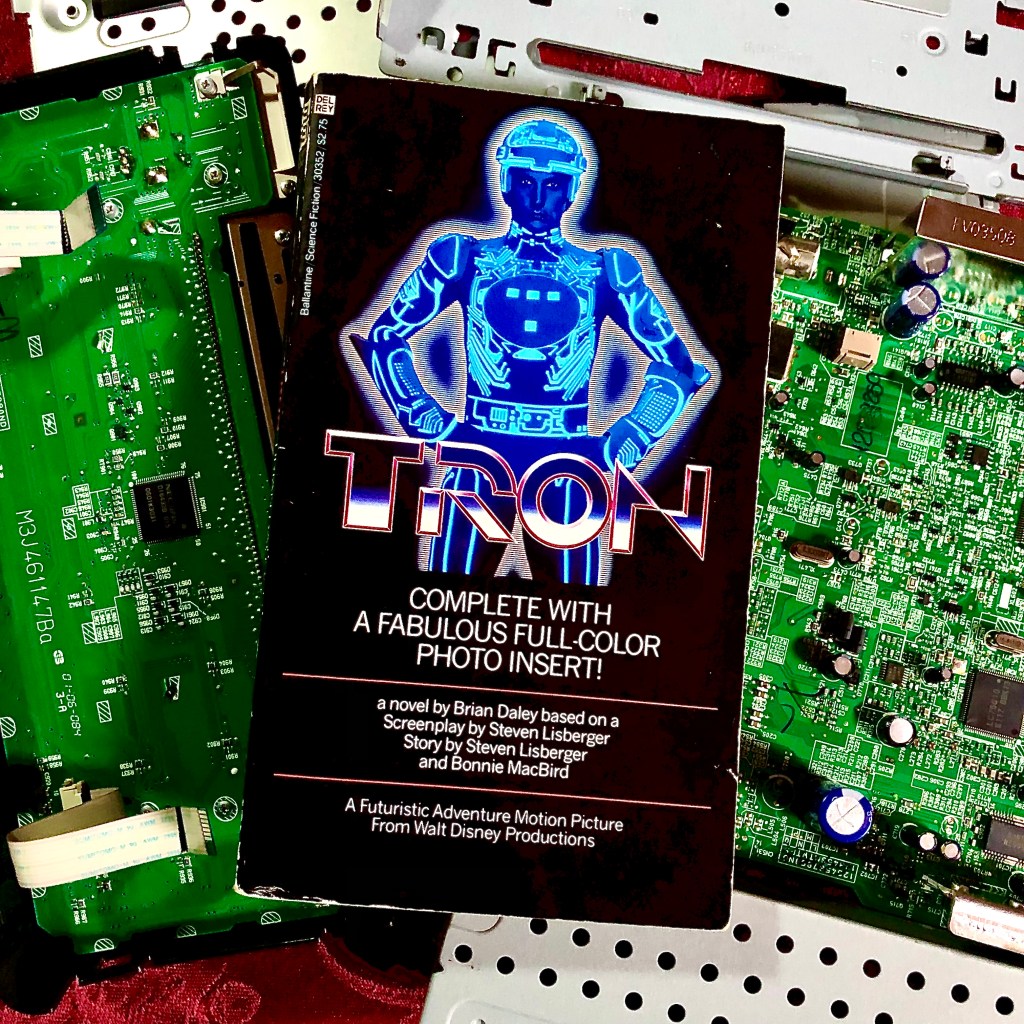
    Daley, Brian. Tron (Ballantine, 1982). Adapted from a screenplay by Steven Lisberger and a story by Steven Lisberger and Bonnie MacBird.

    Narratives in the Age of Mechanical Reproduction

    Book and film critics have spilled a lot of ink on the subject of film adaptations of books. Spike Jonze even made a (hilarious, absurd) movie satirizing the process. But what about the reverse process: taking an original screenplay and adapting it as a novel?

    I am just old enough to remember when it was commonplace for films made from original screenplays to release a “novelization” of the film that coincided with, or just preceded, the release of the film. Before the advent of streaming services that allow anyone with a subscription to watch movies anywhere on their phones, before the advent of VCR’s and rental videocassettes even, studios sponsored film novelizations to promote their films. The concept was simple: a film novelization, usually a mass-market paperback, is portable and readable anywhere, letting fans connect to a movie they like without having to drop everything and go to a movie theater. The novelization is also one more artifact about the movie circulating out in the world, on bookstore and magazine rack shelves, in the hands of readers on the bus or in a doctor’s office.

    Suffice it to say that film novelizations are not, and were never really meant to be, great literature. They are mass-produced promotional objects on a level akin to Mcdonald’s movie tie-in drinking glasses. I do have a soft spot for them, though, as they represent a feature of the pre-Internet, pre-personal-computer days of my childhood that are increasingly hard to remember or even imagine.

    I didn’t own a lot of film novelizations personally. The one I remember best was the 1986 novelization of Top Gun by Mike Cogan, which I know I read six or seven times. (Don’t judge me; it was a strange time in my life.) My fondest memory, though, is of the novelization of Tron, the widely-panned 1982 Disney sci-fi film starring Jeff Bridges, Bruce Boxleitner, and David Warner.

    The Program, The Myth, the Legend

    Tron was released on July 9, 1982 to a great deal of hype. If you don’t know anything about the movie, the short synopsis is that Kevin Flynn, a computer hacker/programmer, gets blasted into the world of the computer—called the System—by the tyrannical Master Control Program, or MCP, an artificial-intelligence program run amok. Inside the System, Flynn helps Tron, a heroic program written by Flynn’s friend Alan Bradley, overthrow the MCP and restore freedom to the System. It was the first film I know of that made extensive use of 3D-rendered computer animation, most of which was rendered painstakingly frame-by-frame. It was the gee-whiz visuals that Disney used to sell the movie, and understandably so; they were unlike anything that had ever been on screen up to that point.

    I was about to turn eight years old in 1982 and as a geeky little boy of course I wanted to see Tron desperately. Life, though, had other plans. My family took a trip to Disney World in the summer of 1982 to celebrate my older sister’s tenth birthday, and on our down time we went to see movies. The theatrical competition for Tron was John Huston’s adaptation of the Annie musical with Carol Burnett and Albert Finney and the Steven Spielberg blockbuster E.T. The family opted to see the latter two movies. No one in my family besides me had the slightest interest in seeing Tron. (Well, my father might have, but he wasn’t with us on that trip, and anyway I only remember going to the movies with him once. It was Santa Claus Conquers the Martians, which played a matinee in my hometown movie theater when I was four or five. We walked out.)

    What I did get as a consolation prize, though, was the novelization of Tron, by Brian Daley. I have no recollection of exactly where my parents bought it for me, whether on our Florida vacation or later. But I loved having it. It had a color insert of post-production stills from the movie that showcased the CGI animation. I do not recall ever actually reading the book; having it as an artifact on my bookshelf was enough, at least until I could see the movie itself.

    Tron ultimately came to be lampooned as a bomb at the same time as it had a sort of geek cult following, probably due to its aesthetic and its place in the history of CGI animation. Its biggest weakness was that it was just not that great a movie. The story had problems that went beyond the simple suspension of disbelief required to accept Jeff Bridges/Flynn getting blasted into the world of the computer. The dialogue was clunky, especially Flynn’s; Jeff Bridges did his best, but some of what the movie has him exclaim is as incongruous as Pavement lyrics. The light-cycle sequence, the first sustained CGI sequence in the history of film, is genuinely thrilling, but it’s a set piece packed away in a lot of turgid struggle between the MCP, his chief lieutenant Sark, and their red-clad minions with the glowing blue forces of good. The chief axis of the struggle is over, oddly enough, something like religion: the MCP seeks to quash programs’ belief in the Users, the beings in the world outside who write and use the programs, and the blue-clad good guys are those who stubbornly refuse to renounce their belief in the Users and hence get pitted against the MCP’s Warrior Elite (and each other) in gladiatorial combat.

    This element of Tron echoes late-Cold-War anti-Communist ideology (the dastardly, power-hungry Reds demanding that everyone renounce faith in a higher power and worship them as lords and masters), but the ideology of the movie is too vaguely rendered to serve as a transparent allegory. This is largely because of the added element Tron introduces of unease over advanced computer technology run amok, a concern that cuts across the conflict between capitalism and communism. In this Tron was a movie ahead of its time. In 1982, hardly anyone had a personal computer, much less one capable of networking with other machines, and AI was still the stuff of sci-fi stories. Tron was a cautionary tale about techbro anarchocapitalism decades before anyone thought that was something we might need to fear. But the movie almost tries to be too much in too little time: gee-whiz adventure, Star Wars liberation fantasy, allegory. It doesn’t quite succeed at any of it.

    The Novel and the Film

    Brian Daley’s novelization, though, is in some important ways superior to the film. I don’t know what specific process Daley used to write this book, but commonly the studio would give the author some more or less final version of the screenplay, plus perhaps some conceptual art, production stills, or other visual references, and then the novelist would make a book out of that. Given the need for a novelization to come out at the same time as the movie, there would normally be no time for the writer to see a finished cut of the movie before writing the book. This means that sometimes novelizations include dialogue, entire scenes, or entire subplots that ultimately get cut out of the theatrical version of the film. Even if the screenplay the novelization author uses as a basis for the novel, though, tracks the final cut of the film perfectly, the author inevitably has to use a certain amount of license in turning the story into a readable novel. The conventions of fiction writing for a popular audience demand a certain amount of characterization and expansion that a “show, don’t tell” screenplay simply don’t provide.

    I know the movie Tron well—it’s one of those movies like David Lynch’s 1984 Dune that I love, even as I realize how flawed they are—and so I looked forward to the possibility that the book would tell a richer story than the film. In that I was not disappointed.

    The story of the Daley novel and much of the detail does not depart radically from the theatrical film.[1] Flynn’s dialogue is as jarringly absurd as ever—I guess Daley felt he couldn’t entirely rewrite dialogue that would end up in the film. Also, the new scenes or story elements portrayed in the book that are not in the movie are of only minor significance.[2] Where the book oustrips the theatrical film is that it sheds new light on the characterization and motivations of certain characters, as well as certain story elements that are certainly implicit in the film but are so implicit as to be scarcely legible.

    The most significant of these advances:

    The character of Ed Dillinger. In both the book and the film, Ed Dillinger (David Warner), whose counterpart in the System is Sark, the MCP’s Command Program, is a menacing, power-hungry thief. Dillinger rose to Senior Vice President of ENCOM by stealing Flynn’s ideas and code for Space Paranoids and other highly profitable video games, hiding the evidence of his theft, and steering Flynn to the exits. He had a hand in creating the MCP, but he learns in the course of the story that the MCP has developed plans of its own and that it will brook no resistance from Dillinger or anyone else to its execution of those plans.

      In the book, though, we get more of a window into Dillinger’s state of mind—an easier feat in a novel than in a movie. The novel’s Dillinger is putting on a brave front, but is secretly terrified both that Flynn will find the evidence he needs to prove Dillinger’s theft and of the MCP, which is spiraling out of control. David Warner is a fine actor, but for whatever reason his performance as Dillinger doesn’t capture this vulnerability and fear very well. At least I don’t think so.

      The character of Lora/Yori. Lora (Cindy Morgan), a researcher working in ENCOM’s laser lab, doesn’t have a lot to do in the movie other than being the current girlfriend of Alan Bradley (Bruce Boxleitner) and Flynn’s ex.Her counterpart in the System, Yori, is a program working in an unnamed sector near the Input/Output Tower manned by Dumont. She is Tron’s love interest (Tron, of course, being Alan Bradley’s System counterpart), and she helps him, but beyond that she doesn’t do much.

      In the novel, though, we get a little more discussion of Lora’s different feelings for both Bradley and Flynn. (Not much more, though, and her conflicted feelings make her seem more than a little indecisive, but this is the character Daley was dealt.) Yori, however, gets even more of a backstory. Yori used to work in the Factory Domain of the System, a domain described as a hub of productivity before the MCP began draining it of power and resources to feed its own designs (see below). She and the programs of the Factory Domain used to do amazing work for the Users, but now they are systematically starved and reduced to dronelike servant labor. They are continually weak and semiconscious, and their speech consists of little beyond strings of numbers. (I see echoes here of the dronelike inhabitants of Planet Camazotz in Madeline L’Engle’s A Wrinkle in Time.)

      In the movie, Tron, upon reuniting with Yori, re-energizes her, and only then does she recognize him. The same thing happens in the book, but the book explains that Tron is able to do so because he has drunk from a pure source of power that he, Flynn, and Ram found after escaping the Light Cycle grid. The MCP, we learn, has either tapped dry the standard sources of power or else diluted or polluted them. The MCP overlooked this power source, though, and it is a rare source of “true” power, providing Tron with clean, good power to spare. This earlier scene also happens in the movie too, but without much explanation of its significance. Hence when Tron reenergizes Yori, the movie leaves the reason why it happens obscure; we are left wondering if it isn’t just her love for Tron that does it. I have watched the movie any number of times and never once thought of connecting the Tron/Yori reunion scene with the “drinking the pure power” scene.

      Yori’s “worker” attire in the Factory Domain is described in the book much as it is shown in the movie: boots, tight-fitting cap. What the movie does not portray, though, is that in the book the “reenergized” Yori is able to transfigure, as it were, into a non-worker-drone form. This transfigured Yori is described almost like an angel, shining with light, long tresses hanging downward, in refulgent robes. She transfigures multiple times in the book, but always reverts to “worker” Yori for action scenes.

      Lora/Yori is, as a character, still underutilized and largely lacks agency. She is there to humanize the male characters a little bit. She, and the movie, definitely fail the Bechdel test, not least because she is the only woman in the whole film.

      The MCP’s relationship to the System and to the real world. As in the movie, the MCP is a megalomaniacal artificial intelligence that has decided that it can run the world better than its human creators. (With the benefit of hindsight it is hard not to see it as a mirror for “there is no alternative” technocratic neoliberalism run amok, but I digress.) Another underplayed element in the movie that Daley’s novel highlights is that the MCP’s hunger for power is also a literal hunger for energy. The MCP’s project of harnessing the power of other programs, like cryptocurrency mining, takes a lot of electricity, and the novel makes clear that the MCP gets it by tapping every energy source it can find (drill, baby, drill!), siphoning off energy that existing sectors need to function, and polluting the rest. The novel ties the lethargy of the Factory Sector, barely remarked in the film, directly to the MCP’s energy vampirism. The novel also explains certain parts of Flynn, Tron, and Yori’s ability to evade the MCP’s forces by saying that the MCP is distracted, operating near the limit of its processing power in pursuing its plan of world domination.

      In the final confrontation between Tron and the MCP, the film depicts, in a few fleeting frames, figures pinned to the inside of the retaining ring hiding the MCP’s central conical head. In another case of added context, the novel explains that these figures are Dumont and other Input/Output majordomos—the high priests, as it were, of the religion of the Users—and that the MCP is draining their energy to power himself. It’s an added phantasmagoric detail that makes the MCP that much more horrific: he surrounds himself with the crucified, dying bodies of the priests of his enemies and lives off of their life force.

      In the real world, the MCP of course does not have the same sort of powers as in the System. The novel, though, underscores the MCP’s main real-world power—the power of surveillance—in a way that, again, the film underplays. Many scenes that take place in ENCOM Tower in the film include cuts to footage of characters walking hallways taken from the screens of security cameras. These images in the film certainly add to the conspiratorial, claustrophobic air of ENCOM Tower, but do little more than that. In the novel, though, the MCP is monitoring all of this security footage and knows more or less where all of the principals are in the building—and possibly elsewhere.

      Style, and a Little More Substance

      Tron the film is arguably a triumph of style over substance. Its visual aesthetic and its pioneering use of CGI are by far its greatest contribution to cinema and visual art. It might seem strange, then, to devote attention to the novelization of Tron. The novelization is a competent, decently plotted piece of storytelling, but hardly innovative as a work of fiction. It’s a novel, and not history-making in any way. Why read it, much less discuss it?

      For me, reading the novel gave me insight into how Tron the film could have been better than it was. As my above discussion makes clear, so much of the additional substance and context the novel provides is clearly implicit in the finished film, just underdeveloped. The screenplay spelled out some, but not all of this original context, and the novel took it further. A few changes in how certain elements of the story got told—not all of which would have added to the movie’s run time—might have made the actual story of the film more legible underneath the computer graphics.

      No version of Tron—screenplay, novelization, film—is great storytelling. Both the in-world stakes of the central conflict between the MCP and the “good guys” as well as its messages about technology and ideological conflict are too ambiguous to be compelling. Movies go through a torturous process on their way to the screen, and in the case of Tron the end product yielded a more cramped story than most. Reading the novelization of Tron is a great reminder of, among other things, the limits of the auteur theory of cinema; films are the outcome of the creative labor and business decisions of large teams of people, and all of those influences leave their mark on what ends up on screen.


      [1] My guess is that most of the edits to the screenplay and story were finished during the screenplay and storyboarding stage, before even principal shooting began. Animated films often work this way, and especially worked this way before the advent of relatively cheap computer animation, since full production of scenes involved armies of human beings drawing by hand. The little I know about the production of Tron suggests that it was produced very much like an animated feature due to the amount of laboriously crafted 1982 CGI.

      [2] The most significant of these is a scene in which Tron, after reuniting with his love interest, the woman-presenting program Yori, in the Factory Domain, spends the night with her in her apartment. The book implies that they spend the night together and have sex, or whatever passes for sex between two computer programs, but does not graphically describe it. This scene is in the screenplay (available online), which makes me suspect that perhaps implied computer-program sex was too much for Disney’s marketing department, or else filming Yori’s transformation would have been one effects-shot expense too many.

    1. A Study in Contrasts

      A Study in Contrasts

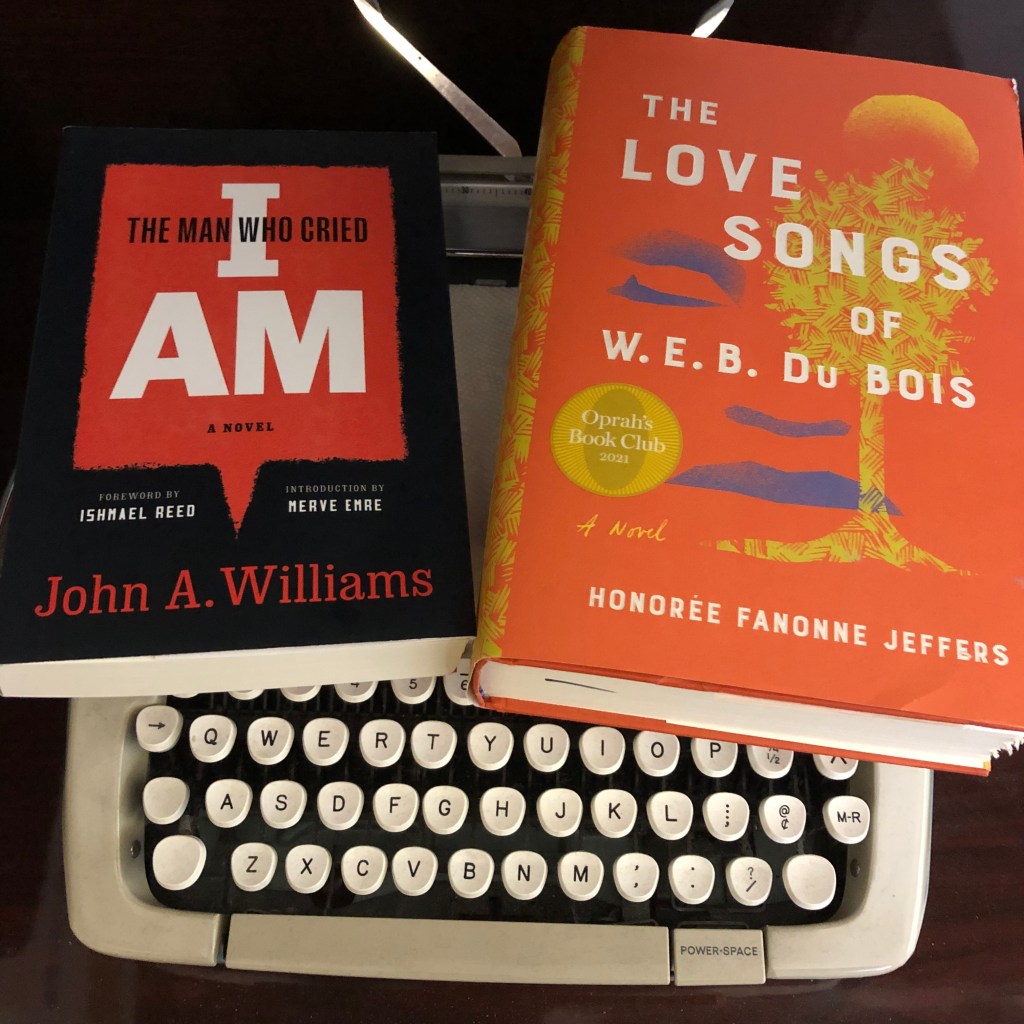
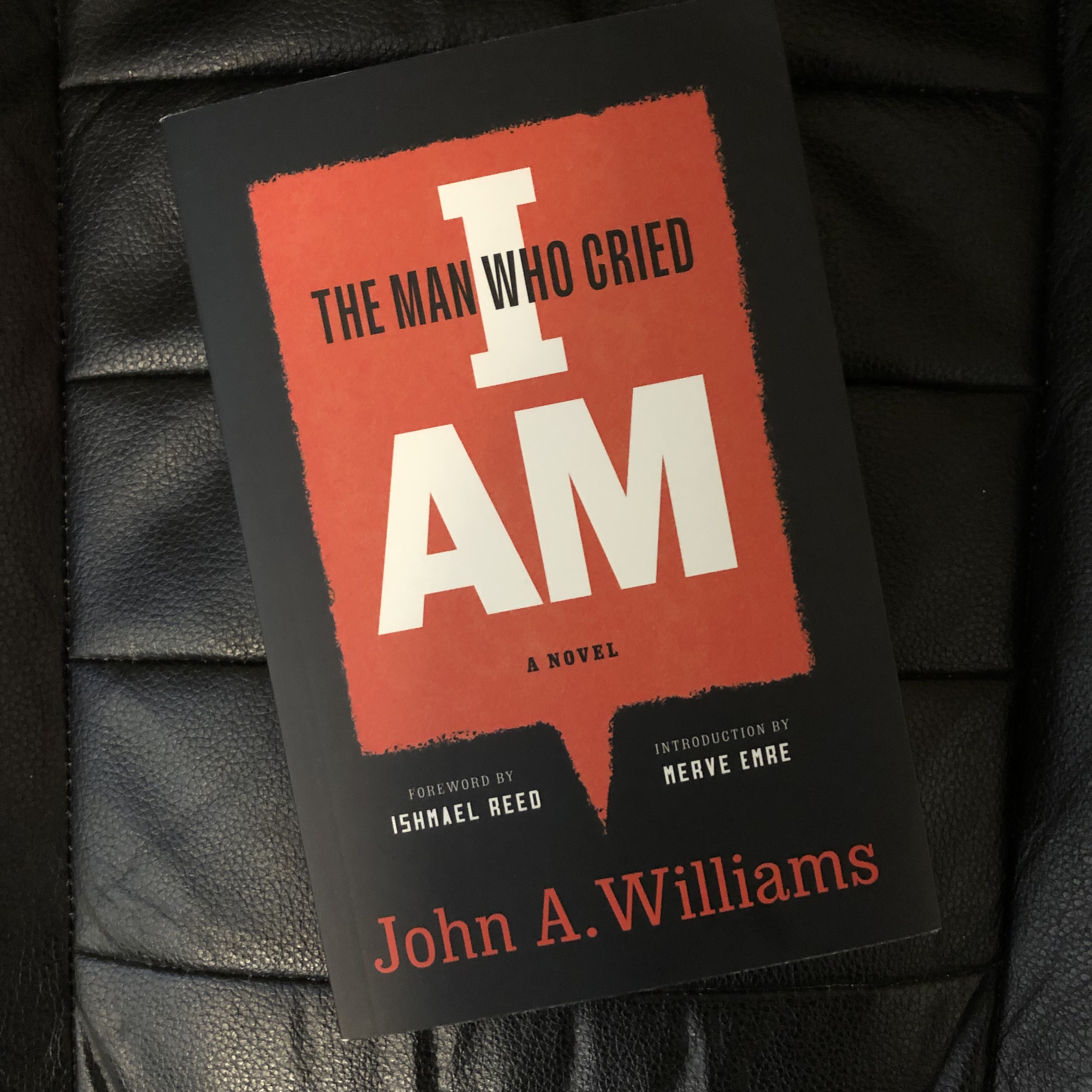
      Williams, John A. The Man Who Cried I Am: A Novel. Library of America, 2023.

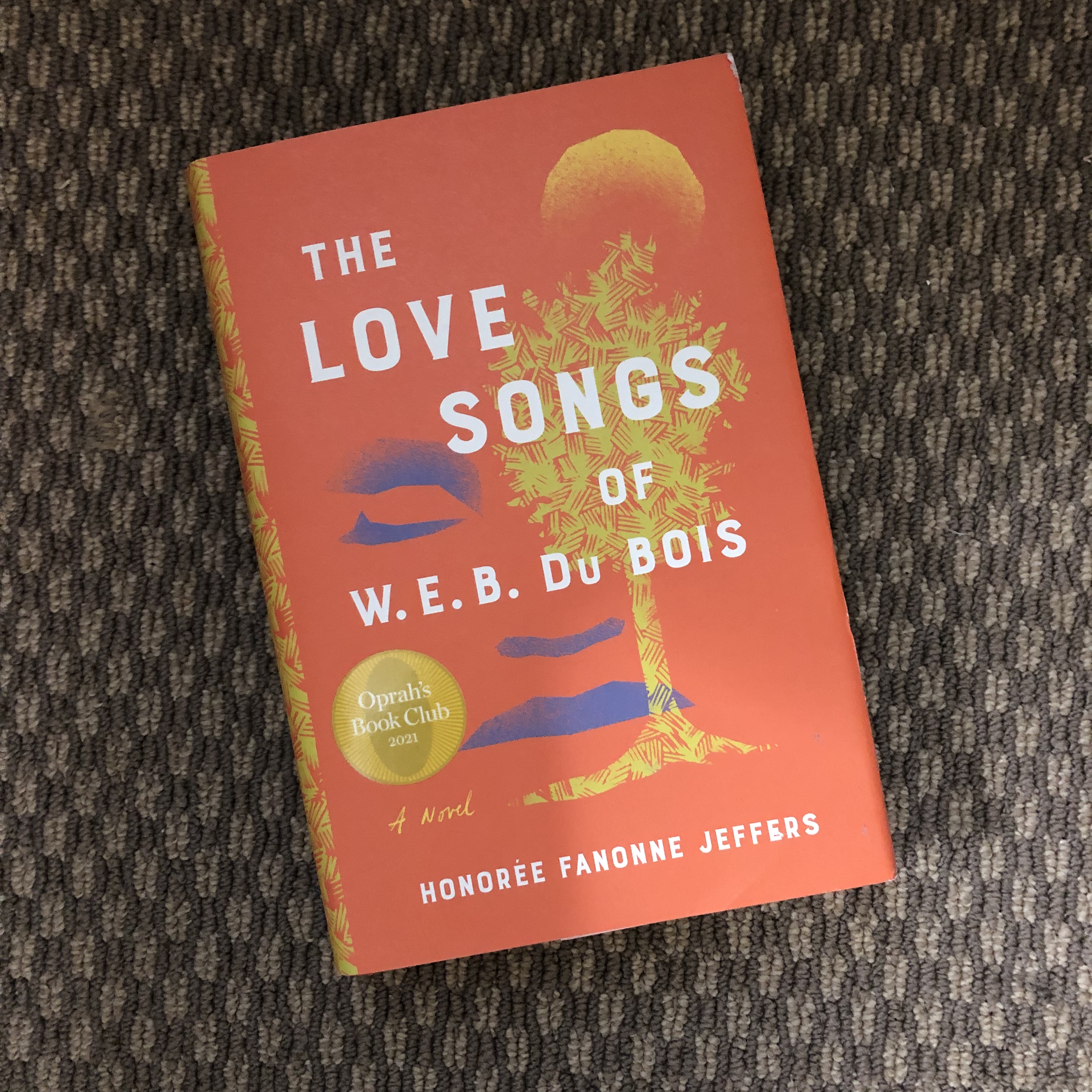
      Jeffers, Honorée Fanonne. The Love Songs of W.E.B. DuBois. Harper, 2021.

      I did not set out this February to read two books that furnish a starkly contrasting view of the Black American experience; it just turned out that way. John A. Williams’ 1967 conspiracy-theory novel The Man Who Cried I Am, reissued in 2023 by the Library of America with a foreword by Ishmael Reed and an introduction by Merve Emre, feels about as far as one can get from Honorée Fanonne Jeffers’ sweeping 2021 family/historical epic The Love Songs of W.E.B. DuBois. The contrasts, though, are oddly illuminating of the ways in which gender norms intersect with race.

      ***

      The LOA’s reissue of The Man Who Cried bills it as a forgotten classic. It tells the story of Max Reddick, a Black American writer and journalist, who we find dying of rectal cancer and reminiscing on the flotsam and jetsam of his personal and professional life during a visit to Europe for the funeral of his friend, the famous author Harry Ames. (The Man Who Cried is, among other things, a roman à clef with many characters torn from real life, and the expat-in-France Ames is obviously modeled on Richard Wright.) While he catches up with his estranged wife in the Netherlands and with other friends he shared in common with Ames, Reddick discovers that Ames bequeathed him documentary evidence of a top-secret US plan, King Alfred, to round up Black Americans in concentration camps and/or to exterminate them in case the civil rights movement went too far for White comfort. Ames, he discovers, was murdered for his knowledge of this information. Reddick, now himself in danger of his life, just manages to leak evidence of the plan to Minister Q, the novel’s equivalent for Malcolm X, before he is murdered for what he knows. The novel ends on an ambiguous note, implying that the American government’s murder of Ames and Reddick signals the beginning of King Alfred’s implementation, but giving no inkling of its success or failure at its genocidal aims.

      It’s a rather long novel and the vast majority of it happens before the unveiling of the King Alfred plan. Reddick, who is loosely modeled on the author himself as well as Williams’ friend and fellow author Chester Himes, takes us via his reminiscences through a turbulent career. Even without the conspiracy theory twist the story takes, the novel is a fascinating and sharply opinionated take on the Black literary scene in postwar America. A common refrain is that the white-dominated literary world will only accept one Black writer at a time, and in the late fifties and early sixties it is Ames (i.e. Richard Wright). The goal of every other Black writer is to dethrone Ames/Wright so that they can get their turn being “the one.” As Marion Dawes, a very unflattering and churlish depiction of James Baldwin, puts it to Ames’s face: he has to kill the father to take over, and Ames/Wright is the father he has to kill. It’s a rather bare-knuckle, cynical take on the famous literary feud between Wright and Baldwin, reductive, perhaps, but also a contemporary (and today under-represented) take on the context behind the feud nonetheless. It’s interesting to know that this take exists, even if one thinks (as I do) that it grossly simplifies Baldwin’s motivations and the merits of his critique.

      The book is also pretty unabashedly misogynistic and homophobic. Reddick and Ames womanizers to the end (a lot of sex happens in this book, very little of it with anyone’s actual “official” partner), and very few woman characters are introduced with a description other than the attractiveness, or lack thereof, of their physical attributes to Reddick. Reddick’s last wish for sexual conquest is to have sex with a redhead, a wish that (spoiler alert) is destined to remain unfulfilled. Reddick’s view on Black women writers is curtly dismissive. Dawes/Baldwin and other literary “faggots” earn little more than Reddick and Ames’ ridicule. And so on. The misogyny and homophobia are not really the point of the book; they’re casual, like the air (and the second-hand smoke) the book breathes. It’s just jarring to read in 2024, and was likely more than a little jarring in 1967. As Ishmael Reed writes in his Foreword, “If #MeToo ever had truth and reconciliation forums, I’d be on trial with the rest of the guys” (xx).

      The Man Who Cried is also a social and political novel, and not just when it comes to the King Alfred plan. Reddick’s journalistic career gets put on hold in the early 60’s when he accepts an irresistible invitation to join the speechwriting team of an unnamed president (who is clearly John F. Kennedy). Reddick quits in disillusionment when the president’s commitment to civil rights is decidedly lukewarm, a fact that in the world of the novel makes perfect sense once the contours of King Alfred come to light. Reddick then resumes his journalism job and works the civil rights movement beat, covering not only Minister Q/Malcolm X but also Paul Durrell, a thinly veiled stand-in for Martin Luther King, Jr. Reddick dislikes and distrusts Durrell, finding his political stance too reactionary and deferential to White feelings and his personal life dangerously messy. He has far greater respect for the radicalism, non-pacifism, and personal rigidity of Minister Q, which is why, when the genocidal aspirations of the US government become clear, Reddick entrusts what he has learned to Q in hopes that he can organize an appropriately militant response to King Alfred in time.

      The Man Who Cried is a hard-boiled, paranoid thriller that is a little enervating to read, but in 1967 it had the ring of literary truth for a lot of people. Williams ran pages from his (fictional) King Alfred plan in New York newspapers as advertisements as a publicity stunt, which led many people to confuse, War of the Worlds-like, the fiction for reality. Emre’s Introduction to the 2023 LOA edition even relates that Clive DePatten, a young Chicago man associated with the Black Panther Party, testified in 1970 before a committee of Congress that he thought the King Alfred plan was real, leading the committee to observe that no, that plan was from a work of fiction. In our time, right-wing conspiracy theories are in the ascendant, including the “Great Replacement” theory that is almost a color-flipped version of King Alfred, and so this novel’s conspiracy theory feels odd, almost quaint. The left speaks now of systems, of neoliberal “best practices” that everyone seems to take as so self-evident that they don’t bother to cover them up, of standard diplomatic and economic policy that of late has made the US Israel’s de facto—and sometimes, literal—defense lawyer while it seeks to liquidate the Palestinian populations of Gaza and the West Bank. We now know that the odds that anyone could hide a plan of the magnitude of King Alfred in official Washington in 2024 is nearly nil, but that it really doesn’t matter; the problem today is a glut of information, a confused, benumbed population incapable of sorting through it all, and a full quarter of the US electorate for whom no countervailing facts will ever overcome their self-absorbed sense of grievance. Official secrecy hardly matters anymore. Yet a book like this serves as a lurid reminder in our times that America still lives in a tense relationship, not only with Blackness, but also with the workings of state power.

      ***

      It is hard to imagine anything more removed from the hard-nosed, solitary, misogynistic, paranoid world of The Man Who Cried than The Love Songs of W.E.B. DuBois. In Love Songs, Jeffers paints a panoramic picture of the life of Ailey Garfield, a contemporary Black woman, and that of her ancestors back to the 17th century in what would become the state of Georgia. It is definitely a woman-centric book—there are plenty of men, but women drive the story—but it is not even remotely all sweetness and light. Many of Aliey’s ancestors are enslaved, and the book does not soft-pedal both the vivid horrors and routine humiliations her ancestors endure. Love Songs is also clear-eyed about Ailey’s White ancestors and their relationship to her story through rape and, occasionally, love, but love warped by the unquestioned power Whites enjoyed in the American South both before and after the Civil War. To boot, a central motif of Ailey’s story involves child sexual abuse; her most prominent White ancestor was a prolific abuser of children, and she and her sisters also endure being sexually abused as children by their paternal grandfather, Gandee. This book stares a lot of pain and injustice squarely in the face.

      But what makes this book feel so different from The Man Who Cried is that it is leavened by a sense of hope, a sense that connecting with one’s ancestors is powerful, a sense that Black women have survived terrible things and that, together, they will keep surviving. Jeffers proudly wears the feminist/womanist influence of Alice Walker (and before her, Zora Neale Hurston) on her sleeve. As in Walker and Hurston, and unlike Williams’ novel, formal politics and political actors play virtually no role in the story. The story is not impervious to such matters; Emancipation and Reconstruction happen, of course, as well as Jim Crow, the civil rights movement, and even the Black militancy of the 1970’s. These things, though, aren’t really the point in Love Songs. Jeffers’ Chicasetta, Georgia, the ancestral home of Ailey’s family, is remarkably like Hurston’s Eatonville, Florida in this respect: a world where Black folk, and especially Black women, live their lives aware of, and wary of, White folks but unencumbered by the White gaze in their daily living.

      Williams is haunted by the specter of White America deciding to liquidate the ten percent or so of its population that is Black. Love Songs observes, though, that by blood, by history, and by culture, Black and White (and Native American) folk in America are so intertwined that even the effort to extricate them from one another mentally requires Herculean feats of denial, intentional obfuscation, and bad faith. Forget about actually doing it!

      Racism is definitely a theme in Love Songs—the episodes from the second half of the book when Aliey begins graduate school in history and encounters White Southern history grad students are cringeworthy and priceless—but unlike in The Man Who Cried, its perpetuation isn’t the work of a conspiratorial cabal among the security apparatuses of world governments. It is what we now call “structural” racism, that ghostly set of taken-for-granted practices and structured ignorance and privilege that is so hard to combat precisely because no single institution implements it according to a plan.

      ***

      Certainly some of the difference between The Man Who Cried and Love Songs is the benefit of what the past few decades have taught us. Love Songs was published over forty years after The Man Who Cried, and the terms of what Charles Mills has called the implicit “racial contract” structuring race as a social category have just changed. For that matter, so has the sex and gender contract. The male characters in The Man Who Cried, if not the entire book, could be read, not without justification, as mid-century machismo and its projections run amok. Reddick literally does cry “I am” at multiple points in the novel, and his sense of what it means to “be” is in these moments agonistic—a cry for his enemies to come forward, name themselves, and grant him the dignity of stating their case against him to his face. To face him “like a man,” in other words. At the end of the novel, he gets his wish, dying not of the rectal cancer eating away at him but assassinated by an acquaintance who he has discovered is working as an agent of the King Alfred plan.

      Love Songs, though, presents a very different sense of what it means to “be” in this strong sense. Aliey discovers not only who she is by exploring who her ancestors were and what they did and suffered. She discovers that in this search for the ancestors, even those who set themselves against one as enemies are among one’s ancestors as well, showing that their taking up the position of adversary rests upon their own alienation from and refusal to acknowledge their own pasts. And at least some of this alienation is the result, not just of the fictitious but socially valent discourse of race, but also of gender and its norms. Multiple men who cross Ailey’s path in Love Songs are much like Max Reddick: damaged, not only by the omnipresent reality of structural racism and its many consequences, but also by the straitjacket of their own gendered expectations.

      But Love Songs at least holds out an example of Black masculinity outside these straitjackets: Dr. Jason Hargrace, Ailey’s uncle and mentor who she knows from childhood as “Uncle Root.” Uncle Root is a retired history professor at Routledge College, the fictional HBCU in Georgia which Ailey and one of her two sisters attends as an undergraduate. Uncle Root is genteel, wise, a defender of W.E.B. DuBois who acknowledges the liabilities of DuBois’s elitism, and a sort of proto-feminist. In a recurring motif in the book, Uncle Root even takes the last name of his wife, Olivia, in an echo of the matrilineal Creek society of the family’s Native American ancestors. Uncle Root’s Black masculinity is not premised on drawing out an enemy for direct combat, but instead in patience, wisdom, and support, especially of Ailey and the other women in their family.

      I did not deliberately set out to read these two books so closely together. They both just happened to rise to the top of my reading pile near one another. Yet it’s now hard for me to think about the issues they both raise without thinking of the tension field that exists between the two. It’s odd how sometimes one’s occasional reading works out like this in ways one never would have expected. This is why I rarely make elaborate reading plans or set terribly specific reading goals. Sometimes the most incongruous books yield the most interesting insights when put in conversation with one another.

    2. Why I Still Prefer Print Books

      Why I Still Prefer Print Books

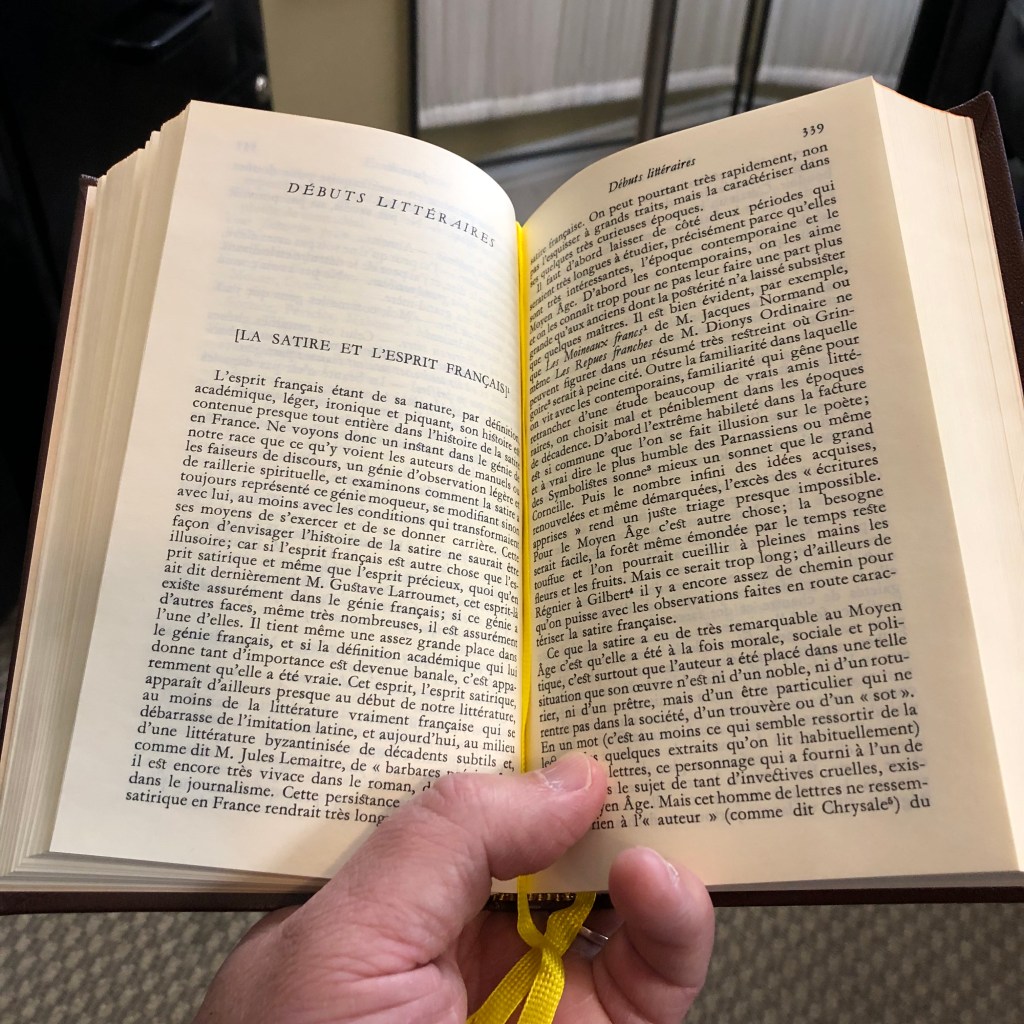
      At present I am making my desultory way through a collection of Marcel Proust’s critical writings,[1] the centerpiece of which is a collection of notes for a book-length work of criticism that would have probably borne the title Contre Sainte-Beuve (Against Sainte-Beuve). Proust’s writing abounds in observations on books and literature, but the writing collected in this volume contains his most sustained discussions of reading, particularly the experience of reading.

      For Proust, there is nothing automatic, transparent, or facile about reading. Contre Sainte-Beuve, written in French, deals with French writers in its entirety, and yet he says: “The great books are written in a sort of foreign language.” He goes on to say that “beneath each word [of them] each of us puts our own reading [sens], or at least our image, which is often a misreading [contresens]. But with the great books, all the misreadings one makes are great.” Yet with care and diligence, one reads great works more than once, and one reads more books by the same author. Reading more than one book by the same author is, in fact, essential; in doing so commonalities become salient, habitual turns of phrase or characterizations, all of those things that go into our sense of a writer’s distinctive style, much as we perceive “the same sinuosity of a profile, the same piece of fabric, the same chair in two paintings by the same painter” which shows us “something common to both: the predilection and the essence of the painter’s spirit.”[3] The more we read, the more we realize, in a form of historical consciousness, that “in the same generation spirits of a similar sort, of the same family, of the same culture, of the same inspiration, of the same context, of the same condition, take up the pen to write almost the same thing in the same way,” and yet each “embroiders it in a particular way that is his own, and which makes the same thing completely new.”[4]

      Contre Sainte-Beuve remained unfinished and unpublished at Proust’s death in 1922, so the work is fragmentary in form and undecided as to its overall literary conceit. Proust did seem to consider it at one point as a straightforward work of criticism under his own voice, but the chief conception that comes through in the notes we have is of a dialogue between Marcel, the narrator of In Search of Lost Time, and his mother. Even then it would have been largely a monologue; the notes we have contain no actual words assigned to Marcel’s mother. Written shortly before Proust began devoting his waning energies chiefly to ISOLT, it is unclear whether it would have been a preface to that work or its final part, its coda. In addition to Proust’s own takes on literature and criticism, we get introduced to preliminary glimpses of Gilberte Swann, Mme de Villeparisis, and the Count and Countess of Guermantes.

      Proust more than once describes the Count of Guermantes’ love of Balzac and says that he has a full edition of The Human Comedy in his library that he inherited from his father. (This version of the Count of Guermantes, at least, has little patience for the vie mondaine of aristocratic society and hides in his second-floor library whenever the Duchess has guests.) Near the end of the notes on Balzac, the narrator writes:

      I must admit that I understand M. de Guermantes—I who read the same way throughout my whole childhood, I for whom Colomba has been for so long “the volume from which one forbade me to read the Venus d’Ille” (“one,” I say, Mother—it was you!) Those volumes from which one read a work for the first time are like the first dress in which one saw a woman for the first time; they tell us what the book was for us then, what we were for it. Finding those volumes is the only way in which I am a bibliophile. The edition from which I read a book for the first time, the edition in which it gave me its first impression, are the only “first editions,” the only “original editions” in which I have an interest. It is still enough for me to remember those volumes. Their old pages are so porous to my memory that I am nearly afraid that they will also absorb my impressions from today and that I will no longer find in them my impressions from before. Every time I think about them, I want them to open themselves up to the page where I shut them near to the lamp or the wooden bench in the garden, when Papa told me: “Stand up straight.”

      And I wonder sometimes whether the way I read today might still more closely resemble that of Mr. Guermantes than that of contemporary critics. A literary work is still for me a living whole whose acquaintance I make from the very first line, that I listen to with deference, to which I grant all rights as long as I am with it, without choosing or debating. [5]

      For Marcel, the physical form of the book—not only the book’s binding, the look of its pages, but also its insertion into his physical space, its relationship to his body—are indissolubly part of the “living whole” of the book as read, not only part of the experience of reading it but also of the memory of what it says.

      Marcel goes on to say that as he matured he began to extend this sense of the living wholeness of a book to encompass all of the books of an author—just that labor of comparison and noticing of commonalities he elsewhere says is part of the work of reading. In this, he says he has gone beyond the Count of Guermantes, whose sense of reading is so bound up with the physical form of the books in his library that he routinely confuses which author wrote a book because, in his library, books by several authors have the same binding:

      [T]he library, M. de Guermantes’ father’s library, contained all of Balzac, all of Roger de Beauvoir, all of Fenimore Cooper, all of Walter Scott and the complete plays of Alexandre Duval, all bound in the same old-fashioned gold binding. The Count adored these books and re-read them often, and one could talk to him about Balzac without finding him at a loss. … But if one asked the Count [about Balzac’s novel Mademoiselle de Choisy], he would say: “I think Roger de Beauvoir wrote that.” He easily confused all these “charming” books that had the same covers, the same way that people mix up the senna and the morphine because they come in the same white bottle.[6]

      Obviously collapsing the experience of encountering a literary work wholly into that of encountering a specific physical object at a specific place and time can go too far! In reading, we are in some part reading through the visible words to the meaning, which is, at some ideal limit anyway, the same regardless of the physical format in which we encounter the words. But this sensuous, physical aspect of reading—the conscious encounter with a specific copy of a book, published at a specific time, on a specific kind of paper, set in a specific font, read under specific conditions, is for me, as it appears to be for Marcel, an irreducible aspect of reading, the soil out of which all reaching for the ideal meaning of the words towards the “spirit” and music of the author grows.

      This episode from Proust helped bring into focus for me why I have become so disenchanted over time with ebooks. In the 1990s and early 2000s, when ebooks went from public-domain text files without formatting and became formatted documents made available by publishers themselves, I was mildly intrigued. However, when I first bought a tablet in 2012 I was not only a convert to ebooks, but a sort of evangelist. The notion of owning a whole library of books that didn’t weigh anything or take up more physical space and that one could carry around everywhere fascinated me. I even contemplated the possibility of obtaining digital copies of all the books I had in my physical library and then getting rid of the physical library. It added to ebooks’ allure that in 2012 I was in a point in my life in which I had moved on an average once every two years and was very tired of schlepping between 40 and 60 boxes of books every time I got a new apartment.

      Yet once I actually began reading more, ebooks really began to lose their luster. Yes, they are convenient. They are also a relatively inexpensive way to obtain books that in some cases would be difficult to obtain in hard copy. I still do about 25-30% of my book reading digitally. But I still find them unsatisfying, and when I expect that a book will be especially enjoyable or useful or important to me, I obtain a physical copy of it whenever possible.

      What changed for me was intimately related to the experience of reading ebooks. To get at what I am after, think about what it’s like to read a print book. A print book is, before it is anything else, a discrete physical object. You hold it in your hand. It has mass, and the longer it is the more mass it has. The covers and the pages have a texture, a color, a smell, a thickness. In reading it, your body has to make certain accommodations to it: you have to hold it a certain way, at a certain distance, under a certain kind of light for it to be legible, you have to support one side of it more than the other depending on whether you are nearer the beginning than the end, and so forth. It is literally another body situated in space alongside my body, a foreign body one handles, maneuvers, cradles, caresses. And different books, like different bodies, have to be handled differently. The brand-new paperback I bought demands to be treated differently than the tiny, fragile 1804 copy of Ossian’s Poems I bought from a library sale in 1993.

      Needless to say, ebooks are not like this. Of course, ebooks are physically instantiated; they aren’t utterly non-physical. The machines (computers, smartphones, tablets) we use to read ebooks are also physical. But their physicality is, with respect to the reading experience, negligible and largely indifferent. The machine from which I read an ebook is just a platform that displays to me, now one ebook, now another. The experience of reading one ebook is more or less like reading any other. For that matter, if I am reading the ebook off of a device I use to do other things, the experience of reading the book is functionally the same as all the other things I do on the device—read and receive e-mail, do work, make phone calls, read and post on social media. All of these things happen within the four corners of the same screen on the same device. The computer, phone, or tablet remains the same physical object in the same physical configuration with respect to my body no matter how much or how many books I read on it.

      This fact about computing gives rise to a different sense of the space in which an ebook is located. Computing tasks—all ebook reading is just a kind of computing task, of course—all take place in a space contained within one or more physical screens that depending on the device one is using is called a “desktop” or a “home screen.” (I will just refer to it as a “desktop” from here on out.) The programs one opens—the e-book reader, the web browser, the e-mail client, and so forth—open within and on top of this desktop. The desktop’s height and width mirror those of the physical world our bodies inhabit, but depending on the platform we are using, they may be slightly bigger than what we can see of it through our screen. (On a Windows PC, for instance, one can move a window for an application so that a large portion of it extends off the screen into void, invisible space.) The strange feature of this space, though, is that its depth functions in ways wholly unlike that of physical space. The background image of one’s desktop functions as the ground, the bedrock, over which one can layer as many application windows as the computing power of one’s device will allow. None of them have the slightest thickness; having fifty windows open on one’s screen is spatially the same as having one open, or none.

      One’s relationship with this strange quasi-physical space of computing that resembles, but is not the same as, our own, to which our screens give us a limited window, is, when you think about it, completely indirect. Before the advent of touch screens, manipulating what happened on the screen involved pushing physical buttons (on a keyboard or mouse) and moving tracking devices (the mouse) which would then make something happen in the computing space. Touch screens have not eliminated this indirection; they have only changed it. One still has to tap on the screen in just the same places one had to click on using one’s mouse previously. On completely touch-screen environments like smartphones or tablets, tapping or swiping with one’s fingers does not always yield the results one would get in the physical world. Tapping or swiping the screen in one application does one thing in one application, another thing in another, and sometimes, depending on the device, swiping brings up entire screens related to the operating system that half the time one didn’t even ask for. In other words, rather than mimicking physical manipulation, touch-screen devices convert physical gestures into yet another set of quasi-linguistic commands with a physical “vocabulary” one has to learn in order to use the devices competently, and that one has to re-learn when one switches between platforms with different operating systems.

      When it comes to ebooks, the quasi-physicality of computing space together with the largely arbitrary physical “vocabulary” of gestures used on touch-screen devices utterly deprives the reading experience of its physicality, its resistance, its thickness. It’s like reading a book hermetically sealed under glass, whose pages move at a command but which one can never hold, never touch. It’s actually a little worse than that, because in a physical book, even one in a glass case, the words are fixed on the pages where they are printed. In an ebook one reads off of an e-reader like a Kindle, Nook, or other tablet, the location of the words on the page and what they look like are fluid and fungible. One can change the font, the font size, the margins, even whether the background “page” is white, sepia-toned, or black (if one is reading off of a color device). Make a change to any of these, and the position of the words on the screen of text one is reading move. (Sometimes, depending on the ebook’s formatting, they even move without making any changes when one swipes forward to a later page and then swipes back to find one’s place.)

      Admittedly, the adaptability of text presentation on ebooks is a great advantage for neuroatypical readers or readers with visual issues, since they can make books accessible in ways that most physical books are not for them. I am definitely not glossing over that—nor am I arguing for the abolition of ebooks! (As I said previously, I do at least 25% of my reading off of an e-reader.) It’s just a different experience for me, and one that is impoverished for me in a lot of ways. I have a hard time savoring writing off an e-reader. I tend to read off an e-reader solely for the ideal content of the words, not the sensuousness of what the words say. Most of my e-reading tends to be nonfiction now that I think about it.

      In ebooks I join the author in what she means to say, but the reading doesn’t bring my body along with it. I miss the kinesthetic experience of physical books—of the words I read, the paper they are printed on, the weight of the book, the sense of anticipation I have when holding open the first few pages of a book I just started, the feeling of clearing the halfway point, the lightness in my right hand as I near the end. (Or in my left hand, if I am reading manga!) More subtly, though, I find myself missing the difference between books—the yellowing mass-market paperback of The Prime of Miss Jean Brodie from the 1960’s I just read versus the leather-bound, bible-paper elegance of the Pléaide edition of Contre Sainte-Beuve I am currently reading. On my e-reader, all ebooks, even PDFs that give literal scanned images of physical pages, feel somehow interchangeable, like scraps of a single vast ocean of context-free text. (A fact about electronically stored text that large-language AI models have, of course, exploited.)

      Perhaps I am just a cranky old man consumed by nostalgia for his past. Physical books, after all, are themselves a technology that has undergone numerous transformations in history.[7] Holding up one form of the book as somehow sacred is historically blinkered, to say the least. Yet the advent of ebooks has not led to the demise of the physical book, as presaged in the late 2000’s and early 2010’s. Print books, at last report, still vastly outsell ebooks. It can’t be the case that all of those physical book buyers are just buying them to show on Instagram or TikTok or to use as interior design accessories. Something endures about the physical book format.

      Or, as Proust puts it, those porous book pages are still soaking up our memories, our impressions, our thoughts, all of the embodied reactions we have when we encounter the words of another in reading.


      [1] Proust, Marcel. Contre Sainte-Beuve précédé de Pastiches et mélanges et suivi de Essais et articles. Ed. Pierre Clarac et Yves Sandre (Gallimard (Pléiade), 1971). I identify all citations to this volume as “Sainte-Beuve” followed by a page number. All translations, and hence all translation errors, are entirely my own.

      [2] Sainte-Beuve, p. 304.

      [3] Sainte-Beuve, p. 304.

      [4] Sainte-Beuve, p. 306.

      [5] Sainte-Beuve, p. 295.

      [6] Sainte-Beuve, p. 297.

      [7] Irene Vallejo provides a colorful anecdote-filled account of this history in Papyrus: The Invention of Books in the Ancient World (Knopf, 2022).

    3. The Spice Must Flow

      The Spice Must Flow

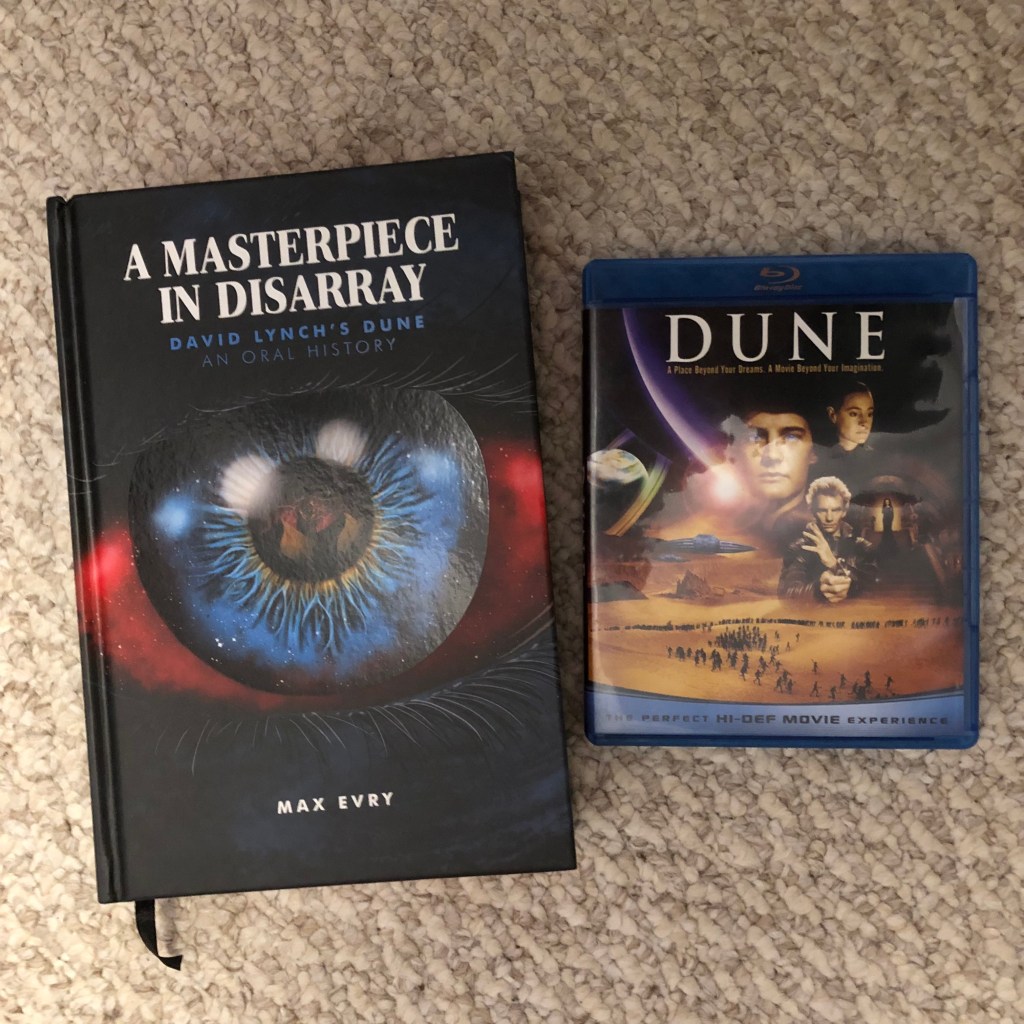
      Evry, Max. A Masterpiece in Disarray: David Lynch’s Dune. An Oral History (1984 Publishing, 2023).

      Any number of feature films have been released in theaters in versions so truncated that they are nearly incomprehensible. Two examples of this always leap to my mind: Wim Wenders’ Until the End of the World (1991), and David Lynch’s Dune (1984). In the case of Until the End of the World, at least, we now have the benefit of Wenders’ five-hour director’s cut, courtesy of the Criterion Collection. Having loved the 1991 theatrical release of Wenders’ epic road movie in the face of quite a lot of ridicule, and knowing its flaws, the director’s cut was, to me at least, a revelation of what could have been.

      No such director’s cut is forthcoming for Dune, even though a fan edit that restores a great deal of cut footage exists. Max Evry’s A Masterpiece in Disarray: David Lynch’s Dune. An Oral History (2023) gives us, among other things, a glimpse into why that director’s cut will likely never happen. Even if you don’t like the film enough to care about seeing a longer version of it, Masterpiece offers a glimpse at the way studio filmmaking worked in the early 1980’s, when Star Wars had already changed the rules of the game, for better or for worse, and the studios were racing to catch up. Films simply aren’t made like this anymore, and reading this book made me nostalgic for the version of Hollywood we get in the book, one where oddballs and hustlers could get a major studio to throw money at them to make a bizarre movie in the hope that it would stick. This book has no mention of focus groups, of creative decisions made with foreign distribution in mind, of crossover franchising—it’s just Lynch and Raffaella and Dino DeLaurentiis and a bunch of other weirdos in a literal sandbox in Mexico playing with millions of dollars.

      Lynch’s Dune was not the first attempt at adapting the 1965 Frank Herbert novel. Perhaps the best known was Alejandro Jodorowsky’s ambitious but abortive 1970’s project, the subject of the 2013 documentary Jodorowsky’s Dune. In the late 1970’s and early 1980’s, though, the blockbuster success of Star Wars and The Empire Strikes Back had all of the studios searching for what might be the next epic sci-fi adventure franchise. Famed producer Dino DeLaurentiis decided that it could be Dune and its many sequels. After all, Star Wars had cribbed so much from Dune that Frank Herbert himself had even contemplated suing George Lucas. What DeLaurentiis and company had in mind was that Dune, adapted for the screen, could become a Star Wars for adults.

      The real weirdness of the making of Dune, when compared with 2024 Hollywood, begins with how David Lynch ended up directing it. At one point, Ridley Scott was attached to the project, but he decided to make Blade Runner instead (another sci-fi classic that, like Dune, suffered from studio interference). Lynch had developed a small but devoted art-house following in the industry from making Eraserhead and The Elephant Man—so devoted, in fact, that by 1981 and 1982 Lynch found himself in considerable demand from the major studios. He was on a short list to direct, if one can believe this, Fast Times at Ridgemont High (!), and George Lucas himself was courting him to direct Return of the Jedi, the third of the original Star Wars trilogy.

      But DeLaurentiis and Dune won out. Evry’s account, which is pieced together from interviews, reporting from the time, and other available sources, suggests but does not firmly conclude that Dune was, of all these major-studio courtships, the movie Lynch really wanted to make. It hints that Lynch really had little interest in Return of the Jedi, a film all of whose artistic decisions had already been made before production even began, but he strung Lucas along for a long time in order to use Lucasfilm’s interest in him as leverage over Universal, DeLaurentiis, and Dune. If so, the stratagem worked—at least as far as Lynch and his creative team getting the movie off the ground, which is more than previous attempts to adapt Dune had managed to do.

      The long story leading from pre-production to the release of the film, which comprises the bulk of the actual oral history in Masterpiece, is in effect the story of Lynch and his creative team running up against the limits of what a major studio was willing to do in 1983 and 1984. Universal and DeLaurentiis pumped a lot of money into Dune, and Lynch, as we now know with the benefit of his subsequent career, has a definite artistic vision, one which he brought to bear on Dune and which was blessed by Frank Herbert himself. The original hope, consistent with the Star Wars-like blockbuster franchise model, was that Dune would be the opening installment of a franchise that would eventually adapt Dune Messiah and Children of Dune. (As Masterpiece discusses, the studio even planned and marketed a series of tie-in action figures and toys, something I had completely forgotten.) As anyone who has read those sequels to Dune knows, though, that story isn’t the feel-good Joseph Campbell-style Journey of the Epic Savior Hero that Lucas baked into Star Wars. It is, in fact, a cautionary tale of the dangers posed by the (ahem, white) Epic Savior Hero narrative when wedded to advanced technology and geopolitical ambitions, a ciphered criticism of the colonial adventures of the European powers in the Middle East. A story for adults, definitely, and apparently the story Lynch was prepared to adapt for the screen.[1]

      The film, however, began to fall foul of the inevitable limitations of what a major movie studio hungry for smash hits would finance before principal photography even finished. Some of the problem was sheer cost, of course, a concern compounded by the fact that the Dune Lynch had in mind would have been at least three, possibly four, hours long. Add to that the fact that the film was being made before the advent of cheap, relatively easy CGI visual effects, and that the production had to switch visual effects companies right as the post-production VFX stage started, and the business side had a real problem on its hands. Masterpiece is careful not to draw firm conclusions or to point unambiguous fingers on this most sensitive point—it merely quotes the principals interviewed at length and lets the reader decide—but the picture that emerged for me is that both Universal and DeLaurentiis blinked in tandem early in post-production, albeit each for slightly different reasons, and forced Lynch to cut Dune into a much shorter, more traditional Epic Savior Hero film.

      The final product is now, after forty years, fairly well known—a perplexing two hour and seventeen-minute head-scratcher with awkward exposition and odd voice-over narration taking the place of several minutes’ worth of cut material, awkwardly paced, with the feel-good “rain on Arrakis” Kwisatz Haderach Messiah ending. (This was not originally how the film was supposed to end, and it certainly isn’t how the book ends.) Since the studio took control of the final cut before the visual effects production was done, there is famously not enough completed footage that could be used to reconstruct a director’s cut even if Lynch were interested in making one. (A 1988 version of the film—the “Alan Smithee” version, done without Lynch’s involvement—that restored cut material without finished visual effects that aired on independent TV stations in the US had to make do in some portions with still artistic drawings and lengthy voiceover narration.)

      Masterpiece abounds in anecdotes from numerous people who participated in making Dune—actors Kyle MacLachlan, Sean Young, and Alicia Witt and costume designer Bob Ringwood are especially memorable. But the main character of the book is obviously Lynch himself, who we encounter through the anecdotes of others in his first picture for a major Hollywood studio, losing creative control bit by bit. The experience was, by all reports, deeply traumatic for Lynch, and he famously says as little about it as possible in public (except that it taught him never to surrender the right of final cut). Predictably, then, Masterpiece does not include much from Lynch himself—the book’s coda, after over 500 pages, is a brief three-page discussion with Lynch that does not really offer much that he hasn’t said publicly before. This isn’t the fault of Evry’s book, though. It does a remarkable job of putting together interviews with a lot of people, most of the Dune team in fact who are still alive and willing and able to talk frankly about a forty-year-old film production. (Alas, there are no interviews with Patrick Stewart here, although I am told that Stewart’s recent memoir Making it So relates Stewart’s experiences acting in Dune.)

      If anything Masterpiece is, as a book, too comprehensive, too encyclopedic. The book seems to be aware of this fact—a foreword to the reader who isn’t interested in reading the whole thing gives advice on which parts she should read depending on her interest. I give kudos to the publisher for its willingness to produce a book of this size and production quality. (The copy I have is a hardcover with red foil page edges, a ribbon marker, and a forty-page photo insert, all of which is printed on heavy, high-quality paper.) In some cases, though, its ambit of trying to stuff all it can about Lynch’s Dune between two covers wears thin, especially in the last fourth of the book which discusses the film’s legacy. The chapter on subsequent cultural references to the film, for instance, reads like a more elaborate version of the “References in Popular Culture” section of a Wikipedia page. However, I can recommend this book, not only to fans of the film and of David Lynch, but also to anyone who is interested in the process and the challenges of adapting a literary work for the cinema. If that process fascinates and mystifies you as much as it does me, A Masterpiece in Disarray will give you a lot to think about.


      [1] As a critical aside, it took the Star Wars franchise forty years—that is, until Rian Johnson’s Star Wars Episode VIII: The Last Jedi (2017)—to make a tentative foray at grappling with the problems inherent in the Epic Savior Hero narrative, especially when it plays out in a diverse, technologically sophisticated world. In other words, the very element of Dune George Lucas didn’t steal. And what happened? The film critics seemed to like it, but “the fans” (and the “paid a lot of money to be consistently wrong” Ross Douthat) raised such a hue and cry that the next film basically pretended that none of The Last Jedi even happened. Not even Lucasfilm can make, or seriously wants to make, “Star Wars for adults.”

    4. Negative, Silent Space

      Negative, Silent Space

      Lacey, Catherine. Biography of X (FSG, 2023).

      “Then she said this one thing I’ve thought of many times since—‘You have to know what you’re leaving out in order for it not to be there. Otherwise, it’s not an absence, it’s just nothing.’”[1]

      At a moment in Catherine Lacey’s alternate-history novel Biography of X (Farrar Straus Giroux, 2003), the title subject, a Protean woman who late in life simply referred to herself as “X,” has impressed Tom Waits enough for him to bring her to recording sessions at Electric Lady Studios in 1974. She amazes Waits and the rest of the studio with her inscrutable, mercurial style, which the narrator of the novel (her widow, C.L. Lucca) parses as a front she put up to play for time while she learned how to use the controls of the mixing board. As the episode with Waits in 1974 floats out of the narrative, Lucca writes:

      At the time of the Waits session, four years after Jimi Hendrix’s death, many at Electric Lady felt Hendrix’s emanation hanging around. Several were convinced that Hendrix’s ghost was responsible for blessings and curses, but no one was sure if Bee [the pseudonym under which X was working at the time] was the former or the latter. (186)

      The narrative of the novel has reached 1974 after a tour through the 1960’s. In the novel’s imagined counterfactual history of America, much of the 1960’s and early 1970’s counterculture and its literary and music scene has happened as it did here—folk music, Bob Dylan, protest songs—but the role of black folk in this period barely appears. This is the only mention of Hendrix in the entire book, and he is dead, a ghost, a spectral presence in the studio while she serves as a muse to Tom Waits.

      This small episode encapsulated both what I found so interesting and, ultimately, so frustrating about Biography of X. It is an entertaining, playful, and suspenseful romp through the artistic and cultural avant-garde of the American sixties and its aftermath, at the same time as it invites us to think through our cultural and political present through the lens of a different version of American history. The trouble, though, with this latter invitation is that the alternate America of X is deeply, profoundly divided along most of the same lines as our America, but, unlike in our America, race appears to play virtually no part in either creating the divisions or shaping the self-understanding of those most committed to maintaining them. As an invitation to rethink America’s past and present, black folk in X are, like Jimi Hendrix in the quote above, ghostly presences, capable of blessing or cursing from beyond the grave but of, it seems, little else. And, with respect to the fictional quote from X above, the book leaves several hints that race is a genuine, carefully contrived absence in the narrative, not a mere nothing.

      What that absence is trying to say, however, is unclear.

      ***

      It is possible to read Biography of X the way one might read, say, Dan Brown’s Da Vinci Code: that is, simply take for granted the factual premises the characters themselves take for granted, bracket those premises’ inherent implausibility, and get lost in the narrative, the characters, the events. In other words, read it simply as speculative fiction. At that level, the novel is both a great mystery story and a compelling portrait of a damaged, unlikable, cruel person and the abuse she metes out on virtually everyone in her life. (I have mixed feelings admitting that I have known people very much like X.) Yet it’s possible, and in fact much easier, I suspect, to tell a story like this without inventing an entire alternate history of the United States from the early 20th century forwards. (The film Tár leaps to mind.) It would seem that the elaborate counterfactual scenario Lacey invents isn’t just sci-fi style “worldbuilding,” but is instead part of the point the book is trying to get across. As such, it deserves some analysis in its own right.

      The broad outlines of X’s alternate history of America are as follows. On Thanksgiving Day 1945, as the United States was emerging from World War II, a secret cabal of Southern state governors suddenly put into action a plan they had been carrying out in secret for a decade. A swiftly erected wall formed a border between, roughly speaking, the states of the old Confederacy and the rest of the nation. The new seceded South re-christened itself the “Southern Territory” (“ST” for short), and, as Lacey writes, by mid-1946 the rest of the country, rather than fighting a new civil war, simply let the ST secede and attempted to isolate it diplomatically. The remainder of the country broke up into the Northern Territory (which seems to have comprised most of the US north of Tennessee and east of the Mississippi) and the Western Territory, which encompassed the rest. The Northern and Western Territories enjoy more or less pacific relations with one another, and the Western Territory has a “laissez-faire” policy towards the ST, but the relationship between the North and the ST are antagonistic and governed by tense and draconian treaties. Specifically, emigration out of the ST is strictly forbidden, and attempts to cross the border lead invariably to summary execution.

      The grounds of the ST’s secession are chiefly theocratic. In the America of X, Emma Goldman, far from being a harried, occasionally imprisoned anarchist revolutionary, is a pragmatic, yet still very progressive, socialist who moves from being governor of Illinois to chief of staff to FDR. She is assassinated in 1945, but not before leaving an indelible mark on the politics of the Northern Territory by means of her political activities and her essays. Under Goldman’s influence, the New Deal is far more progressive than that of our America, and in the America of X, the ST secedes largely on the stated rationale that American New Deal politics went too far to the left. In an act with practical and symbolic resonances, Southerners in X’s America bomb projects initiated by the New Deal Tennessee Valley Authority (TVA) in 1937, plunging what later becomes the ST into literal, not just metaphorical darkness. (The ST never gets widespread electrical service; a purported nighttime satellite photo prepared for the book dated 1993 shows the entire southeast of the continent in total darkness, surrounded by the bright lights of the other territories.)

      The Southern Territory in X, though, is modeled more on the Puritanism of Hawthorne and Henry Miller than it is on the actual Jim Crow south. Church attendance becomes mandatory; expressions of questioning and doubt are penalized; a Stasi-like network of informants, the Guardians of Morality, keep tabs on the entire populace. The ST, we learn, by its formal end in 1996 incarcerated nearly half of its population at some point in their lives. Lacey adds, almost as an afterthought, that of course this extremely punitive situation fell harder on black folk than it did on white, but there is no sense that criminality in the ST was, as it was in the actual American South in this period, a thoroughly racialized matter. Racial disparities were merely a difference of degree, it seems, not of kind. The book makes no mention of segregated institutions and public accommodations, the hallmark of the Jim Crow South. There is a mention, in passing, of anti-miscegenation laws, but they aren’t portrayed as revealing something important about the ST. It’s just portrayed as of a piece with the explicitly theocratic oppression that falls on pretty much everyone in the ST; preachers are power brokers on a par with governors and legislators, and public professions of faith are the coin of the realm.

      The Northern Territory is, by contrast, politically and socially progressive on a far more aggressive timeline than the more liberal areas of the actual United States. Early on, the Northern Territory abolishes sex and gender discrimination (including in employment and compensation), legalizes same-gender marriage, provides universal health care, provides universal basic income, and (we learn) very nearly abolishes prisons.[2] A recurring theme is that more subtle biases and discriminations still exist, but the formal legal framework is robustly anti-discrimination. However, even the descriptions of the Northern Territory do not make considerations of race central, other than to observe that it, too, has its own lingering legacy of racism, as it does for all of the invidious forms of oppression. But the ST is also, improbably, in one way far more progressive than the Northern Territory; for a time in the 1950’s and 1960’s, the ST had a formal program of reparations for descendants of enslaved persons, something that neither the Northern Territory nor the Western ever attempted.

      By the time of the novel’s present (2005), the ST had collapsed under the weight of its ignorance and paranoia in 1996, was reinvaded by the Northern Territory, and is on the path to an uneasy “reunification” (not reconstruction—don’t call it reconstruction!) with the north. (Reunification with the Western Territory is not even mentioned as possible or desirable.) There are echoes of post-Civil-War Reconstruction, especially in the form of a counterpart to the KKK, the American Freedom Kampaign—spelled with that “K,” I guess, so we won’t miss the parallel—who carry out acts of terrorism in support of re-secession and assassinations of their enemies. It is telling, though, that over the entire course of the novel, the only named victims of the AFK are white people, mostly escapees from the former ST with whom they sought to settle old scores.

      ***

      This alternate-history backdrop is an intriguing act of imagination, subtly portrayed. Biography of X is certainly a well-crafted novel. And I think one could just take the imagined history in X at face value and simply appreciate the way in which its characters’ lives are shaped by it. After all, it’s a made-up history. Who could tell Lacey she is wrong about it?

      No one, certainly; and yet the readers of this novel will undoubtedly bring their own sense of history to her novel in search of potential lessons about what might have been (and hence what might be today). What we find, then, is a history shorn of many of the familiar landmarks we now take for granted. There is no Vietnam War[3]; no civil rights movement, no Dr. King; no Huey P. Newton, no Black Panthers, no Angela Davis; for that matter, no 9/11 and no wars in Afghanistan or Iraq. Nor is there the engagement that the New York art and cultural scene of the novel’s 1960’s heyday had with any of these subjects: no James Baldwin, no Nina Simone. The cultural linchpins of X’s alternate late 20th century are David Bowie, Kathy Acker, Susan Sontag: Europe-facing white artists and intellectuals.

      All of this might, of course, just be an act of simple omission. A story need not be about everybody and everything, after all; stories that try risk reaching Forrest Gump levels of farce. (There is, for example, no mention or even hint of the 1969 New York Mets in this book, and it is, I suspect, better for it.) And yet, there are nagging hints in the case of race of a carefully structured absence, not just a mere omission. Start with the very title of the book. Biography of X’s whole conceit as a novel is that it is a biography/memoir published by X’s widow also titled Biography of X. How anyone could hear that title, especially in light of the period in time it covers, and not think of the Autobiography of Malcolm X?

      Yet Malcolm—who, like X in the novel, took on the name “X,” although for very different reasons—is very nearly absent entirely from the historical narrative. But not entirely. In one episode, our narrator goes to Maine to interview a former FBI agent who claimed that X worked with him in the 1960s and 1970s on espionage missions to the Southern Territory. The book itself reaches no firm conclusions about whether X really did this—the FBI agent is elderly and a little bit doddering—but the book doesn’t close off that possibility either. Our narrator writes:

      When I later learned that the letter “X” was used on internal FBI documents as a stand-in for agents’ real names, I again considered that there had been some sort of misunderstanding, and perhaps she’d never worked for the bureau. Then again, that, too, might have been a coincidence. “X” was often used in such a way, a placeholder for people or things discarded, hidden, or unknown. Malcolm X, Madame X, solving for x. (262)

      This quote is the novel’s only flirtation with confronting the resonances of its own title head-on, and it is, it seems, deliberately vague. We don’t really know how or who Malcolm X was in the world of the novel, although one can only assume that he achieved fame under that name, rather than under the name Malcolm Little, El-Hajj Malik El-Shabazz, or some other. So we can infer that in this world he joined the Nation of Islam, from whom he adopted this naming convention as a way of representing his unknown ancestors. But Malcolm himself, in our history, was about more than that lack of knowledge of what his ancestors were called. Indeed, one can read his Autobiography as a profound meditation on working out just who one’s ancestors actually are, on finding what really belongs in that placeholder. On solving for x, as it were. (There is a reason Alex Haley pivoted from editing the Autobiography to writing Roots.)

      The X of this novel is, however, engaged in almost the opposite endeavor: that is, that of destroying the self by refracting it through a limitless set of simulacra so much and so often that the line between self and simulacrum threatens to break down. (Or seems to; there is a stable core of manipulativeness and violence to X throughout all her manifestations, a certain pleasure she takes in the discomfort and fear of others.) It feels like a stretch just too far to suggest that X is a sort of inverted negative of Malcolm X, and yet there is a sense in which this is true, a sense in which the novel itself invites such a comparison. But it’s a comparison that, like most of the rest of Biography of X’s engagement with race, consists of a frustrating absence, an absence that refuses to speak.

      Much of X’s principled stands, such as they are, turn on a steadfast refusal to take on an identity and to allow her work to reflect, enhance, and grow out of that identity. In other words, she is vehemently opposed to what we would, in our time, call “identity politics.” In a way, the alternate American history Lacey puts into Biography of X mirrors the wish list of liberal and left-leaning critics of identity politics in our times: one in which identity-based oppression is merely an embarrassing artifact of individuals’ atavistic biases, rather than a structural (and personality-structuring) element of society. Were I wanting to be extremely uncharitable, I would read Biography of X’s portrayal of X and her relationship to the background history as a sort of fantasy for the Ricky Gervaises and Bill Mahers of the world, self-satisfied white people tired of exhortations to “wokeness” and of DEI programs when they feel like they have bent over backwards enough already.

      Yet X is not offered up as a hero in this book. Far from it. And there are hints that, beneath it all, X herself may have come to view her estrangement from struggles against racism and contention with race (an estrangement shared, perhaps, by her society) as a genuine problem. The fictional biography of X we are reading dates from 2005, nine years after X’s untimely death. Fairly early on in the book, we learn that at her death X left written instructions that “the only people who would be allowed unfettered access to X’s archive and permission to use it in any way they pleased were the founding members of BASEL/ART, that is, the Black Americans for Southern Equality and Liberation through Art, Resistance, and Terror.” (116) We then learn that this group of artists is the only one for whom X has unmitigated praise. And yet, the novel does not flesh out this tantalizing lead. We learn a little about some of the artistic program of BASEL/ART and its members, but we don’t really learn anything about what makes their art or their program “black.” The only (imagined) work of art the narrative examines is a piece of performance art that criticizes and subverts the ST’s theocracy and religious practices, not its anti-blackness.

      ***

      One famous reading of Joseph Conrad’s Heart of Darkness is to read its racist tropes and the near-silence of Africans in the novel as a sort of critique of the colonialist mindset, dragging it out into the light of day and making us confront its bankruptcy, as readers, from within. I think in the case of Conrad this gives him far too much credit, but one might ask the same question about what Lacey is doing in Biography of X. Is this book a portrait of what it’s like to follow through a certain rejection of stable identity—the sort of project that is, after all, so much easier for a white person in our society—all the way to its end, where we realize that it is an abject failure? Is that the message of its imagined alternative history—that a color-blind version of American history is more telling in its absences than in what is present in it?

      Maybe. That is, it’s possible to read the book in this way. It’s also possible to read the dialogues of Plato as a series of tantalizing hints at an esoteric doctrine the master carefully declined to commit to writing. As a friend in graduate school put it, shrugging his shoulders: it’s a reading, I guess. But Biography of X doesn’t force us to read it this way, and it’s possible to read it otherwise. It’s hard to say. Which is to say, if that was the point of the book, it demands a lot of uptake from the reader.

      The book was published in 2023, at a time when a large enough portion of the United States would be comfortable with a neo-fascist white nationalist government that dispensed with democratic niceties and norms. The USA claimed in 2020 and 2021 to have engaged in a “reckoning” with its racist past and its continuation in the present in the form of police violence. American publishing treated the reading public to a spate of books about race and racism that purported to forward this crucial public conversation. And yet, Biography of X, one of the more critically lauded novels of 2023, all but writes the history of race and racism in the US out of existence, leaving it in, if at all, solely as the negative space in a sketch. It’s hard not to see both this book and its critical reception as US publishing and criticism’s way of saying: We’re bored with the racism conversation now; let’s move on.

      Another writer, Thomas Mann, wrote a diagnosis of his own country’s descent into fascist chaos while in exile. In Doctor Faustus, like Biography of X a fictional biography attributed to another writer, in Mann’s case Serenus Zeitblom, a friend of Adrian Leverkühn, the temperamental and difficult artist at the center of the work. Near the end of his descent into syphilitic madness, a metaphor for Germany’s descent into the horrors of National Socialism, Zeitblom describes for us Leverkühn’s last work, The Lamentations of Doctor Faustus. Zeitblom sums up the work as a sort of inversion of, or reversal of, Beethoven’s Ninth Symphony, that exuberant icon of pan-European humanism. It “more than once formally negates the symphony, reverses it into the negative.”[4] Mann, at least, writing in exile as Germany spearheaded the near-destruction of humanistic Europe, affords the reader the clarity of knowing just what we are supposed to make of this project. America has a long way to go in its dance with its own racist and authoritarian demons. Will we look back on Biography of X as a sort of Doctor Faustus-like diagnosis of our times? Probably not. As a symptom of our times, however, it is a thoughtful and fascinating read.


      [1] Biography of X, p. 240. All other citations to the book will be contained in parenthetical citations containing only a page number, e.g. (240).

      [2] The queer politics of the novel are, interestingly, stuck somewhere around the 2005 of the actual United States for all that. There is not even a mention of nonbinary gender identities, transgender folk, or any of the other flashpoints of contemporary identitarian politics in 2023 and 2024. With possibly one exception: After the Tom Waits episode, X falls into David Bowie’s orbit and helps produce what becomes his 1977 studio album Low. One of the other producers with whom Bowie is already working is “Brianna Eno,” a gender-swapped version of Brian Eno, one of the actual co-producers of Low. In the world of X, was Brianna Eno simply a cis woman, or an AMAB trans woman? The book breezes past this question, perhaps as if to say that it isn’t really an interesting one to ask.

      [3] Improbably, in the course of her research into X’s life our narrator meets a former FBI agent and State Department official who, we learn, participated in the diplomacy that averted war in Vietnam.

      [4] Mann, Thomas, Doctor Faustus (Vintage Books, 1948), p. 490.