Tag: reading

  • In a Bad Romance: Gustav Mahler and Psychoanalytic Biography

    In a Bad Romance: Gustav Mahler and Psychoanalytic Biography

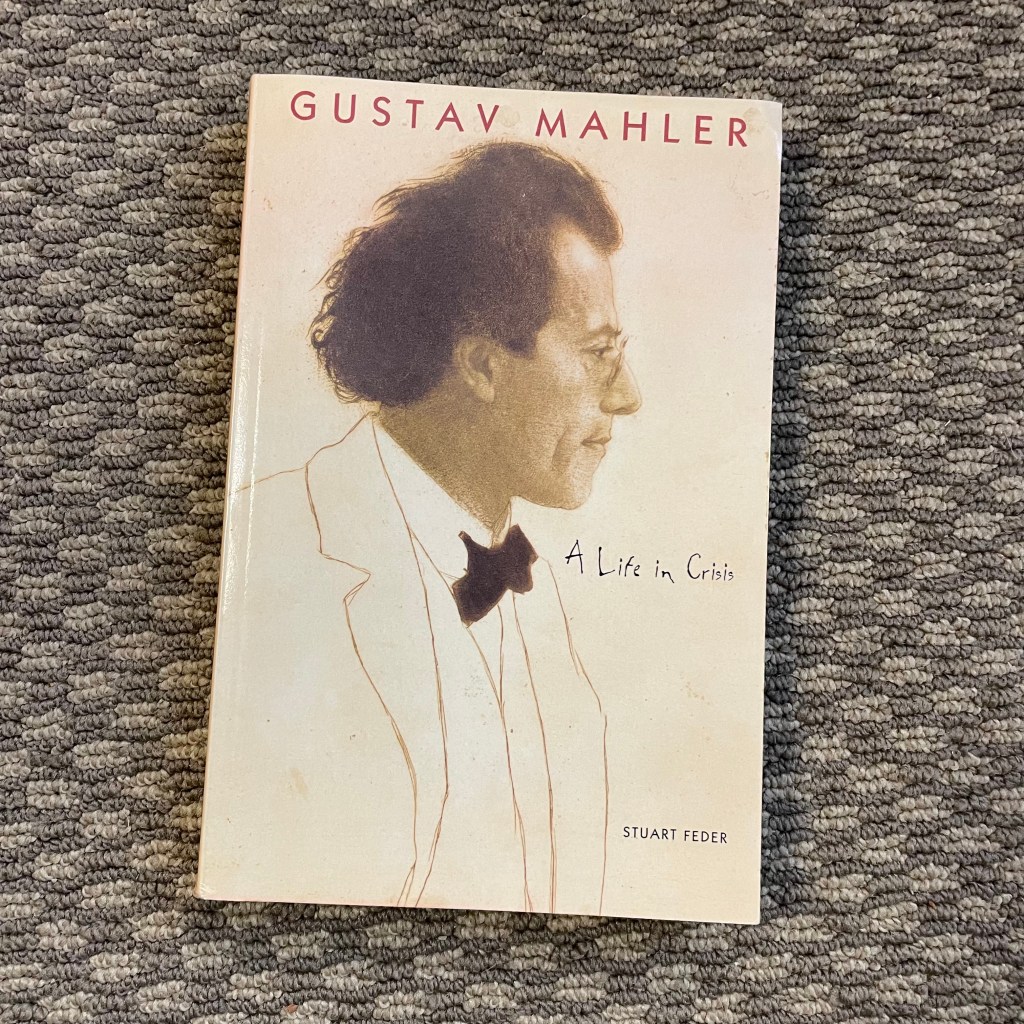
    Feder, Stuart. Gustav Mahler: A Life in Crisis. New Haven: Yale University Press, 2004.

    Gustav Mahler’s music has left subsequent generations grasping for handles to grab in order to understand it. It abounds in contradictions—lush sensuousness alongside loud cacophony, vast symphonic themes punctuated by cow bells and musical kitsch (klezmer, military band music). It is extraordinarily dramatic and unique, with a sound that borrows widely from late Romantics such as Bruckner and Wagner and at the same time little resembles anyone who came before him.

    It is unsurprising, then, that many have looked to Mahler’s biography to gain traction on the immensity of the music. The biographical route yields a great deal of information; Mahler spent a long career in public life as an orchestra conductor, and both his professional and private lives are well documented. Memoirs of those who knew Mahler at varying periods of his life also abound, and in recent years Henry Louis de la Grange wrote a massive, all-encompassing multivolume academic biography.

    Faced with the sheer profusion of biographical work on Mahler that already exists, other biographers are faced with the choice of reinventing the wheel or organizing a biographical study around a specific focus. Stuart Feder’s Gustav Mahler: A Life in Crisis follows the latter course. Feder ostensibly organizes his biography around certain “crises” in Mahler’s life. Feder’s real aim, however, is to apply Freudian psychoanalysis to Mahler and his work, and especially to Mahler’s marriage to Alma (Schindler) Mahler-Werfel, as well as to examine the (tenuous) relationship between Mahler and Freud himself.

    The results of Feder’s study are convincing enough, given the purposes that animate it. Feder doesn’t, however, provide much insight into Mahler’s artwork, with a few exceptions (more on that below). In order to get to his real area of biographical interest—Mahler’s courtship of, and marriage to, Alma, in the last eleven years of his life—Feder is obligated to pass over the first four decades of Mahler’s life and career in spectacularly cursory fashion. Bare numbers of pages tell the tale. The book, exclusive of acknowledgements, indices, and the like, is 315 pages. It treats Mahler’s entire life prior to meeting Alma—years in which he wrote the Wunderhorn songs and his first four symphonies—in the first 91 pages. Many of those 91 pages are spent stage-setting Mahler’s first meeting Alma.

    As the book’s narrative proceeds, the focus on Mahler’s marriage—and the now-infamous role Alma played in it—becomes virtually exclusive. In some of the best researched and most vivid sections of the book, Feder dissects Alma’s famous affair with Walter Gropius and its effects on Mahler, documenting how, contrary to Alma’s later vagueness on the subject, the affair continued for the remainder of Mahler’s life and after his death with the active support and assistance of Alma’s mother, Anna Moll. Indeed, in the last quarter of the book Mahler himself, ailing and heartbroken, recedes largely into the background as Feder takes obvious jouissance in detailing the perfidy of Alma and of Anna Moll. In Feder’s account Anna is especially treacherous, living vicariously through Alma’s sexual exploits while at the same time hiding them from Mahler and acting as a maternal figure to him. (Anna and her husband Carl, the Epilogue tells us, become raving antisemites; Carl, a supporter of Hitler and National Socialism, committed suicide in April 1945 as the Red Army neared Vienna.)[1]

    The obvious climax of the book is Mahler’s one and only four-hour-long walking conversation with Sigmund Freud in 1910. The book foreshadows this meeting at some length, and yet as a narrative climax it is underwhelming. Mahler, himself skeptical of psychoanalysis, only agreed to talk to Freud during the personal crisis induced by the Alma-Gropius affair. As it turns out, very little is known about the substance of their conversation in this meeting or of its ultimate effect on Mahler, but if you want a fairly comprehensive inventory of what is known about it, this book has it. There are no known notes from Freud of this conversation, and he only alluded to it briefly on a couple of occasions long after Mahler’s death. It is far too much to say that Freud “psychoanalyzed” Mahler in the strict sense; that isn’t something one does in a single four-hour walk around town, not even if one happens to be Freud. In effect, Feder’s book is an attempt to reconstruct what Freud might have concluded about Mahler had Freud had the chance to analyze him at proper length. Despite the paucity of the evidence, Feder nevertheless claims that Freud’s one meeting with Mahler yielded him significant therapeutic benefits—a claim I sincerely doubt.

    Regardless of whether psychoanalysis benefited Mahler in the last year of his life or not, Feder’s psychoanalytic reconstruction provides only scant insight into Mahler the artist. A lot of people endure, as Mahler did, a great deal of childhood trauma only to end up in bad marriages. Not all of them achieve fame in their own lifetime and leave behind a wildly idiosyncratic and hugely influential legacy of artworks. Feder does have very interesting observations about Mahler’s youthful work Das klagende Lied, and the pages he devotes to Das Lied von der Erde, especially to the conclusion of the final song, “Der Abschied,” are possibly the best part of the book. Feder does discuss Mahler’s incomplete sketches of the Tenth Symphony at some length, drafted as they were at the height of his marital crisis, but he is as much, if not more, interested in them for Mahler’s marginalia about Alma and his own state of mind as he is in their music. The remainder of Mahler’s music gets only brief and relatively superficial discussion. The premiere of the Eighth Symphony in Munich in 1910, happening as it did at the height of the Alma-Gropius crisis, gets far shorter shrift than it deserves, given the role it played in Mahler’s career as a public figure as well as that symphony’s role in the social and political life of pre-World-War-I Central Europe. That story is told better elsewhere.[2]

    The effect of Feder’s chosen focus on Mahler’s family life becomes almost stifling as the book nears its end. No doubt as Mahler’s life ended he was, personally, reduced to a pathetic, almost childlike state by his ill health and the unresolved tension of his marriage. How to square this reality with Mahler’s artworks and his public-facing life is hard to resolve, and this book doesn’t really accomplish it. If anything, I came away from this book feeling like I knew less about how the various aspects of Mahler hang together, if in fact they hang together at all. Perhaps this book reminds us that there are simply limits to what biography can teach us about artistic creation.[3]

    If you want an account of the marriage of Gustav and Alma Mahler that puts it into the context of their broader family life, this is your book. In fact, this could be the best single study of that subject available. If you have a wider interest in Mahler’s life in the light of his art and its significance, though, this book is bound to be disappointing.


    [1] Feder is remarkably unsympathetic, in my opinion, to Alma Mahler-Werfel in this book. Granted, she comes off badly in the detailed account of her affair with Gropius. In her defense, she married Mahler when she was twenty (he was forty), and what person makes their best decisions in their twenties? Despite Feder’s best efforts, I see the Alma that emerges from his pages as someone who was trying to live life on her own terms in an era when women had vanishingly narrow options other than just finding a man to marry and having his children. Her relationship with Mahler, and with his legacy after his death, was, to put it generously, complicated, but on the whole Alma deserves better than simple high-minded opprobrium. For a feminist reclamation of Alma’s life, see Haste, Cate, Passionate Spirit: The Life of Alma Mahler (New York: Basic Books, 2019).

    By contrast, Anna Moll sounds pretty terrible no matter how you slice it.

    [2] Karen Painter’s work on the Eighth Symphony is especially enlightening; see her “The Aesthetics of Mass Culture: Mahler’s Eighth Symphony and Its Legacy,” 127-157 of Painter, Karen, ed., Mahler and His World (Princeton: Princeton University Press, 2002), and Symphonic Aspirations: German Music and Politics, 1900-1945 (Cambridge: Harvard University Press, 2008).

    [3] The most famous single discussion of Mahler’s music that largely brackets the details of his biography has to be Theodor Adorno’s 1960 Mahler: A Musical Physiognomy (Edmund Jephcott, English translation, University of Chicago Press, 1996). Interestingly, Feder’s book is the only one on Mahler I know of written after 1996 in English that doesn’t at least mention Adorno or his book even once.

  • Two Strategies for Reading Fiction

    Two Strategies for Reading Fiction

    My latest reading project has been completing the fiction of Jane Austen. In order to organize my thoughts about Austen’s works themselves, I found myself needing to clarify, as a sort of preparatory exercise, my thinking on two different, but interrelated, strategies of reading. If you are interested in theory or abstraction, may you find this helpful or at least of mild interest. If you aren’t, expect some writing about Jane Austen in the coming weeks.

    Although it’s probably an oversimplification, I often entertain in my own thinking a distinction between two strategies of reading fiction. This distinction helps me make sense of not only my own reading, but also the proliferation of discussion of it in our times.

    The first such strategy I call reading as a technology of identity consolidation. This strategy of reading centers upon the reader’s wants, desires, wishes, social location, and agency. The questions to which it seeks answers in fiction center partly on satisfaction—Am I enjoying the experience of reading this book? Do I like the characters? Do I identify with them? Do I find them “relatable”? Does the work help me to confront, or perhaps to escape, aspects of my own reality I find oppressive? Do I think the author is someone I might like? Some of what this strategy seeks to get out of fiction, though, can involve personal aspiration or improvement: Does this book provide role models to help me shape and direct my ambitions? Is the author telling a story that, for political or ideological reasons, I think needs to be told to a wider audience? Is the author exploring some aspect of identity that is underrepresented in fiction, and doing so in a way that supports ideals of dignity and increased understanding?

    The common thread running through this diverse set of questions and expectations is, I believe, a singular preoccupation: How can fiction help me be the sort of person I should be, by helping me figure out who I really am, how I should act, what I should do, what I should believe? In other words, its preoccupation is the reader’s sense of their own identity, and the critical touchstone it recommends is the extent to which a book helps or does not help achieve that goal. (Also, by implication, it can evaluate books based on the extent to which the book or its author are compatible with the sorts of political or moral aspirations we should have, which lends this attitude towards a certain censoriousness about books that is no doubt familiar to anyone reading this on the Internet in 2025.)

    I call this sort of reading a technology because, on this view, the work of fiction is a sort of tool or device the reader uses to achieve other goals that go beyond the work of fiction itself. What’s more, reading fiction is not even the sole means to achieve those goals; other people who aren’t devoted to reading achieve them by watching movies or television, chatting up strangers on the Internet, backpacking across the American West, or some other thing. Perhaps reading fiction is the best way to figure out who you are and who you want to be, or at least has certain advantages over other ways[1], but it isn’t the only way.

    Although the most recent public site where this strategy of reading is on full view is undoubtedly #BookTok and its related social media communities, the strategy of reading as a technology of identity consolidation is by no means new. The explosion of the novel as a popular literary form in the 18th century in Europe, and its appeal to young, impressionable people living through the upheavals of the crumbling of absolute monarchy, Sturm und Drang pre-Romanticism in culture, and a general transformation in how the world appeared to intellectuals[2], led to a sense of moral panic not dissimilar to those that swept post-World-War-II America. When novelists of the 19th century incorporated the pitfalls of this kind of subjective investment in reading fiction within fiction itself—Catherine Morland in Jane Austen’s Northanger Abbey and Emma Bovary in Gustave Flaubert’s Madame Bovary are two salient examples—they were already taking place against the backdrop of a social debate with a long history. By the mid-20th century the cultural place of the novel was well cemented, but Vladimir Nabokov, himself no opponent of fiction, was lampooning what he polemically took to be the excesses of “bad reading” (reading aimed at identification with characters, concentrating on the “socio-economic angle,” etc.) among his students and contemporaries.[3]

    While I agree that a singular focus on fiction as a technology of identity consolidation is limiting, I don’t reject it entirely or think that it is an illegitimate way of reading across the board. For what it’s worth, I think that this strategy of reading represents something ineliminable from anyone’s experience of, and interest in, reading fiction. I will return to that point below.

    For now, I will be content to contrast this strategy of reading fiction with another I call reading as an inquiry into cultural artifacts. This strategy of reading tends to bracket the reader’s personal identitarian investment in, or response to, the work of fiction and instead seeks to appreciate the work of fiction as an artifact embedded in its own multilayered context. The implied metaphor of an archaeological dig is deliberate, as the work of fiction’s contexts are numerous, interrelated, and take sometimes dirty work to decipher if one is to do it well. Reading fiction as artifact can, for instance, dwell on the author’s broader aims: Is the author preparing a brief for a moral or political case? If so, what is it, and does the work forward that goal of persuasion? How does the work relate to other work by the author—as a departure, a continuation, a repetition? Does the work reflect the author’s inner state or personal biography, and if so, how? Some of its questions are the familiar territory of academic literary criticism: What are the work’s structural or formal qualities, and how do these qualities relate to other works? What are the inherent aesthetic qualities of the work, and on what standards might we judge its quality? How does the work relate to similar works produced in a historical time, place, or era? Some of the questions this strategy of reading asks veer off into history, philosophy, sociology, economics, and other social sciences: What factual information does the work of fiction tell us about its time (even if “its time” is right now)? What does it convey to us about what it was like to be a subject in its time and place: the characters’ sense of their own agency and choices for action, how they imagined themselves and their world (and sometimes the distance between their imaginations and reality), what sorts of radical options were open to them or foreclosed?  How was the book read (or misread), received or rejected, in ways that illuminate both the work itself and its subsequent history? Does the book illuminate or provide unique traction on a philosophical problem, like free will, the nature of justice, or religious belief?

    Obviously, what I am calling the strategy of reading as an inquiry into cultural artifacts is a wide umbrella over a vast range of diverse interests, questions, and curiosities. It covers the aims of the hack political pundit’s obtuse commentary on contemporary novels, the integrative work of the cultural critic or public intellectual, and the minute, detailed research of the humanities academic. I know full well that many people whose interest in fiction lies in the general direction I am describing would chafe at being associated even loosely with some of the other preoccupations I am grouping together under this umbrella. This strategy is far too broad to be called a “method”; it’s more a general orientation, a tendency.

    I don’t call the strategy of reading fiction as a cultural artifact a “technology” because, unlike the strategy with which I am contrasting it, the work is not being used as a tool or an implement to achieve an end. However, it does share with that technology of reading, though, a certain tendency to lose focus on what we might call, in an old-fashioned sort of way, the “work itself.” Reading as a technology of identity consolidation tends to view the work as a sort of mirror or lens that is trained squarely upon the reader’s selfhood. The properties of the mirror or lens only matter to the extent that they help the self see itself more clearly. Reading as an inquiry into the book as cultural artifact, though, tends, at its extremes, to dissolve the work itself into a mere set of illuminations of its contexts, as one more data point in the service of a broader thesis about whatever historical, philosophical, or sociological interest the reader brings to the work.[4]

    Fiction writers themselves have perhaps been less worried about the drawbacks of this attitude towards fiction than about the drawbacks of its contrasting attitude. Certain fiction authors and works certainly portray the dissolution of the traditional novel into other discourses and registers, though. The most well-known examples are the works of modernist authors like Joyce or Beckett, but there’s also Tolstoy’s War and Peace, a fictional work (Tolstoy denied it was a “novel”) which shades over its great length into a work of history and philosophy. At the extreme, we have the French nouveau roman as well as Burroughs’ cut-up trilogy, with long passages that consist of literal cut-up and scrambled texts from newspapers and magazines (and which Burroughs also denied were “novels”).

    I must confess that the habits of mind that govern my choice of fiction reading tend more towards the appreciation of fiction works as cultural artifacts than towards identity-consolidation. (Perhaps being a middle-aged man who thinks he is blessed with an adequate degree of self-awareness explains this: I am not looking to fiction as a form of therapy or to figure out who I am, or even to get away from who I am.) But I am not personally above reading fiction that is escapist, or relatable, or blatant wish-fulfillment, or just plain entertaining. In the end I suspect that these two strategies of reading I have identified can scarcely be divorced from one another entirely. For lack of a better terminology, the subjective pole and the objective, the personal and the impersonal, care of the self and concern for the world, can’t be pulled apart neatly. Both sets of motivations and interests confronts all of us when we read fiction to some extent. They are like the charged electrical field in the midst of which we engage with the work of fiction, which then blocks, amplifies, reflects, and redirects those energies into different directions.[5]

    When it comes to talking about fiction and literature, what I abhor is the insistence on a single strategy of reading as the only one that is worthwhile, or else the sheer predominance of a single strategy of reading by the volume of commentary and conversation that exclusively presupposes it. (If you haven’t guessed, I endured maybe ten minutes of browsing on #BookTok before abandoning it in frustration.) I am, generally speaking, a maximalist when it comes to reading, a “let a thousand flowers bloom” sort of person. I sometimes intentionally seek out negative reviews of books I love, and sometimes they even change my mind. When they don’t, I still find them instructive as idiosyncratic readings or misreadings. When people present me with excessively rigid reading methodologies or otherwise seem to have a perpetual blind spot in their critical judgment, I just think, “Hm, OK,” and then keep on reading what I want for whatever reasons interest me.

    With all that in mind, my next post will reflect on the one author whose public and academic reception in modern times best exemplifies both of these strategies of reading at once: Jane Austen.


    [1] Reading novels certainly entails less physical risk than embarking on a career of libertinage among the demi-monde of Paris. To pick an example.

    [2] One of the central theses of Michel Foucault’s The Order of Things is the transition of episteme he identifies in the late 18th and early 19th centuries, in the very way that the discourse surrounding knowledge was subtly reorganized and transformed.

    [3] Vladimir Nabokov, “Good Readers and Good Writers,” in Lectures on Literature (ed. Fredson Bowers; New York: Harvest, 1980), 3ff.

    [4] Yet another target of Vladimir Nabokov’s critical polemic in “Good Readers and Good Writers” are people who insist on using Jane Austen’s novels as a source of information about “landowning England with baronets and landscaped grounds when all she knew was a clergyman’s parlor” (p. 2).

    [5] Without getting too far into it, I suspect that the relation between these two strategies of reading is broadly dialectical (though not in a rigidly Hegelian or Marxist sense). What I will say is that, pace certain cultural critics who have dotted the landscape throughout my lifetime, I am not convinced that either strategy is inherently prone to, or exclusively guilty of, the closed-mindedness, epistemic closure, or sheer obtuseness significant swaths of the reading public constantly exhibit. Reading for escapism or sheer entertainment value can teach one things about oneself and the world that one didn’t know before (maybe even things that one doesn’t really want to know at all), or it can simply reinforce one’s existing feelings and prejudices. Reading for aesthetic merit or for cultural significance can lead one to broader insights about the world and one’s own place in it, or it can devolve into a rigid exercise in policing the boundaries of a canon or an interminable collection of grist for one’s preferred mill. What makes for this difference is a more basic personal disposition on the part of the reader, not the strategy of reading they employ.

  • A Study in Contrasts

    A Study in Contrasts

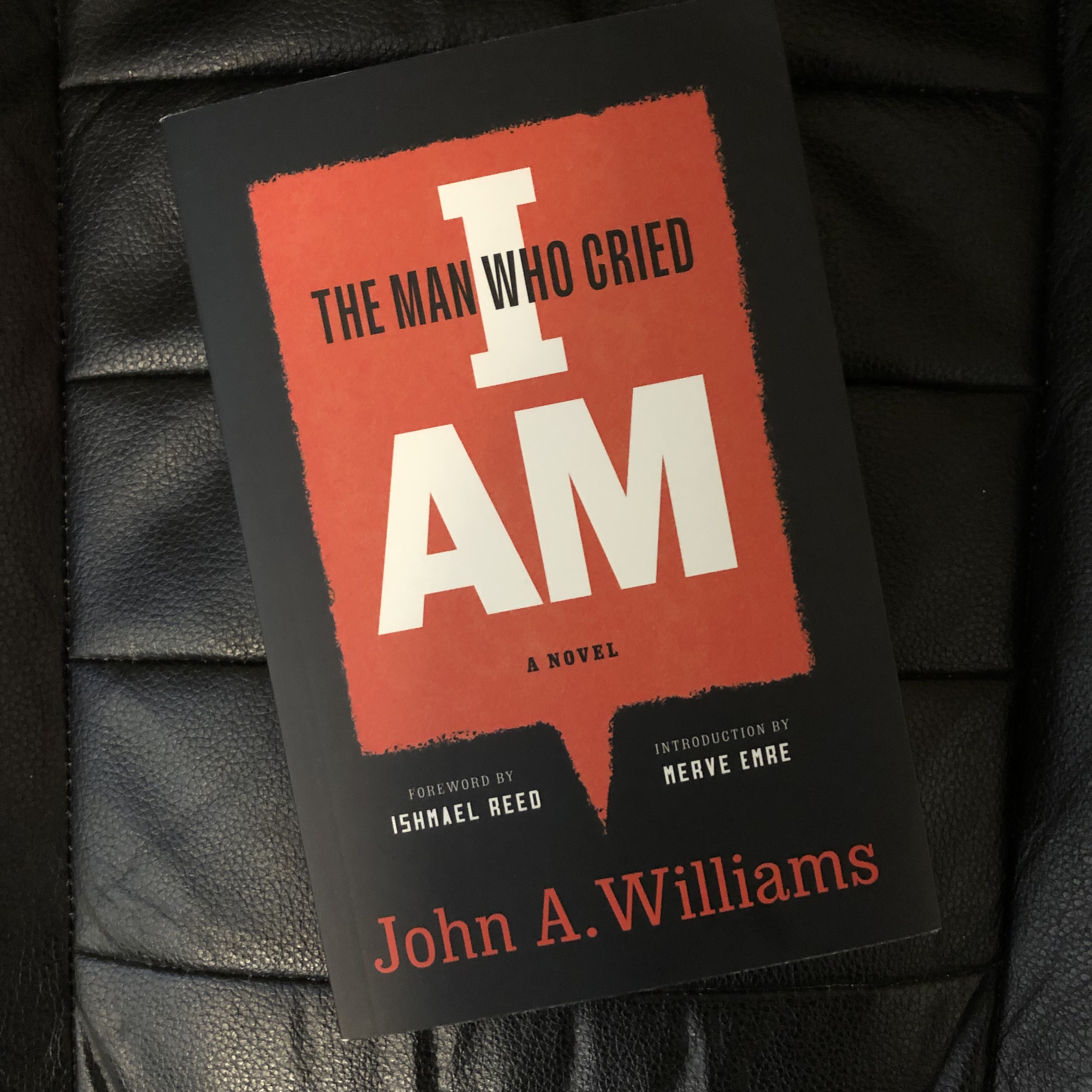
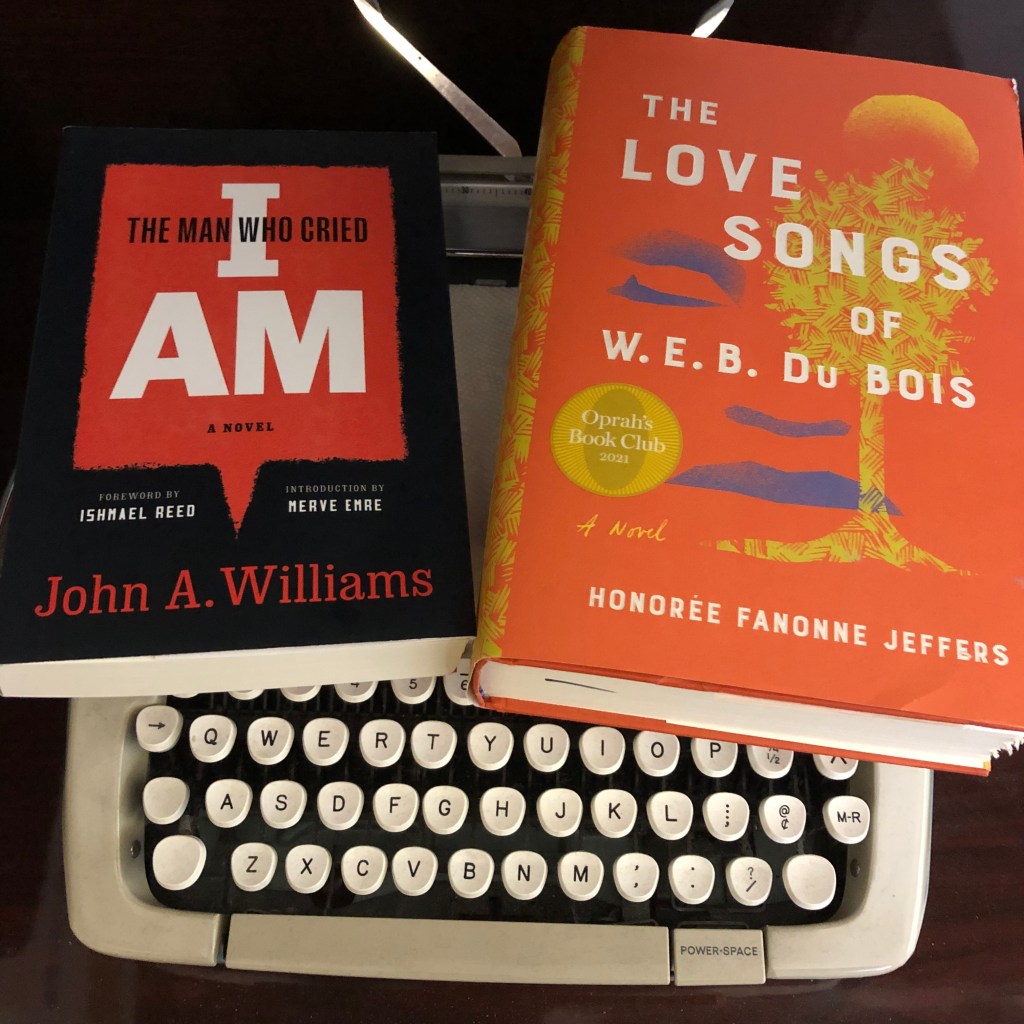
    Williams, John A. The Man Who Cried I Am: A Novel. Library of America, 2023.

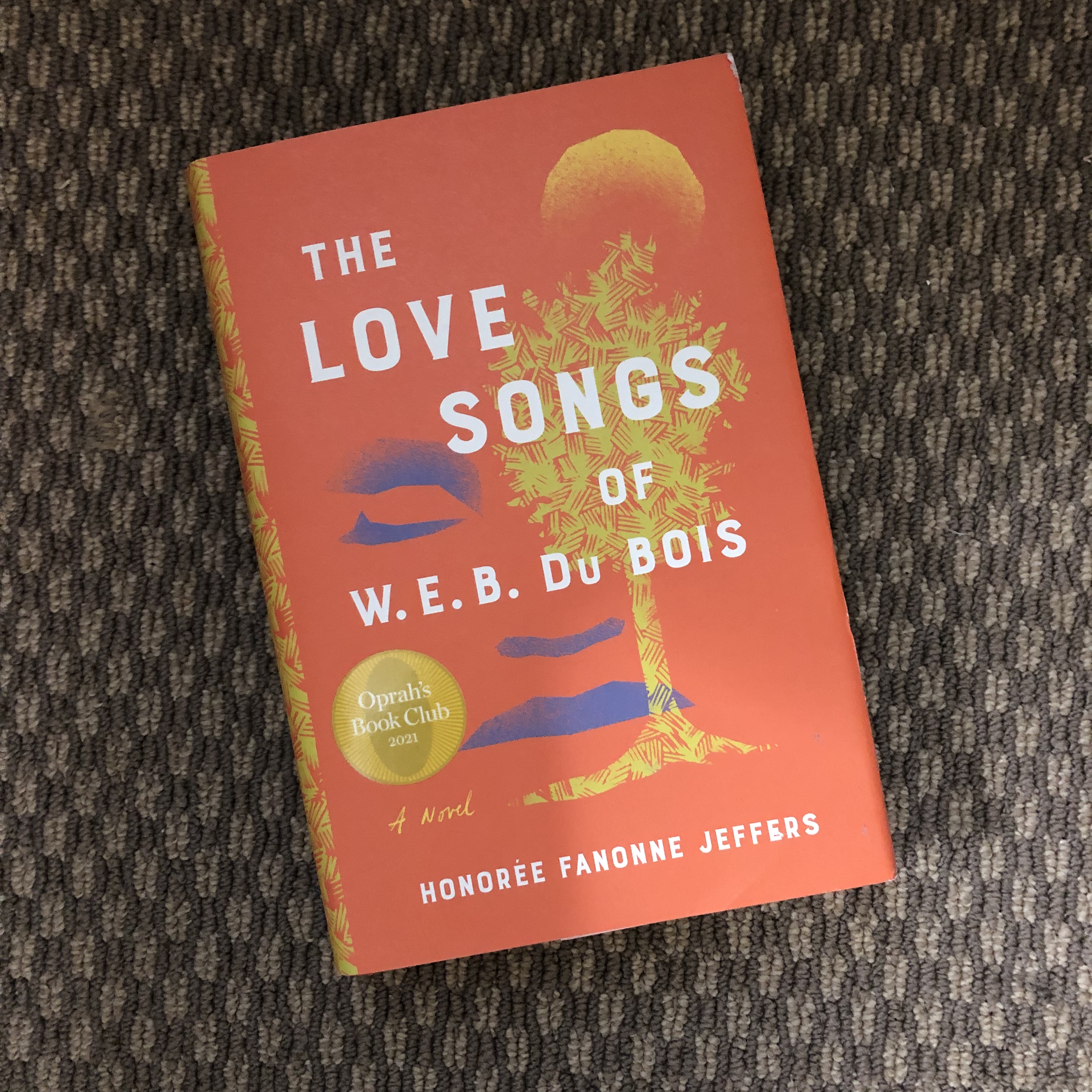
    Jeffers, Honorée Fanonne. The Love Songs of W.E.B. DuBois. Harper, 2021.

    I did not set out this February to read two books that furnish a starkly contrasting view of the Black American experience; it just turned out that way. John A. Williams’ 1967 conspiracy-theory novel The Man Who Cried I Am, reissued in 2023 by the Library of America with a foreword by Ishmael Reed and an introduction by Merve Emre, feels about as far as one can get from Honorée Fanonne Jeffers’ sweeping 2021 family/historical epic The Love Songs of W.E.B. DuBois. The contrasts, though, are oddly illuminating of the ways in which gender norms intersect with race.

    ***

    The LOA’s reissue of The Man Who Cried bills it as a forgotten classic. It tells the story of Max Reddick, a Black American writer and journalist, who we find dying of rectal cancer and reminiscing on the flotsam and jetsam of his personal and professional life during a visit to Europe for the funeral of his friend, the famous author Harry Ames. (The Man Who Cried is, among other things, a roman à clef with many characters torn from real life, and the expat-in-France Ames is obviously modeled on Richard Wright.) While he catches up with his estranged wife in the Netherlands and with other friends he shared in common with Ames, Reddick discovers that Ames bequeathed him documentary evidence of a top-secret US plan, King Alfred, to round up Black Americans in concentration camps and/or to exterminate them in case the civil rights movement went too far for White comfort. Ames, he discovers, was murdered for his knowledge of this information. Reddick, now himself in danger of his life, just manages to leak evidence of the plan to Minister Q, the novel’s equivalent for Malcolm X, before he is murdered for what he knows. The novel ends on an ambiguous note, implying that the American government’s murder of Ames and Reddick signals the beginning of King Alfred’s implementation, but giving no inkling of its success or failure at its genocidal aims.

    It’s a rather long novel and the vast majority of it happens before the unveiling of the King Alfred plan. Reddick, who is loosely modeled on the author himself as well as Williams’ friend and fellow author Chester Himes, takes us via his reminiscences through a turbulent career. Even without the conspiracy theory twist the story takes, the novel is a fascinating and sharply opinionated take on the Black literary scene in postwar America. A common refrain is that the white-dominated literary world will only accept one Black writer at a time, and in the late fifties and early sixties it is Ames (i.e. Richard Wright). The goal of every other Black writer is to dethrone Ames/Wright so that they can get their turn being “the one.” As Marion Dawes, a very unflattering and churlish depiction of James Baldwin, puts it to Ames’s face: he has to kill the father to take over, and Ames/Wright is the father he has to kill. It’s a rather bare-knuckle, cynical take on the famous literary feud between Wright and Baldwin, reductive, perhaps, but also a contemporary (and today under-represented) take on the context behind the feud nonetheless. It’s interesting to know that this take exists, even if one thinks (as I do) that it grossly simplifies Baldwin’s motivations and the merits of his critique.

    The book is also pretty unabashedly misogynistic and homophobic. Reddick and Ames womanizers to the end (a lot of sex happens in this book, very little of it with anyone’s actual “official” partner), and very few woman characters are introduced with a description other than the attractiveness, or lack thereof, of their physical attributes to Reddick. Reddick’s last wish for sexual conquest is to have sex with a redhead, a wish that (spoiler alert) is destined to remain unfulfilled. Reddick’s view on Black women writers is curtly dismissive. Dawes/Baldwin and other literary “faggots” earn little more than Reddick and Ames’ ridicule. And so on. The misogyny and homophobia are not really the point of the book; they’re casual, like the air (and the second-hand smoke) the book breathes. It’s just jarring to read in 2024, and was likely more than a little jarring in 1967. As Ishmael Reed writes in his Foreword, “If #MeToo ever had truth and reconciliation forums, I’d be on trial with the rest of the guys” (xx).

    The Man Who Cried is also a social and political novel, and not just when it comes to the King Alfred plan. Reddick’s journalistic career gets put on hold in the early 60’s when he accepts an irresistible invitation to join the speechwriting team of an unnamed president (who is clearly John F. Kennedy). Reddick quits in disillusionment when the president’s commitment to civil rights is decidedly lukewarm, a fact that in the world of the novel makes perfect sense once the contours of King Alfred come to light. Reddick then resumes his journalism job and works the civil rights movement beat, covering not only Minister Q/Malcolm X but also Paul Durrell, a thinly veiled stand-in for Martin Luther King, Jr. Reddick dislikes and distrusts Durrell, finding his political stance too reactionary and deferential to White feelings and his personal life dangerously messy. He has far greater respect for the radicalism, non-pacifism, and personal rigidity of Minister Q, which is why, when the genocidal aspirations of the US government become clear, Reddick entrusts what he has learned to Q in hopes that he can organize an appropriately militant response to King Alfred in time.

    The Man Who Cried is a hard-boiled, paranoid thriller that is a little enervating to read, but in 1967 it had the ring of literary truth for a lot of people. Williams ran pages from his (fictional) King Alfred plan in New York newspapers as advertisements as a publicity stunt, which led many people to confuse, War of the Worlds-like, the fiction for reality. Emre’s Introduction to the 2023 LOA edition even relates that Clive DePatten, a young Chicago man associated with the Black Panther Party, testified in 1970 before a committee of Congress that he thought the King Alfred plan was real, leading the committee to observe that no, that plan was from a work of fiction. In our time, right-wing conspiracy theories are in the ascendant, including the “Great Replacement” theory that is almost a color-flipped version of King Alfred, and so this novel’s conspiracy theory feels odd, almost quaint. The left speaks now of systems, of neoliberal “best practices” that everyone seems to take as so self-evident that they don’t bother to cover them up, of standard diplomatic and economic policy that of late has made the US Israel’s de facto—and sometimes, literal—defense lawyer while it seeks to liquidate the Palestinian populations of Gaza and the West Bank. We now know that the odds that anyone could hide a plan of the magnitude of King Alfred in official Washington in 2024 is nearly nil, but that it really doesn’t matter; the problem today is a glut of information, a confused, benumbed population incapable of sorting through it all, and a full quarter of the US electorate for whom no countervailing facts will ever overcome their self-absorbed sense of grievance. Official secrecy hardly matters anymore. Yet a book like this serves as a lurid reminder in our times that America still lives in a tense relationship, not only with Blackness, but also with the workings of state power.

    ***

    It is hard to imagine anything more removed from the hard-nosed, solitary, misogynistic, paranoid world of The Man Who Cried than The Love Songs of W.E.B. DuBois. In Love Songs, Jeffers paints a panoramic picture of the life of Ailey Garfield, a contemporary Black woman, and that of her ancestors back to the 17th century in what would become the state of Georgia. It is definitely a woman-centric book—there are plenty of men, but women drive the story—but it is not even remotely all sweetness and light. Many of Aliey’s ancestors are enslaved, and the book does not soft-pedal both the vivid horrors and routine humiliations her ancestors endure. Love Songs is also clear-eyed about Ailey’s White ancestors and their relationship to her story through rape and, occasionally, love, but love warped by the unquestioned power Whites enjoyed in the American South both before and after the Civil War. To boot, a central motif of Ailey’s story involves child sexual abuse; her most prominent White ancestor was a prolific abuser of children, and she and her sisters also endure being sexually abused as children by their paternal grandfather, Gandee. This book stares a lot of pain and injustice squarely in the face.

    But what makes this book feel so different from The Man Who Cried is that it is leavened by a sense of hope, a sense that connecting with one’s ancestors is powerful, a sense that Black women have survived terrible things and that, together, they will keep surviving. Jeffers proudly wears the feminist/womanist influence of Alice Walker (and before her, Zora Neale Hurston) on her sleeve. As in Walker and Hurston, and unlike Williams’ novel, formal politics and political actors play virtually no role in the story. The story is not impervious to such matters; Emancipation and Reconstruction happen, of course, as well as Jim Crow, the civil rights movement, and even the Black militancy of the 1970’s. These things, though, aren’t really the point in Love Songs. Jeffers’ Chicasetta, Georgia, the ancestral home of Ailey’s family, is remarkably like Hurston’s Eatonville, Florida in this respect: a world where Black folk, and especially Black women, live their lives aware of, and wary of, White folks but unencumbered by the White gaze in their daily living.

    Williams is haunted by the specter of White America deciding to liquidate the ten percent or so of its population that is Black. Love Songs observes, though, that by blood, by history, and by culture, Black and White (and Native American) folk in America are so intertwined that even the effort to extricate them from one another mentally requires Herculean feats of denial, intentional obfuscation, and bad faith. Forget about actually doing it!

    Racism is definitely a theme in Love Songs—the episodes from the second half of the book when Aliey begins graduate school in history and encounters White Southern history grad students are cringeworthy and priceless—but unlike in The Man Who Cried, its perpetuation isn’t the work of a conspiratorial cabal among the security apparatuses of world governments. It is what we now call “structural” racism, that ghostly set of taken-for-granted practices and structured ignorance and privilege that is so hard to combat precisely because no single institution implements it according to a plan.

    ***

    Certainly some of the difference between The Man Who Cried and Love Songs is the benefit of what the past few decades have taught us. Love Songs was published over forty years after The Man Who Cried, and the terms of what Charles Mills has called the implicit “racial contract” structuring race as a social category have just changed. For that matter, so has the sex and gender contract. The male characters in The Man Who Cried, if not the entire book, could be read, not without justification, as mid-century machismo and its projections run amok. Reddick literally does cry “I am” at multiple points in the novel, and his sense of what it means to “be” is in these moments agonistic—a cry for his enemies to come forward, name themselves, and grant him the dignity of stating their case against him to his face. To face him “like a man,” in other words. At the end of the novel, he gets his wish, dying not of the rectal cancer eating away at him but assassinated by an acquaintance who he has discovered is working as an agent of the King Alfred plan.

    Love Songs, though, presents a very different sense of what it means to “be” in this strong sense. Aliey discovers not only who she is by exploring who her ancestors were and what they did and suffered. She discovers that in this search for the ancestors, even those who set themselves against one as enemies are among one’s ancestors as well, showing that their taking up the position of adversary rests upon their own alienation from and refusal to acknowledge their own pasts. And at least some of this alienation is the result, not just of the fictitious but socially valent discourse of race, but also of gender and its norms. Multiple men who cross Ailey’s path in Love Songs are much like Max Reddick: damaged, not only by the omnipresent reality of structural racism and its many consequences, but also by the straitjacket of their own gendered expectations.

    But Love Songs at least holds out an example of Black masculinity outside these straitjackets: Dr. Jason Hargrace, Ailey’s uncle and mentor who she knows from childhood as “Uncle Root.” Uncle Root is a retired history professor at Routledge College, the fictional HBCU in Georgia which Ailey and one of her two sisters attends as an undergraduate. Uncle Root is genteel, wise, a defender of W.E.B. DuBois who acknowledges the liabilities of DuBois’s elitism, and a sort of proto-feminist. In a recurring motif in the book, Uncle Root even takes the last name of his wife, Olivia, in an echo of the matrilineal Creek society of the family’s Native American ancestors. Uncle Root’s Black masculinity is not premised on drawing out an enemy for direct combat, but instead in patience, wisdom, and support, especially of Ailey and the other women in their family.

    I did not deliberately set out to read these two books so closely together. They both just happened to rise to the top of my reading pile near one another. Yet it’s now hard for me to think about the issues they both raise without thinking of the tension field that exists between the two. It’s odd how sometimes one’s occasional reading works out like this in ways one never would have expected. This is why I rarely make elaborate reading plans or set terribly specific reading goals. Sometimes the most incongruous books yield the most interesting insights when put in conversation with one another.

  • Why I Still Prefer Print Books

    Why I Still Prefer Print Books

    At present I am making my desultory way through a collection of Marcel Proust’s critical writings,[1] the centerpiece of which is a collection of notes for a book-length work of criticism that would have probably borne the title Contre Sainte-Beuve (Against Sainte-Beuve). Proust’s writing abounds in observations on books and literature, but the writing collected in this volume contains his most sustained discussions of reading, particularly the experience of reading.

    For Proust, there is nothing automatic, transparent, or facile about reading. Contre Sainte-Beuve, written in French, deals with French writers in its entirety, and yet he says: “The great books are written in a sort of foreign language.” He goes on to say that “beneath each word [of them] each of us puts our own reading [sens], or at least our image, which is often a misreading [contresens]. But with the great books, all the misreadings one makes are great.” Yet with care and diligence, one reads great works more than once, and one reads more books by the same author. Reading more than one book by the same author is, in fact, essential; in doing so commonalities become salient, habitual turns of phrase or characterizations, all of those things that go into our sense of a writer’s distinctive style, much as we perceive “the same sinuosity of a profile, the same piece of fabric, the same chair in two paintings by the same painter” which shows us “something common to both: the predilection and the essence of the painter’s spirit.”[3] The more we read, the more we realize, in a form of historical consciousness, that “in the same generation spirits of a similar sort, of the same family, of the same culture, of the same inspiration, of the same context, of the same condition, take up the pen to write almost the same thing in the same way,” and yet each “embroiders it in a particular way that is his own, and which makes the same thing completely new.”[4]

    Contre Sainte-Beuve remained unfinished and unpublished at Proust’s death in 1922, so the work is fragmentary in form and undecided as to its overall literary conceit. Proust did seem to consider it at one point as a straightforward work of criticism under his own voice, but the chief conception that comes through in the notes we have is of a dialogue between Marcel, the narrator of In Search of Lost Time, and his mother. Even then it would have been largely a monologue; the notes we have contain no actual words assigned to Marcel’s mother. Written shortly before Proust began devoting his waning energies chiefly to ISOLT, it is unclear whether it would have been a preface to that work or its final part, its coda. In addition to Proust’s own takes on literature and criticism, we get introduced to preliminary glimpses of Gilberte Swann, Mme de Villeparisis, and the Count and Countess of Guermantes.

    Proust more than once describes the Count of Guermantes’ love of Balzac and says that he has a full edition of The Human Comedy in his library that he inherited from his father. (This version of the Count of Guermantes, at least, has little patience for the vie mondaine of aristocratic society and hides in his second-floor library whenever the Duchess has guests.) Near the end of the notes on Balzac, the narrator writes:

    I must admit that I understand M. de Guermantes—I who read the same way throughout my whole childhood, I for whom Colomba has been for so long “the volume from which one forbade me to read the Venus d’Ille” (“one,” I say, Mother—it was you!) Those volumes from which one read a work for the first time are like the first dress in which one saw a woman for the first time; they tell us what the book was for us then, what we were for it. Finding those volumes is the only way in which I am a bibliophile. The edition from which I read a book for the first time, the edition in which it gave me its first impression, are the only “first editions,” the only “original editions” in which I have an interest. It is still enough for me to remember those volumes. Their old pages are so porous to my memory that I am nearly afraid that they will also absorb my impressions from today and that I will no longer find in them my impressions from before. Every time I think about them, I want them to open themselves up to the page where I shut them near to the lamp or the wooden bench in the garden, when Papa told me: “Stand up straight.”

    And I wonder sometimes whether the way I read today might still more closely resemble that of Mr. Guermantes than that of contemporary critics. A literary work is still for me a living whole whose acquaintance I make from the very first line, that I listen to with deference, to which I grant all rights as long as I am with it, without choosing or debating. [5]

    For Marcel, the physical form of the book—not only the book’s binding, the look of its pages, but also its insertion into his physical space, its relationship to his body—are indissolubly part of the “living whole” of the book as read, not only part of the experience of reading it but also of the memory of what it says.

    Marcel goes on to say that as he matured he began to extend this sense of the living wholeness of a book to encompass all of the books of an author—just that labor of comparison and noticing of commonalities he elsewhere says is part of the work of reading. In this, he says he has gone beyond the Count of Guermantes, whose sense of reading is so bound up with the physical form of the books in his library that he routinely confuses which author wrote a book because, in his library, books by several authors have the same binding:

    [T]he library, M. de Guermantes’ father’s library, contained all of Balzac, all of Roger de Beauvoir, all of Fenimore Cooper, all of Walter Scott and the complete plays of Alexandre Duval, all bound in the same old-fashioned gold binding. The Count adored these books and re-read them often, and one could talk to him about Balzac without finding him at a loss. … But if one asked the Count [about Balzac’s novel Mademoiselle de Choisy], he would say: “I think Roger de Beauvoir wrote that.” He easily confused all these “charming” books that had the same covers, the same way that people mix up the senna and the morphine because they come in the same white bottle.[6]

    Obviously collapsing the experience of encountering a literary work wholly into that of encountering a specific physical object at a specific place and time can go too far! In reading, we are in some part reading through the visible words to the meaning, which is, at some ideal limit anyway, the same regardless of the physical format in which we encounter the words. But this sensuous, physical aspect of reading—the conscious encounter with a specific copy of a book, published at a specific time, on a specific kind of paper, set in a specific font, read under specific conditions, is for me, as it appears to be for Marcel, an irreducible aspect of reading, the soil out of which all reaching for the ideal meaning of the words towards the “spirit” and music of the author grows.

    This episode from Proust helped bring into focus for me why I have become so disenchanted over time with ebooks. In the 1990s and early 2000s, when ebooks went from public-domain text files without formatting and became formatted documents made available by publishers themselves, I was mildly intrigued. However, when I first bought a tablet in 2012 I was not only a convert to ebooks, but a sort of evangelist. The notion of owning a whole library of books that didn’t weigh anything or take up more physical space and that one could carry around everywhere fascinated me. I even contemplated the possibility of obtaining digital copies of all the books I had in my physical library and then getting rid of the physical library. It added to ebooks’ allure that in 2012 I was in a point in my life in which I had moved on an average once every two years and was very tired of schlepping between 40 and 60 boxes of books every time I got a new apartment.

    Yet once I actually began reading more, ebooks really began to lose their luster. Yes, they are convenient. They are also a relatively inexpensive way to obtain books that in some cases would be difficult to obtain in hard copy. I still do about 25-30% of my book reading digitally. But I still find them unsatisfying, and when I expect that a book will be especially enjoyable or useful or important to me, I obtain a physical copy of it whenever possible.

    What changed for me was intimately related to the experience of reading ebooks. To get at what I am after, think about what it’s like to read a print book. A print book is, before it is anything else, a discrete physical object. You hold it in your hand. It has mass, and the longer it is the more mass it has. The covers and the pages have a texture, a color, a smell, a thickness. In reading it, your body has to make certain accommodations to it: you have to hold it a certain way, at a certain distance, under a certain kind of light for it to be legible, you have to support one side of it more than the other depending on whether you are nearer the beginning than the end, and so forth. It is literally another body situated in space alongside my body, a foreign body one handles, maneuvers, cradles, caresses. And different books, like different bodies, have to be handled differently. The brand-new paperback I bought demands to be treated differently than the tiny, fragile 1804 copy of Ossian’s Poems I bought from a library sale in 1993.

    Needless to say, ebooks are not like this. Of course, ebooks are physically instantiated; they aren’t utterly non-physical. The machines (computers, smartphones, tablets) we use to read ebooks are also physical. But their physicality is, with respect to the reading experience, negligible and largely indifferent. The machine from which I read an ebook is just a platform that displays to me, now one ebook, now another. The experience of reading one ebook is more or less like reading any other. For that matter, if I am reading the ebook off of a device I use to do other things, the experience of reading the book is functionally the same as all the other things I do on the device—read and receive e-mail, do work, make phone calls, read and post on social media. All of these things happen within the four corners of the same screen on the same device. The computer, phone, or tablet remains the same physical object in the same physical configuration with respect to my body no matter how much or how many books I read on it.

    This fact about computing gives rise to a different sense of the space in which an ebook is located. Computing tasks—all ebook reading is just a kind of computing task, of course—all take place in a space contained within one or more physical screens that depending on the device one is using is called a “desktop” or a “home screen.” (I will just refer to it as a “desktop” from here on out.) The programs one opens—the e-book reader, the web browser, the e-mail client, and so forth—open within and on top of this desktop. The desktop’s height and width mirror those of the physical world our bodies inhabit, but depending on the platform we are using, they may be slightly bigger than what we can see of it through our screen. (On a Windows PC, for instance, one can move a window for an application so that a large portion of it extends off the screen into void, invisible space.) The strange feature of this space, though, is that its depth functions in ways wholly unlike that of physical space. The background image of one’s desktop functions as the ground, the bedrock, over which one can layer as many application windows as the computing power of one’s device will allow. None of them have the slightest thickness; having fifty windows open on one’s screen is spatially the same as having one open, or none.

    One’s relationship with this strange quasi-physical space of computing that resembles, but is not the same as, our own, to which our screens give us a limited window, is, when you think about it, completely indirect. Before the advent of touch screens, manipulating what happened on the screen involved pushing physical buttons (on a keyboard or mouse) and moving tracking devices (the mouse) which would then make something happen in the computing space. Touch screens have not eliminated this indirection; they have only changed it. One still has to tap on the screen in just the same places one had to click on using one’s mouse previously. On completely touch-screen environments like smartphones or tablets, tapping or swiping with one’s fingers does not always yield the results one would get in the physical world. Tapping or swiping the screen in one application does one thing in one application, another thing in another, and sometimes, depending on the device, swiping brings up entire screens related to the operating system that half the time one didn’t even ask for. In other words, rather than mimicking physical manipulation, touch-screen devices convert physical gestures into yet another set of quasi-linguistic commands with a physical “vocabulary” one has to learn in order to use the devices competently, and that one has to re-learn when one switches between platforms with different operating systems.

    When it comes to ebooks, the quasi-physicality of computing space together with the largely arbitrary physical “vocabulary” of gestures used on touch-screen devices utterly deprives the reading experience of its physicality, its resistance, its thickness. It’s like reading a book hermetically sealed under glass, whose pages move at a command but which one can never hold, never touch. It’s actually a little worse than that, because in a physical book, even one in a glass case, the words are fixed on the pages where they are printed. In an ebook one reads off of an e-reader like a Kindle, Nook, or other tablet, the location of the words on the page and what they look like are fluid and fungible. One can change the font, the font size, the margins, even whether the background “page” is white, sepia-toned, or black (if one is reading off of a color device). Make a change to any of these, and the position of the words on the screen of text one is reading move. (Sometimes, depending on the ebook’s formatting, they even move without making any changes when one swipes forward to a later page and then swipes back to find one’s place.)

    Admittedly, the adaptability of text presentation on ebooks is a great advantage for neuroatypical readers or readers with visual issues, since they can make books accessible in ways that most physical books are not for them. I am definitely not glossing over that—nor am I arguing for the abolition of ebooks! (As I said previously, I do at least 25% of my reading off of an e-reader.) It’s just a different experience for me, and one that is impoverished for me in a lot of ways. I have a hard time savoring writing off an e-reader. I tend to read off an e-reader solely for the ideal content of the words, not the sensuousness of what the words say. Most of my e-reading tends to be nonfiction now that I think about it.

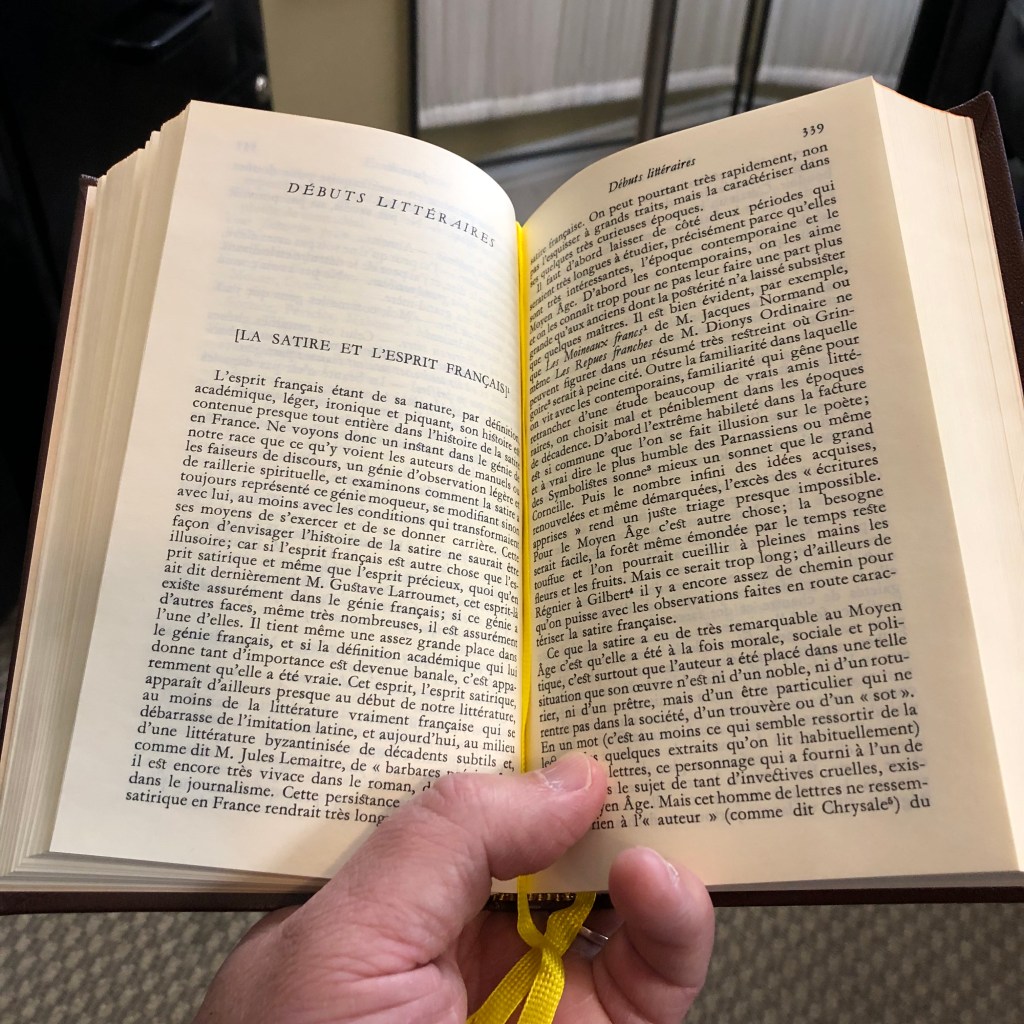
    In ebooks I join the author in what she means to say, but the reading doesn’t bring my body along with it. I miss the kinesthetic experience of physical books—of the words I read, the paper they are printed on, the weight of the book, the sense of anticipation I have when holding open the first few pages of a book I just started, the feeling of clearing the halfway point, the lightness in my right hand as I near the end. (Or in my left hand, if I am reading manga!) More subtly, though, I find myself missing the difference between books—the yellowing mass-market paperback of The Prime of Miss Jean Brodie from the 1960’s I just read versus the leather-bound, bible-paper elegance of the Pléaide edition of Contre Sainte-Beuve I am currently reading. On my e-reader, all ebooks, even PDFs that give literal scanned images of physical pages, feel somehow interchangeable, like scraps of a single vast ocean of context-free text. (A fact about electronically stored text that large-language AI models have, of course, exploited.)

    Perhaps I am just a cranky old man consumed by nostalgia for his past. Physical books, after all, are themselves a technology that has undergone numerous transformations in history.[7] Holding up one form of the book as somehow sacred is historically blinkered, to say the least. Yet the advent of ebooks has not led to the demise of the physical book, as presaged in the late 2000’s and early 2010’s. Print books, at last report, still vastly outsell ebooks. It can’t be the case that all of those physical book buyers are just buying them to show on Instagram or TikTok or to use as interior design accessories. Something endures about the physical book format.

    Or, as Proust puts it, those porous book pages are still soaking up our memories, our impressions, our thoughts, all of the embodied reactions we have when we encounter the words of another in reading.


    [1] Proust, Marcel. Contre Sainte-Beuve précédé de Pastiches et mélanges et suivi de Essais et articles. Ed. Pierre Clarac et Yves Sandre (Gallimard (Pléiade), 1971). I identify all citations to this volume as “Sainte-Beuve” followed by a page number. All translations, and hence all translation errors, are entirely my own.

    [2] Sainte-Beuve, p. 304.

    [3] Sainte-Beuve, p. 304.

    [4] Sainte-Beuve, p. 306.

    [5] Sainte-Beuve, p. 295.

    [6] Sainte-Beuve, p. 297.

    [7] Irene Vallejo provides a colorful anecdote-filled account of this history in Papyrus: The Invention of Books in the Ancient World (Knopf, 2022).